How to Reduce Food Spending: Practical Strategies That Actually Work
Food is one of the most controllable expenses in most household budgets, and also one of the most leaky. Unlike rent or a car payment, food spending fluctuates with dozens of small decisions made every day: what to buy, where to buy it, how much to cook, what to do with leftovers, whether to eat out or cook in. Because the decisions are small and frequent, the waste and overspending accumulate invisibly until you look at a monthly bank statement and wonder where several hundred dollars went.
The good news is that reducing food spending doesn’t require deprivation. It requires structure. This guide covers the strategies that consistently produce the largest reductions with the least sacrifice in food quality or enjoyment.
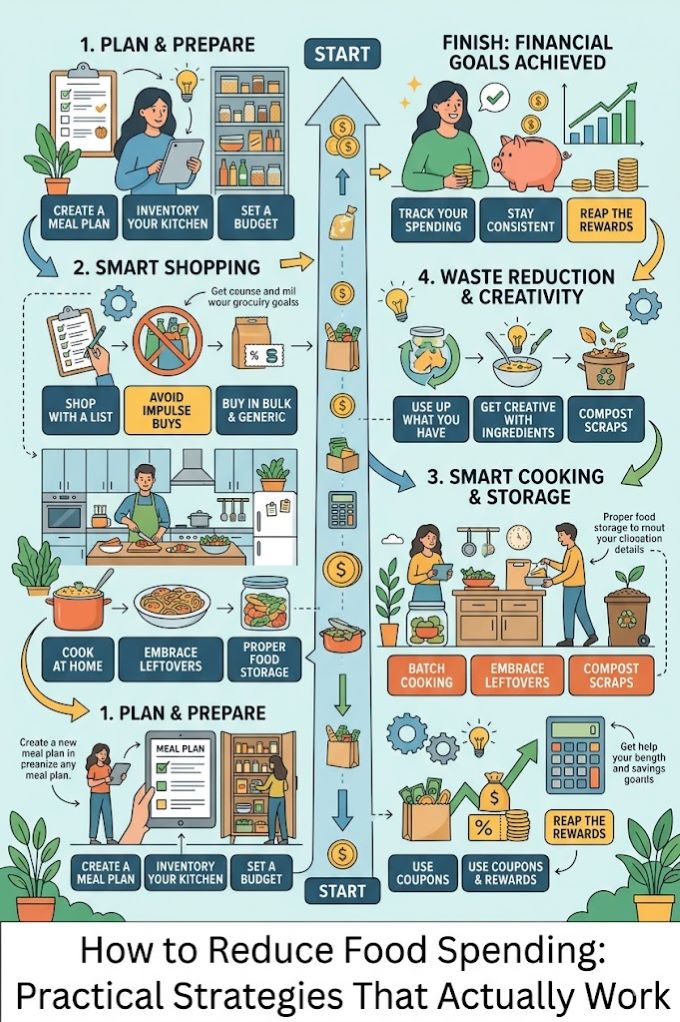
Strategy 1: Meal Planning Is the Foundation
The single most impactful thing most households can do to reduce food spending is plan meals in advance. Meal planning means deciding what you’ll eat for the week before you go to the grocery store, buying only what those meals require, and cooking with intention rather than improvising from a full refrigerator that somehow produces nothing obvious for dinner.
Without a meal plan, grocery shopping tends toward buying food that sounds appealing in the store rather than food that serves a complete set of meals. You end up with ingredients that don’t form complete meals, you buy duplicates of things you already have at home, and the produce bought with vague healthy intentions wilts before it’s used.
With a meal plan, every item in the cart has a specific destination. Waste drops significantly. Impulse purchases become easier to resist because you’re buying against a list, not browsing.
How to start: plan five dinners, two lunches, and breakfasts for the week before you shop. Write the grocery list from those meals. Stick to the list.
Strategy 2: Reduce Restaurant and Takeout Frequency
Restaurant meals and takeout are the highest per-serving food cost in most household budgets by a significant margin. A family of four eating dinner at a casual restaurant spends $60-$100 on a single meal. That same family could eat a comparable home-cooked meal for $15-$20.
The most effective way to reduce food spending for most households is not buying cheaper groceries: it’s shifting meals from restaurants to home cooking. Even reducing restaurant frequency from four times per week to two produces hundreds of dollars in monthly savings.
This doesn’t mean never going to restaurants. It means being intentional about which restaurant meals are genuinely valuable (a special occasion, a particularly convenient situation, a meal you specifically look forward to) versus which ones are just defaults that happened because nobody felt like cooking.
Practical approaches: designate specific nights for cooking versus eating out so the default is cooking. Keep easy, quick meals available (frozen vegetables, eggs, pasta, canned beans) for nights when cooking feels like too much effort but a $60 restaurant trip isn’t justified.
Strategy 3: Buy Store Brands and Generic Products
The price difference between name-brand and store-brand products at most grocery stores ranges from 20% to 50% on comparable items. For staple goods — canned tomatoes, dried pasta, flour, sugar, frozen vegetables, dairy, cooking oils, condiments — the quality difference is minimal to nonexistent. Many store brands are produced by the same manufacturers as name brands.
Systematically switching to store brands on staple items produces meaningful monthly savings without any noticeable change in meals. Reserve name brands for the specific products where the quality difference is actually worth it to you.
Strategy 4: Reduce Food Waste
The USDA estimates that American households waste approximately 30-40% of the food they purchase. If your household’s monthly grocery bill is $600, that means roughly $180-$240 worth of food is being thrown away rather than eaten. Reducing food waste is effectively free money: you’re already buying it.
The primary causes of household food waste and their fixes:
Produce going bad: buy less produce more frequently rather than a full week’s worth at once, or buy frozen vegetables that keep indefinitely without spoilage.
Leftovers not eaten: designate one or two nights per week as “leftover nights” where the meal is whatever’s in the refrigerator. This prevents perfectly good food from sitting until it’s no longer edible.
Ingredients bought for one recipe but not used again: plan recipes that share ingredients so nothing purchased for a specific dish goes to waste.
Forgetting what’s in the freezer: maintain a simple list on the freezer door of what’s inside and when it was frozen. Rotate older items to the front so they get used first.
Strategy 5: Shop with a List and Avoid Hungry Shopping
Shopping without a list is one of the most reliable ways to overspend on groceries. Without a list, the store environment (designed specifically to encourage unplanned purchases) dictates what ends up in the cart. With a list, you have a clear decision framework: if it’s not on the list, it requires a conscious choice to add it rather than an automatic one.
Shopping while hungry amplifies impulse buying significantly. Food that you wouldn’t consider under normal circumstances becomes appealing when you’re hungry, and willpower around the list deteriorates. Eating before shopping is a small habit with a measurable impact on the bill.
Strategy 6: Use the Freezer Strategically
The freezer is one of the most underutilized food cost reduction tools in most households. It allows you to:
Buy in bulk when items are on sale. Meat is the best example: when chicken breasts go on sale for $1.99/lb instead of the regular $4.99/lb, buying several pounds and freezing what you won’t use that week locks in the sale price for future use.
Freeze leftovers instead of refrigerating them. Leftovers refrigerated beyond three to four days often go to waste. Leftovers frozen immediately after cooking last months and become ready-made meals for busy nights.
Buy frozen vegetables and fruits. Frozen produce is typically cheaper than fresh, nutritionally comparable (often more nutritious since it’s frozen at peak ripeness), and eliminates the spoilage problem entirely.
Strategy 7: Track Your Food Spending
You can’t effectively reduce food spending without knowing how much you currently spend and where it goes. Most people significantly underestimate their food costs because they don’t track the small purchases (coffee, convenience store snacks, lunch here and there) that add up substantially.
Spend one month tracking every food dollar: groceries, restaurants, takeout, coffee shops, vending machines, everything. The total is often surprising. Once you see the number and the breakdown, specific reduction targets become obvious rather than vague.
For a broader framework around food spending as part of overall financial planning, what are some key components of successful budgeting covers how to build a budget structure where food spending has a defined category with an actual target rather than an unlimited open-ended expense.
Key Takeaways
- Meal planning is the single highest-impact strategy for reducing food spending: it eliminates waste, prevents impulse buying, and ensures every grocery purchase serves a specific purpose
- Reducing restaurant and takeout frequency produces larger savings than almost any other single food spending change: even reducing from four to two restaurant meals per week saves hundreds per month for most households
- Store brands on staple items (canned goods, pasta, dairy, condiments) are 20-50% cheaper than name brands with minimal quality difference
- Reducing food waste is effectively free savings: the USDA estimates 30-40% of purchased food is thrown away, meaning a significant portion of your grocery bill is buying food that gets discarded
- The freezer enables bulk buying at sale prices, extends leftover life from days to months, and provides ready-made meals that reduce restaurant dependency on busy nights
- Shopping with a list and not shopping while hungry are small behavioral habits with measurable impact on the final grocery bill
- Track total food spending (groceries plus restaurants plus coffee plus convenience purchases) for one month before setting reduction targets: most people underestimate this number significantly