How to Address an Envelope the Right Way Every Time
Mailing a letter feels like it should be foolproof, and then the envelope comes back two weeks later stamped “Return to Sender.” Wrong corner, missing ZIP, illegible handwriting, the reasons are always small and always avoidable. Knowing how to address an envelope properly takes about two minutes to learn, and it is one of those skills that quietly saves you from late birthday cards, missed invoices, and returned wedding invitations.
The Three Zones of an Envelope
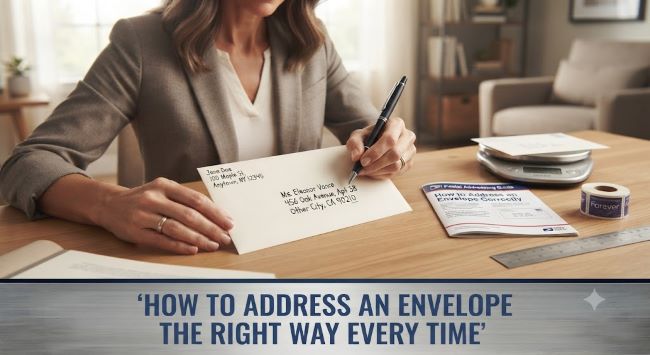
Every envelope, from a greeting card to a business mailer, uses the same layout. Picture the front of the envelope split into three zones:
- Top left corner: the return address. Your name and address go here, so the postal service can send the letter back if delivery fails.
- Center: the delivery address. The recipient’s name and address, placed in the middle of the envelope, parallel to the longest edge.
- Top right corner: the postage. One Forever stamp covers a standard letter up to 1 ounce anywhere in the United States.
That is the entire framework for how to address an envelope. Everything else in this guide is detail layered on top of those three zones.
Writing the Delivery Address
The center address follows a strict order, one line each:
- Line 1: Recipient’s full name
- Line 2: Street address, including apartment, suite, or unit number
- Line 3: City, state abbreviation, ZIP code
It looks like this:
Maria Lopez
482 Birchwood Ave Apt 3B
Columbus, OH 43215
A few rules keep the postal machines happy. Use the two-letter state abbreviation in capitals, without periods. Write the ZIP code on the same line as the city and state. If the apartment number does not fit on the street line, place it on its own line above the street address, never below it. USPS reads addresses from the bottom up, so the bottom line must always be the city, state, and ZIP.
Print in clear capital letters with dark ink, blue or black. Sorting machines read the address by camera, and cursive flourishes are the number one reason machines kick letters out for slow manual handling.
Writing the Return Address
The return address in the top left follows the exact same format as the delivery address, just with your information. Some people skip it. Do not. Without it, an undeliverable letter goes to the Mail Recovery Center instead of coming back to you, and anything inside is effectively gone.
For invitations, tradition allows the return address on the back flap of the envelope. USPS prefers the front top left, but the back flap remains acceptable and common for weddings.
How to Address an Envelope for Business Mail
Business correspondence adds one or two lines to the standard format:
Mr. James Okafor
Director of Operations
Brightline Manufacturing Inc.
1200 Commerce Park Dr Ste 400
Nashville, TN 37214
The pattern: name on top, title below it, company on the third line, then the street and city lines as usual. If you do not know the specific person, the company name takes the top line, and you can add “Attn: Accounts Payable” or the relevant department above the street address. Anyone learning how to address an envelope for job applications should take the extra five minutes to find the hiring manager’s actual name. Addressed mail gets opened faster than mail aimed at a department.
Special Cases People Get Wrong
Knowing how to address an envelope gets trickier with these cases. Couples and families. For married couples, “Mr. and Mrs. David Chen” is the traditional form, while “David and Anna Chen” is the modern one. Both work. For a whole household, “The Chen Family” keeps it simple.
Military addresses. Replace the city with the unit designation and use APO or FPO with the state codes AA, AE, or AP. Standard postage applies, which surprises people.
PO boxes. The box number replaces the street address entirely: “PO Box 1142” on line two, city and ZIP on line three.
International mail. The rules for how to address an envelope going abroad shift slightly. Follow the destination country’s format for the middle lines, then write the country name alone in capital letters on the final line: FRANCE, JAPAN, BRAZIL. International letters need extra postage, currently a global Forever stamp rather than a domestic one.
Stamps and Weight
One domestic Forever stamp mails a standard letter weighing up to 1 ounce, which covers roughly four to five sheets of paper in a normal envelope. Heavier letters need additional postage per ounce. Square, rigid, or lumpy envelopes trigger a nonmachinable surcharge because they jam the sorting equipment. If your envelope contains anything thicker than folded paper, weigh it at the post office rather than guessing. A returned envelope for insufficient postage delays your mail by a week or more.
Place the stamp squarely in the top right corner. Machines look for it there, and a stamp floating in the middle of the envelope can misread as missing.
A Quick Word on Handwriting vs. Printing
You can absolutely print labels from a computer, and for business mail it looks cleaner. For personal mail, handwriting still carries weight, and knowing how to address an envelope by hand neatly is part of the charm of sending one. The compromise many people use: handwrite the delivery address for the personal touch, and use a printed or stamped return address to save time on stacks of holiday cards.
The Two-Minute Checklist
Before the envelope leaves your hands, scan it once: recipient centered with name, street, and city-state-ZIP in order, your return address in the top left, a stamp in the top right, dark legible ink, and a sealed flap. That is genuinely all there is to how to address an envelope. Master it once and every card, check, and invitation you send for the rest of your life arrives where you pointed it.
Key Takeaways
- Every envelope uses three zones: return address top left, delivery address centered, stamp top right.
- The delivery address runs name, street with unit number, then city, state abbreviation, and ZIP on the final line.
- USPS machines read from the bottom line up, so city, state, and ZIP must always be last.
- Print in capital letters with dark ink, since cursive and light colors cause machine rejections and delays.
- Always include a return address, or an undeliverable letter is lost to the Mail Recovery Center.
- Business mail adds the recipient’s title and company between the name and street lines.
- Military mail uses APO/FPO with AA, AE, or AP codes, and international mail ends with the country name in capitals on its own line.
- One Forever stamp covers up to 1 ounce domestically; weigh anything heavier or rigid at the post office.