How Far Apart Are Cornhole Boards? Official and Casual Setup Guide
Cornhole has grown from a casual backyard game into a genuinely competitive sport with official sanctioning bodies, standardized equipment specifications, and tournament play at a level many casual players don’t realize exists. Understanding the official board distance, along with the practical reasoning behind it and how casual play sometimes differs, helps you set up a proper game whether you’re hosting a backyard gathering or training for more competitive play.
Official Cornhole Board Distance
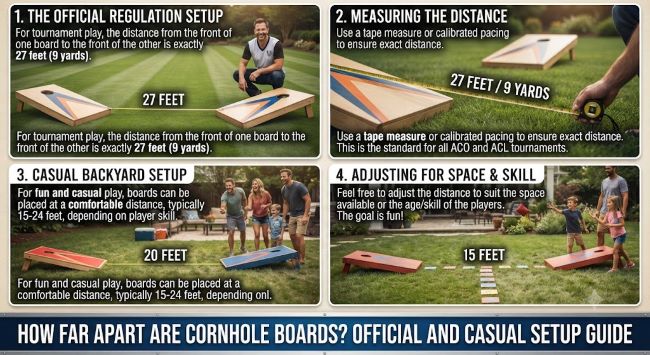
The official, regulation distance between cornhole boards, as established by the American Cornhole Organization (ACO) and other major sanctioning bodies, is 27 feet measured from the front edge of one board to the front edge of the opposite board. This is the standard distance used in official tournament play and is the measurement most serious players and cornhole sets reference when discussing “regulation” setup.
This 27-foot measurement is specifically taken from front edge to front edge (the edge closest to the player, where the board’s front lip sits), not from the back edge or from the center of each board, an important distinction worth understanding since measuring incorrectly from a different reference point on the boards will produce an inaccurate setup distance even if you’re using the correct 27-foot number.
Why 27 Feet Specifically
The 27-foot regulation distance reflects a calculated balance reached through the sport’s competitive development: close enough to allow for genuine skill-based accuracy and consistent scoring, while far enough to create meaningful challenge and prevent the game from becoming trivially easy. This specific distance has become the broadly accepted standard across most organized cornhole leagues and tournaments in the United States, providing consistency for players who compete across different events and locations.
Standard Board Dimensions (Relevant Context)
Understanding the full official setup also requires knowing standard board dimensions, since the board distance measurement is taken relative to these standardized board specifications:
Board size: regulation cornhole boards measure 24 inches wide by 48 inches long.
Hole diameter: the cornhole hole itself measures 6 inches in diameter, positioned 9 inches from the top center of the board and centered left to right.
Board height: the front edge of the board sits 3 inches off the ground, while the back edge (the elevated end where the hole is located) sits 12 inches off the ground, creating the board’s signature angled playing surface.
Casual Backyard Variations
While 27 feet is the official regulation distance, casual backyard cornhole games quite commonly use shorter distances, particularly in situations where space constraints make the full regulation distance impractical, or when playing with children, beginners, or in a more relaxed, lower-stakes social setting where strict regulation adherence matters less than simply having an enjoyable, accessible game.
Common casual variations include:
A shortened distance of around 20-24 feet, frequently used in backyard settings with more limited space, or specifically to make the game more accessible and immediately enjoyable for younger or less experienced players who might find the full 27-foot distance genuinely too challenging for a casual social setting.
Adjusted distances for children specifically, sometimes shortened to as little as 12-15 feet for very young players, prioritizing fun and immediate success over strict adherence to adult regulation standards.
There’s no rule preventing casual play at whatever distance works for your specific space and group, and many cornhole sets sold for casual backyard use don’t strictly require or even reference the official tournament distance at all, making this entirely a matter of preference for non-competitive play.
Setting Up Your Cornhole Game Correctly
Step 1: Choose a flat, level playing surface with adequate clearance, ideally measuring at least 10 feet wide by 30+ feet long to comfortably accommodate the regulation distance plus reasonable space around the boards for player movement and bag retrieval.
Step 2: Position your two boards facing each other, with the front edges (the lower edge closest to where players will stand to throw) facing inward toward each other.
Step 3: Measure the 27-foot regulation distance (or your chosen casual distance) from the front edge of one board to the front edge of the other, using a tape measure for accuracy rather than estimating by eye, particularly if you want a genuinely consistent, regulation-accurate setup.
Step 4: Ensure both boards are positioned on level ground and don’t wobble, since an uneven playing surface affects bag trajectory and scoring fairness regardless of how accurately you’ve measured the distance between boards.
Other Official Cornhole Rules Worth Knowing
Beyond board distance, official cornhole play follows specific rules regarding scoring (typically 3 points for a bag through the hole, 1 point for a bag remaining on the board after the round, with points often canceling out between opposing players in certain scoring formats), the number of bags per player per round (typically 4), and games generally played to 21 points, though casual play frequently adapts these specifics as well based on group preference and the specific social context of the game.
Cornhole Bag Specifications (Related Setup Context)
Since board distance and bag specifications work together to determine overall gameplay feel and difficulty, it’s worth knowing the official bag dimensions alongside board distance. Regulation cornhole bags measure 6 inches by 6 inches and weigh approximately 15-16 ounces, filled with either corn (the traditional filling) or, increasingly common in modern competitive play, resin or plastic pellets, which offer more consistent weight and weather resistance compared to traditional corn filling. Most competitive players use four bags per team per round, with games typically played to 21 points using either straight scoring or cancellation scoring formats, depending on the specific league or tournament rules being followed.
Understanding these related specifications alongside board distance gives you a more complete picture of what “regulation” cornhole setup actually involves beyond just the single distance measurement, useful if you’re aiming to replicate genuinely tournament-standard conditions for practice or more serious casual competitive play among friends.
Key Takeaways
- The official regulation distance between cornhole boards is 27 feet, measured from the front edge of one board to the front edge of the opposite board, as established by the American Cornhole Organization and other major sanctioning bodies
- Regulation boards measure 24 inches wide by 48 inches long, with a 6-inch diameter hole positioned 9 inches from the top center, and the board’s elevated back edge sitting 12 inches off the ground compared to a 3-inch front edge height
- Casual backyard play commonly uses shortened distances, often 20-24 feet, particularly for space-constrained settings or when playing with children or beginners
- There’s no rule preventing casual games at whatever distance works for your specific space and group, since regulation distance only matters for official tournament or league play
- Use a tape measure rather than estimating by eye when setting up boards, particularly if you want a genuinely accurate regulation distance for more serious or competitive play
- Ensure both boards sit on level, stable ground in addition to correct distance measurement, since an uneven surface affects fair play regardless of distance accuracy