Auto AC Repair Near Me: What’s Wrong, What It Costs, and How to Find a Good Shop
Car AC problems tend to announce themselves on the hottest day of summer, which is exactly when you least want to deal with them. The good news is that most car AC issues fall into a predictable set of problems with defined repair approaches and relatively predictable costs. Knowing what’s wrong before you talk to a shop — or at least knowing enough to evaluate what a shop tells you — saves money and prevents unnecessary repairs. This guide covers the most common auto AC problems, what they cost to fix, and how to find a reliable shop near you.
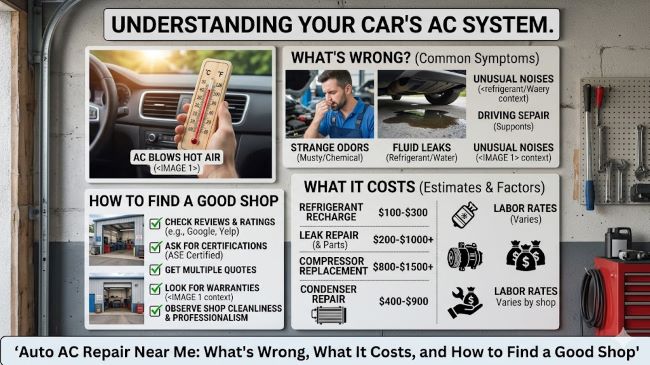
How Your Car’s AC System Works (Briefly)
Understanding the basic system helps you evaluate repair advice intelligently.
Your car’s AC system is a closed loop that circulates refrigerant (R-134a in vehicles made before about 2021; R-1234yf in newer vehicles). A compressor pressurizes the refrigerant and sends it to the condenser (usually in front of the radiator), where it releases heat and becomes liquid. The liquid refrigerant passes through an expansion valve, dropping in pressure and temperature, then moves through the evaporator (inside the cabin), where it absorbs heat from the cabin air. A blower motor pushes cabin air over the evaporator, chilling it and sending it into the car. The refrigerant then returns to the compressor to restart the cycle.
The most common failure points are the compressor, refrigerant level, electrical components, and the cabin air filter and blower motor.
Common Auto AC Problems and Their Symptoms
Low refrigerant / refrigerant leak. Symptom: AC blows warm or mildly cool air, not cold. Warm air is the most common AC complaint and refrigerant leak or low charge is the most common cause. Cause: refrigerant doesn’t deplete through normal use: if it’s low, there’s a leak somewhere in the system. Common leak points are the compressor shaft seal, hose connections, and the condenser.
Compressor failure. Symptom: AC doesn’t cool at all, or you hear a loud clunking or grinding noise when AC is turned on. Cause: the AC compressor engages via a clutch mechanism driven by the engine belt. Compressor failure can be the clutch, the compressor itself, or debris damage from an internal failure.
Condenser damage. Symptom: AC performs poorly, especially at low speeds or in heavy traffic. Cause: the condenser sits at the front of the car and is vulnerable to road debris damage. A bent or punctured condenser can’t release heat effectively.
Cabin air filter clogged. Symptom: reduced airflow from vents even when AC seems to be working; musty smell. Cause: cabin air filters are typically replaced every 15,000-25,000 miles but are often forgotten. A severely clogged filter dramatically reduces airflow without affecting the refrigerant system.
Blower motor failure. Symptom: AC produces cold air at the evaporator but little or no air comes out of the vents. Cause: the blower motor fan or its resistor module (which controls fan speed settings) has failed.
Electrical issues. Symptom: AC doesn’t engage at all, or works intermittently. Cause: AC systems have multiple switches, relays, and sensors. A faulty pressure switch, relay, or the AC control module can prevent the system from engaging even when the refrigerant and mechanical components are fine.
What Auto AC Repair Costs
Costs vary significantly by vehicle make/model, region, and shop type. These are national averages:
Refrigerant recharge (R-134a): $100-$200. Note that recharging without finding and fixing the leak is a temporary fix: the refrigerant will leak out again.
Refrigerant leak detection: $50-$150. Using UV dye or electronic leak detectors to find where refrigerant is escaping.
Refrigerant leak repair (hose or fitting): $150-$400 depending on location of leak.
Compressor replacement: $500-$1,500 depending on vehicle. Labor is often 3-6 hours; compressor cost varies widely by make and model. Import luxury vehicles and trucks trend higher.
Condenser replacement: $400-$900 including parts and labor.
Cabin air filter replacement: $25-$75 at a shop, or $15-$30 DIY if the filter is accessible (most are).
Blower motor replacement: $200-$600 depending on vehicle and motor access.
Evaporator replacement: $800-$2,500+. The evaporator is inside the dash and requires significant disassembly. One of the most labor-intensive AC repairs.
AC system flush (after compressor failure with debris contamination): $150-$300, done alongside compressor replacement to remove debris.
R-1234yf refrigerant recharge (newer vehicles): $150-$300+. The newer refrigerant is significantly more expensive than R-134a.
How to Find a Reliable Auto AC Repair Shop Near You
Google Maps search. Search “auto AC repair near me” and filter by rating. Look specifically at reviews from the past six months that mention AC work, diagnostic quality, and whether the problem was fully resolved after the first visit.
Dealerships. For new or recent vehicles with specific AC systems, dealerships have factory-trained technicians and access to OEM parts. They’re typically more expensive than independent shops but are appropriate for complex or warranty-covered issues.
ASE-certified independent shops. The ASE (Automotive Service Excellence) certification indicates technicians have passed standardized competency tests. Shops displaying ASE Master Technician credentials have demonstrated broader competency. Searching for ASE-certified shops through the ASE website is a starting point.
Specialty AC shops. Some shops specialize in auto AC and HVAC systems specifically. These specialists often have more diagnostic equipment and experience than general repair shops and may be more effective with complex or unusual AC failures.
Chain shops (Firestone, Jiffy Lube, Midas, Pep Boys): these chains do AC work and are widely available. Quality varies significantly by location and individual technician. Reviews for the specific location you’re considering matter more than the chain’s overall reputation.
Questions to Ask Before Approving AC Work
Will you diagnose what’s causing the low refrigerant before recharging? A shop that offers to simply recharge without leak detection is offering a temporary fix that will repeat. Any shop worth using will diagnose the source of a leak before recharging.
Do you use OEM or aftermarket parts? For compressors especially, the quality of aftermarket parts varies widely. Ask what brand compressor they’re installing.
What’s the warranty on parts and labor? Reputable shops offer at least 12 months/12,000 miles on AC repairs. Some offer longer warranties on compressor replacements.
Will the system be flushed if the compressor failed? A failed compressor often sends metal debris through the AC system. If the system isn’t flushed before installing a new compressor, debris damages the new unit quickly.
Can I see the old parts? Legitimate shops will show you removed components.
Key Takeaways
- The most common auto AC problem is warm air from refrigerant leak: a recharge without leak repair is temporary
- Common repairs range from $100-$200 for a simple recharge to $800-$2,500 for an evaporator replacement requiring dashboard disassembly
- R-1234yf refrigerant in newer vehicles costs significantly more than older R-134a systems
- Find auto AC repair near me through Google Maps with attention to recent reviews mentioning AC work, ASE-certified independent shops, dealerships for warranty or complex issues, and specialty AC shops for unusual failures
- Always ask for leak diagnosis before approving a recharge: responsible shops don’t just top off refrigerant without finding why it’s low
- Compressor replacements should be accompanied by system flush to remove metal debris that damages the new compressor
- Ask about parts warranty and labor warranty before approving any repair: 12 months/12,000 miles minimum is standard