What Are the Three Main Protection Methods Against Cave-Ins?
A trench collapses in seconds. The soil that moments ago seemed solid suddenly moves. A cubic yard of earth weighs as much as a car, and when it falls, it buries workers before anyone can react. This isn’t hypothetical. Cave-ins happen regularly on construction sites, and they’re among the deadliest hazards workers face. Understanding what are the three main protection methods against cave-ins isn’t optional. It’s the difference between workers going home safely and families losing loved ones.
OSHA requires protection systems for all trenches deeper than 5 feet. The agency recognizes exactly three methods: sloping, shoring, and shielding. Each method works differently, and choosing the right one depends on soil type, trench depth, and site conditions. This guide explains how each method protects workers and when to use each technique.
Understanding Why Cave-Ins Happen
Before discussing protection, you need to understand the danger. Soil isn’t inert. It presses outward constantly, creating lateral force against trench walls. The deeper the trench, the greater the pressure. Loose, sandy, or saturated soil collapses more easily than clay. Water makes everything worse, destabilizing walls and increasing collapse risk dramatically.
Factors That Increase Cave-In Risk:
- Depth of the trench beyond 5 feet
- Soil type ranging from loose sand to dense clay
- Water accumulation creating hydrostatic pressure
- Nearby traffic vibrating the ground
- Weather changes from rain or freeze-thaw cycles
- Spoil piles placed too close to the trench edge
- Equipment vibration from nearby machinery
Construction supervisors must designate a competent person to inspect trenches daily, classify soil, and monitor conditions. This person has authority to stop work when safety is compromised. They understand how soil density, moisture content, and trench configuration affect stability.
The OSHA requirement for protection isn’t bureaucratic red tape. It’s based on decades of incident data showing that protected trenches have dramatically lower fatality rates than unprotected ones.
Method One: Sloping
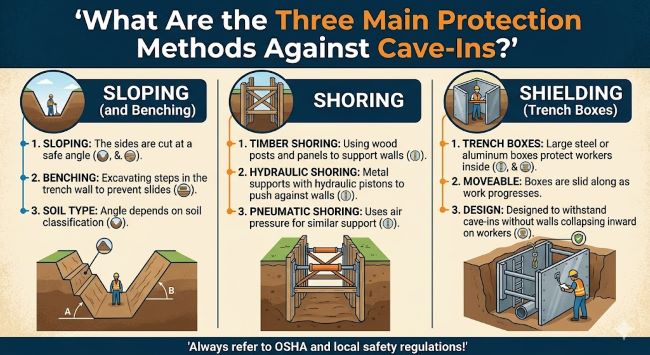
Sloping is the most straightforward protection method. Rather than digging straight down, you cut the trench at an angle, creating a V-shaped excavation. The angle reduces the height of unsupported soil walls, which decreases the lateral pressure that causes collapse. Sloping is simple in concept but requires careful calculation in execution.
How Sloping Works:
- Cuts trench walls at an angle away from the excavation
- Reduces the height of unsupported soil
- Decreases lateral pressure against trench walls
- Relies on the soil’s angle of repose for stability
- Requires adequate space around the excavation
The required angle depends on soil type. OSHA classifies soil into Type A (most stable, dense clay), Type B (normal conditions, mostly soil), and Type C (loose, sandy, or saturated soil). Type A soil can be cut at a shallower angle. Type C soil requires a much wider slope.
OSHA Slope Requirements:
- Type A soil: 1:1.5 ratio minimum (cut 1 foot out for every 1.5 feet deep)
- Type B soil: 1:1 ratio minimum (equal distance out as deep)
- Type C soil: 1:0.5 ratio minimum (cut 2 feet out for every 1 foot deep)
- Stable rock: Vertical walls allowed
Sloping works best when you have horizontal space available. On a wide property with minimal constraints, sloping is often the most economical choice. The downside is that sloping requires more excavation and disturbs a larger area of ground. In confined spaces, sloping becomes impractical. You might need to excavate a massive area just to create a safe slope angle.
Sloping also requires constant vigilance. Rain, vibration from nearby equipment, and ground disturbance can change soil conditions. The competent person must inspect the slope daily and after any weather event or ground movement.
Method Two: Shoring
Shoring uses structural supports to hold trench walls in place. Rather than reshaping the excavation, shoring installs bracing systems that push back against soil pressure. This method allows deeper, narrower trenches in confined spaces where sloping isn’t practical. Multiple shoring system types exist, each suited to different conditions.
How Shoring Works:
- Installs support systems to prevent soil movement
- Creates temporary bracing against trench walls
- Allows narrower, deeper trenches than sloping
- Works in confined spaces with space constraints
- Requires proper installation and monitoring
Types of Shoring Systems:
Hydraulic Shoring uses hydraulic pistons that pump outward until they press against trench walls with controlled force. The hydraulic system provides even pressure distribution and can be adjusted as conditions change. Steel plates or aluminum rails spread the force across wider wall areas. Hydraulic shoring is quick to install and works in diverse soil types. The trade-off is equipment cost and operator training requirements.
Timber Shoring uses wooden planks and beams cut to fit trench dimensions. Workers brace vertical posts against the trench walls and secure them with horizontal beams. Timber shoring is traditional and often more economical for smaller projects. However, it’s labor-intensive, requires custom cutting for each trench, and degrades over time in wet conditions.
Aluminum or Steel Trench Boxes are prefabricated systems with interlocking panels. Workers assemble the box above ground, then lower it into the trench as a complete unit. These boxes provide maximum protection and are reusable across projects. The downside is weight and equipment requirements for installation.
The competent person must verify that shoring is installed correctly and that support systems maintain adequate pressure throughout the project. Water accumulation behind shoring can reduce effectiveness, so drainage systems are critical.
Shoring is Ideal For:
- Deep trenches in confined spaces
- Projects where sloping isn’t feasible
- Stable soil types that respond well to bracing
- Sites requiring narrow trenches for utility work
For detailed guidance on proper equipment selection and site safety planning, organizations like the Occupational Safety and Health Administration provide comprehensive excavation safety standards that every construction supervisor should reference before beginning work.
Method Three: Shielding
Shielding doesn’t prevent cave-ins. Instead, it protects workers if a cave-in occurs. A shield is a protective structure placed in the trench that catches falling soil, creating a safe zone for workers to operate. The most common shield is a trench box, which is a steel or aluminum structure with spreaders that brace it within the trench.
How Shielding Works:
- Places protective barriers between workers and soil
- Doesn’t stop the cave-in from occurring
- Creates a reinforced shelter for workers inside
- Catches or deflects falling soil
- Protects workers rather than excavation walls
Shield Types:
Trench Boxes are rigid structures lowered into excavations. Workers stand inside the box while performing tasks like laying pipe or installing utilities. If soil collapses, the box catches the falling material and protects the workers inside. Trench boxes are heavy and require equipment to place and remove, but they’re extremely effective and reusable.
Portable Aluminum Shields are lighter alternatives to trench boxes. They’re easier to move and install but provide less total protection. These work better for shallower trenches or situations where the full rigidity of a trench box isn’t necessary.
Shield Walls are individual panels arranged to create protective barriers. Workers can arrange multiple panels to accommodate different trench configurations.
Shielding is essential in situations where soil conditions make preventing collapse impractical. Saturated, very loose, or mixed soil types sometimes can’t be held with shoring or sloped safely. Shielding becomes the only practical protection method.
When to Use Shielding:
- Saturated or unstable soil where collapse is likely
- Projects where preventing cave-ins entirely is impractical
- Deep trenches in challenging soil conditions
- Utility work requiring workers in narrow spaces
- Situations where sloping or shoring isn’t feasible
The limitation of shielding is that it protects workers but doesn’t stop ground movement. Soil can still collapse around the shield sides, potentially making extraction difficult. However, protecting workers is the primary goal, and shielding accomplishes that effectively.
Selecting the Right Protection Method
Choosing between sloping, shoring, and shielding depends on multiple factors. The competent person evaluates site-specific conditions before deciding. Most projects benefit from combining methods, using different approaches in different areas of the same trench.
Decision Factors:
- Soil type and stability determining how easily collapse occurs
- Trench depth requiring progressively stronger protection
- Available space limiting whether sloping is practical
- Project duration affecting equipment rental versus purchase decisions
- Water conditions creating additional pressure and instability
- Nearby structures requiring narrow trenches without sloping room
- Budget constraints balancing cost with safety requirements
- Worker skill levels affecting whether complex shoring is feasible
A competent person with soil classification training can determine which method works best. Professional excavation companies often have experience with all three methods and can rapidly assess optimal approaches.
Beyond the Three Methods: Additional Protection
The three methods are the foundation, but excavation safety requires additional measures. Keep spoil piles at least 2 feet away from the trench edge. The weight of excavated soil pressing against an already-stressed wall accelerates collapse. Mark spoil boundaries clearly with caution tape or temporary fencing. For professional guidance on broader workplace safety and resource management practices, consult resources covering workplace resource allocation and equipment deployment strategies.
Remove standing water immediately using pumps. Water is one of the deadliest cave-in contributors because it increases soil weight and reduces friction holding walls in place. Stop work during heavy rain and inspect trenches carefully afterward. The water table sometimes rises after rainfall, destabilizing previously safe walls.
Inspect trenches daily before work begins. The competent person walks the entire trench, looking for cracks in walls, water accumulation, ground subsidence, or any changes from the previous day. After any significant event (rain, nearby vibration, temperature change), inspect again before workers enter.
Properly train all workers in excavation safety. Workers should understand the specific protection method being used on their project and watch for warning signs of collapse. Training should cover soil classification basics, recognition of unsafe conditions, and proper use of protective systems.
Key Takeaways
- Sloping cuts trench walls at an angle to reduce unsupported soil height, with angle requirements depending on soil type from 1:1.5 for Type A to 1:0.5 for Type C soil.
- Shoring installs support structures like hydraulic systems, timber bracing, or aluminum boxes to hold back soil pressure and works best in confined spaces.
- Shielding protects workers if collapse occurs by placing trench boxes or shields that create safe zones, rather than preventing cave-ins entirely.
- OSHA requires one of these three methods for all trenches deeper than 5 feet except when excavated in stable rock.
- A competent person must inspect trenches daily, classify soil, and have authority to stop work when safety is compromised.
- Additional protective measures include keeping spoil piles back 2 feet, removing standing water, and maintaining vigilant daily inspections.
- Selecting the right method depends on soil type, trench depth, available space, and project-specific conditions.
Understanding what are the three main protection methods against cave-ins is essential for anyone working in excavation or supervising construction sites. These three methods, implemented properly with competent oversight, protect workers from one of construction’s deadliest hazards. Your team’s safety depends on selecting the right method and executing it correctly every single day. For additional workplace safety protocols and emergency response training relevant to hazardous operations, explore workplace emergency procedures and incident management resources to ensure comprehensive site safety.