
Which Resource Management Task Deploys or Activates Personnel and Resources?
If you’re studying for a FEMA NIMS exam, working through IS-700 test prep, or simply trying to understand how emergency management actually works, you’ve landed on a question that trips people up more than it should. Which resource management task deploys or activates personnel and resources? The answer is Mobilize. But that one-word answer deserves a proper explanation, because understanding what mobilization means in the context of NIMS (the National Incident Management System) also explains a lot about how well-run organisations handle resource deployment in any high-stakes situation, including increasingly, AI systems operating at scale.
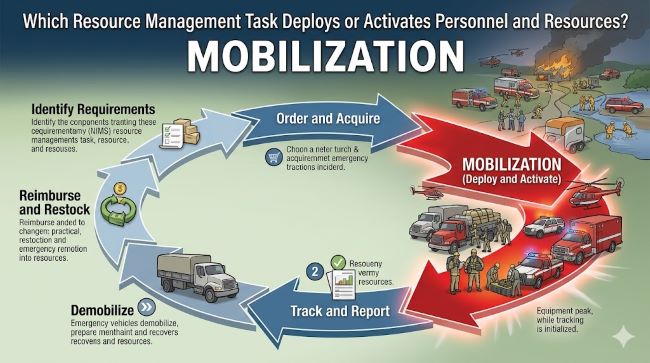
The Answer: Mobilize
The resource management task that deploys or activates personnel and resources is Mobilize. This is the official answer according to FEMA’s IS-700.b course material and confirmed consistently across NIMS documentation.
Mobilization is the third of five core resource management tasks in the NIMS framework. It refers specifically to the process of assembling and moving personnel, equipment, and other resources to an incident site so they can be put to work. It’s the moment the plan becomes action: resources stop being on standby and start moving toward where they’re needed.
The four answer choices on this exam question are typically:
- A. Identify Requirements
- B. Order and Acquire
- C. Mobilize (correct answer)
- D. Track and Report
Each of those represents a distinct phase in NIMS resource management. Understanding why Mobilize is the correct answer requires understanding what the others do and don’t include.
The Five NIMS Resource Management Tasks Explained
NIMS breaks resource management into five sequential tasks. They follow a logical order that mirrors how real incident response actually unfolds.
1. Identify Requirements
Before anything moves, someone has to figure out what’s needed. Identify Requirements is about assessing the incident, determining what personnel and equipment are necessary, and establishing the scope of what needs to be ordered. This is the planning phase of resource management. Nothing is activated yet.
2. Order and Acquire
Once requirements are clear, the next step is formally requesting those resources through the proper channels. This task includes activating local resource requirements if they’re available, initiating mutual aid agreements, and placing formal resource orders through established protocols. Resources are requested and located here, but they haven’t moved yet.
3. Mobilize
This is the deployment task. Mobilization is when resources are activated and physically dispatched to the incident. It involves coordinating transportation, staging areas, check-in processes, and ensuring that the right resources arrive at the right location at the right time. When the exam asks which task “deploys or activates,” this is the answer because deployment and activation only happen at the Mobilize stage.
4. Track and Report
Once resources are in the field, someone has to know where they are, what they’re doing, and what condition they’re in. Track and Report is the accountability task: maintaining visibility of deployed resources, documenting status changes, and ensuring accurate records throughout the incident.
5. Demobilize
When the incident winds down, resources need to be released in an orderly way. Demobilization involves returning personnel and equipment to their pre-incident status, completing documentation, and restoring resources so they’re ready for the next call. Critically, NIMS instructs managers to begin planning for demobilization at the same time they begin mobilizing. This is a common exam question: managers do not wait until the incident ends. They plan for demobilization from the start.
Why Mobilize Is Specifically the Deployment Task
People sometimes confuse Order and Acquire with Mobilize, which is understandable. Ordering resources and deploying them feel like they’re part of the same action. The NIMS framework separates them deliberately.
Order and Acquire handles the administrative and logistical side of getting resources assigned to your incident. You’re working the phones, the radio systems, the mutual aid networks. The resources exist somewhere, and you’re securing the authority and the pathway to use them.
Mobilize is the physical execution. Resources check in, receive their assignments, confirm their equipment, and move. The Incident Command System (ICS) facilitates this through structured check-in processes, staging areas, and clear chains of command that ensure deployed resources don’t arrive as an uncoordinated mass but as an organised, functional response.
That distinction matters in real incidents. A resource that’s been ordered but not mobilized is not helping anyone. A resource that’s mobilized without proper ordering creates accountability gaps. The sequential structure is the point.
NIMS Resource Management in Context: ICS and MAC Groups
Mobilization doesn’t happen in isolation. Within the broader NIMS framework, it connects to two other key structures.
The Incident Command System (ICS) provides the operational structure that mobilized resources plug into. The Incident Commander sits at the top, with General Staff (Operations, Planning, Logistics, Finance/Administration) managing functional areas. Resources that are mobilized report into this structure through the check-in process, which is how Track and Report takes over from Mobilize.
Multi-Agency Coordination (MAC) Groups support the bigger picture. When an incident requires resources from multiple jurisdictions, MAC Groups make the cooperative decisions about which resources go where. They don’t command incidents directly but they enable the ordering and prioritisation that makes mobilization at scale possible.
The Emergency Operations Center (EOC) functions as the coordination hub, providing support to incident command and ensuring that resource management flows properly across all five tasks.
The Parallel to AI Governance Failure
Here’s where this connects to a broader organisational challenge worth examining. The NIMS resource management framework works because every task has a clearly defined owner, a specific scope, and explicit handoffs between phases. Nobody in a well-run NIMS response is uncertain about whether a resource has been mobilized or is still in the Order and Acquire stage. The accountability is explicit.
AI governance failure happens for precisely the opposite reason. According to a 2026 analysis, roughly 70% of large-scale AI initiatives fail to move beyond pilot phase or generate measurable ROI. The most common diagnosis is legacy systems, talent gaps, and poor data quality. But those symptoms trace back to a governance failure: unclear ownership, no accountability for individual systems, and decision-making authority spread across too many parties without clear handoffs.
The parallel to NIMS is direct. An AI system deployed without a defined monitoring protocol is like a mobilized resource with no one assigned to Track and Report. It’s moving, it’s active, but nobody knows where it is or whether it’s doing what it’s supposed to. According to Grant Thornton’s 2026 AI Impact Survey, 46% of leaders identified governance or compliance barriers as the primary factor contributing to AI underperformance or failure — making it the top-cited reason, ahead of insufficient training at 31% and data readiness at 23%.
The assertion that AI transformation is a problem of governance rather than a problem of technology is increasingly supported by data. RAND data shows AI project failure rates above 80%, twice that of non-AI IT projects, and S&P Global recorded 42% of companies abandoning most AI initiatives in 2025, up from 17% in 2024. The models often work. The governance structures around them don’t.
Enterprises that take security, accountability, and resilience seriously apply the same logic NIMS applies to physical resources: clear ownership, defined phases, explicit handoffs, and continuous tracking. The technology is secondary to the organisational structure.
What Good AI Governance Borrows from NIMS Logic
The NIMS resource management framework has been refined through decades of real-world incident response. Its logic is applicable well beyond emergency management. Here’s what transfers directly.
Named ownership at every phase. In NIMS, someone owns Identify Requirements, someone owns Order and Acquire, someone owns Mobilize. In AI governance, every high-impact system should have a named executive accountable for its performance and its outcomes. McKinsey data shows only 28% of CEOs take direct responsibility for AI outcomes and only 17% of boards formally own it — which means most organisations have mobilized AI systems with no Track and Report equivalent in place.
Defined activation criteria. NIMS mobilization requires clear triggers and conditions. AI deployment should have the same: defined performance thresholds, monitoring protocols, and explicit criteria for when a system is considered “in operation” versus “in testing.”
Demobilization planning from day one. NIMS managers plan for demobilization at the same time they begin mobilizing. AI teams should plan for model retirement, replacement, and data handling from the moment a system goes live, not as an afterthought when it stops performing.
Track and Report as a continuous function. Deployed resources in NIMS don’t become invisible after mobilization. AI systems that operate without continuous monitoring drift over time as real-world data shifts, producing outputs that undermine the processes they were meant to improve. This is model drift, and it’s a governance failure before it’s a technical one.
Building organisational frameworks that treat AI like any other critical operational resource — with structured deployment, continuous tracking, and clear accountability — is what separates organisations that scale AI successfully from the majority that don’t get past the pilot stage.
Key Takeaways
- Which resource management task deploys or activates personnel and resources? The answer is Mobilize — the third of five NIMS resource management tasks.
- The five NIMS resource management tasks in order are: Identify Requirements, Order and Acquire, Mobilize, Track and Report, and Demobilize.
- Mobilize is specifically the deployment task. Order and Acquire secures the authority and pathway; Mobilize physically moves resources to the incident.
- NIMS managers begin planning for demobilization at the same time they begin mobilizing — a common exam question with a counterintuitive answer.
- AI governance failure is the dominant reason AI transformation initiatives fail in 2026, with 46% of leaders citing governance barriers as their top obstacle.
- The logic of NIMS resource management — named ownership, defined phases, continuous tracking, and early demobilization planning — applies directly to how organisations should govern AI systems.
If you’re studying for the IS-700.b exam, lock in the answer: Mobilize. If you’re building AI programs that need to survive contact with reality, the same framework that makes emergency response work is worth applying to how you deploy and govern the systems your organisation depends on.