D-Wave Quantum Annealing Factoring RSA: Current Capabilities and Limitations
Quantum computers pose a theoretical threat to RSA encryption that protects data worldwide. The headlines announcing D-Wave quantum annealing factoring RSA numbers spark concerns about cryptographic security. People wonder if the encryption protecting their financial data and personal information is about to become obsolete.
The reality is more nuanced than the headlines suggest. D-Wave quantum annealing factoring RSA is a real area of research, and progress is being made. But the practical threat to real-world RSA encryption remains minimal today. Understanding what researchers have actually achieved versus what they claim helps separate fact from fear.
This guide covers what D-Wave quantum annealing is, how it approaches RSA factorization, what progress has been made, and what limitations still exist. You’ll understand both the genuine advances in quantum computing and why RSA remains secure for now.
Understanding RSA Encryption
RSA encryption protects sensitive information everywhere. When you visit a secure website, use online banking, or send encrypted emails, RSA likely secures that data. The security of RSA depends on one simple mathematical fact: factoring large numbers is hard.
RSA works by multiplying two large prime numbers together. Let’s say you multiply prime number P by prime number Q. The result, N, is the public key that everyone can see. The security depends on the difficulty of finding P and Q from N. If someone factors N back into P and Q, the encryption breaks.
This is the prime factorization problem. For RSA-2048, which protects most real-world data, N is a 2048-bit number. That’s roughly a 600-digit decimal number. Factoring such numbers with traditional computers would take thousands of years, even with the fastest algorithms available.
This mathematical difficulty is why RSA has remained secure since its invention in 1977. No one has found a way to factor large numbers efficiently using classical computers.
What Makes Quantum Computers Threatening
Peter Shor published a groundbreaking algorithm in 1994 that changed everything. Shor’s algorithm shows that a sufficiently powerful quantum computer could factor large numbers in polynomial time. Instead of thousands of years, a full-scale quantum computer could do it in hours or minutes.
This is why cryptographers worry about quantum computers. The algorithms protecting modern encryption would fail against quantum attacks. The power of quantum computers comes from quantum superposition and quantum entanglement, properties that don’t exist in classical computers.
But large-scale general-purpose quantum computers don’t exist yet. They’re in early stages of development. This is where D-Wave quantum annealing offers a different approach than traditional quantum computers.
How D-Wave Quantum Annealing Differs
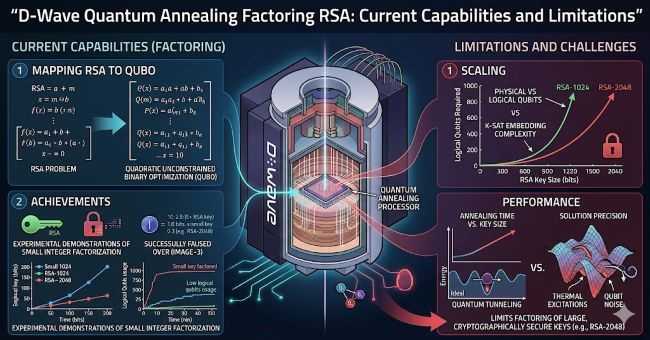
D-Wave Systems builds quantum computers using a different principle than the general-purpose quantum computers most researchers pursue. D-Wave quantum annealing is a specialized approach designed for optimization problems rather than running arbitrary algorithms.
Quantum annealing works by exploiting quantum tunneling, a phenomenon where quantum particles can pass through energy barriers that would block classical solutions. The algorithm searches through possible solutions and uses quantum effects to escape from local minima. This allows it to find better solutions than classical optimization algorithms.
D-Wave’s approach differs fundamentally from Shor’s algorithm. Shor’s algorithm is a mathematical procedure that solves factorization directly through quantum calculations. Quantum annealing reframes factorization as an optimization problem and looks for the optimal solution through quantum tunneling.
This difference matters. Quantum annealing might be able to solve certain problems faster than classical computers, but it doesn’t have the exponential speedup that Shor’s algorithm offers. Still, researchers investigate whether D-Wave quantum annealing can be effective against RSA.
Recent Progress in D-Wave RSA Factorization
In 2024, researchers published results showing D-Wave quantum annealing factoring RSA numbers. The Chinese research group led by Professor Wang Chao at Shanghai University achieved several milestones:
They factored a 22-bit RSA number, demonstrating the basic approach works. They used a hybrid approach combining quantum annealing with classical algorithms to factor a 50-bit RSA number. Later work in 2025 pushed this to 80-bit and even 90-bit RSA numbers using improved hybrid methods.
These results are scientifically interesting and represent genuine progress. They show that D-Wave quantum annealing can successfully approach integer factorization problems. Researchers published these findings in peer-reviewed journals, validating the technical approach.
However, it’s crucial to understand what these numbers mean. A 22-bit RSA number is roughly 2.3 million. In decimal, that’s six digits. A child could factor such a number with a calculator. A modern desktop computer solves it instantly.
The Gap Between Current Progress and Real Threats
Real-world RSA encryption uses 2048-bit keys. That’s 2048 bits, not 22 bits. To put this in perspective:
A 22-bit number has about 7 decimal digits. A 2048-bit number has about 617 decimal digits. The leap from 22-bit to 2048-bit isn’t a linear progression. It’s an exponential jump in difficulty.
The largest RSA number ever factored by classical computers is RSA-250, which is 829 bits. This required the computing power of thousands of machines working for months.
Even the recent 90-bit achievement, while representing progress, is still far from threatening real cryptography. RSA-256 would be the next significant milestone, but even that represents only 256 bits of security, compared to the 2048 bits used in practice.
Hybrid Approaches Combining Quantum and Classical Computing
The most recent research uses hybrid architectures that combine D-Wave quantum annealing with classical algorithms. This hybrid approach works because neither pure quantum annealing nor pure classical methods alone solve large factorization problems efficiently.
The hybrid method reframes factorization as a closest vector problem (CVP). The researchers use classical algorithms to reduce the problem space, then apply quantum annealing to solve optimization subproblems. Classical algorithms then post-process the quantum results.
This approach shows how quantum and classical computing complement each other. Neither alone solves current problems, but together they achieve results beyond what either could do independently.
The hybrid method’s success suggests that future cryptanalysis might combine quantum and classical techniques rather than relying purely on quantum computers.
Understanding the Hype Versus Reality
Media headlines often create alarm that exceeds the actual threat. When research showing D-Wave quantum annealing factoring RSA gets published, some outlets report it as “China breaks RSA encryption” or similar sensational claims. This misleads people about actual security implications.
The scientific reality is more measured. Progress is real. The approach works. But the gap to breaking actual encryption remains enormous.
Think of it this way: if you’re trying to climb a mountain, and you’ve climbed 100 meters of a 100,000-meter mountain, you’ve made progress. You’re on the mountain and climbing upward. But you’re nowhere near the summit.
Researchers at institutions like MIT, academic cryptographers, and security professionals track this progress carefully. They understand the distinction between early-stage results and actual threats.
Quantum Computing Timeline Realities
When will quantum computers actually threaten RSA? Most experts estimate 10 to 20 years before quantum computers become powerful enough to break current encryption.
This is why organizations are already taking action. NIST (National Institute of Standards and Technology) has begun standardizing post-quantum cryptography algorithms. These new encryption methods resist quantum attacks and will gradually replace RSA over the coming years.
This transition takes time. Billions of devices and systems use RSA. Replacing all of them cannot happen overnight. But the process has started, and by the time quantum computers become powerful enough to threaten RSA, post-quantum cryptography will likely be in place.
Hardware Limitations of D-Wave Systems
D-Wave Advantage, their latest quantum annealer, contains 5,000 qubits. But quantum computers have challenges that limits their power.
Quantum decoherence causes qubits to lose their quantum properties. Qubits only maintain quantum states for microseconds before errors creep in. This limits computation time and algorithm complexity.
Noise and errors plague current quantum hardware. Qubits make mistakes. These errors accumulate, corrupting results. Error correction requires many physical qubits to create one reliable logical qubit.
Current D-Wave systems don’t have enough error correction to run long algorithms without degradation. This is why factoring small numbers remains feasible while large numbers remain out of reach.
Solving these hardware challenges will take years of research and development. Current quantum computers represent early stages, similar to classical computers in the 1950s.
The Role of Special Numbers
Some recent research doesn’t factor arbitrary RSA numbers. Instead, it factors special integers with particular mathematical properties. For example, some numbers with specific structures or patterns factor more easily than random numbers of the same size.
Factoring special numbers has limited practical value for cryptanalysis. Real RSA encryption uses numbers chosen specifically to avoid these special properties. Demonstrating success on special numbers doesn’t imply success on general numbers.
This distinction is important. When evaluating claims about D-Wave quantum annealing factoring RSA, check whether the research uses arbitrary numbers or special cases.
What This Means for Data Security
For data encrypted today, the timeline is reassuring. Your data protected by current RSA encryption will likely remain secure until long after quantum computers become powerful. Here’s why:
Organizations are transitioning to post-quantum cryptography. This transition will accelerate in the next few years. Future data encrypted with quantum-resistant algorithms will remain secure against quantum computers.
Historical data encrypted with RSA faces higher risk. If someone captures your encrypted data today and stores it, a quantum computer might decrypt it in 15 years. This “harvest now, decrypt later” attack is theoretically possible but requires advanced adversaries to take action today.
The financial industry, government agencies, and security-conscious organizations are upgrading now to avoid this risk.
Key Takeaways
- D-Wave quantum annealing uses quantum tunneling to solve optimization problems, differing fundamentally from Shor’s algorithm. It reframes RSA factorization as an optimization challenge rather than a direct factorization algorithm.
- Recent progress includes factoring 22-bit, 50-bit, 80-bit, and 90-bit RSA numbers using D-Wave quantum annealing with hybrid classical-quantum approaches. This represents genuine scientific progress but remains far from threatening real encryption.
- Real-world RSA encryption uses 2048-bit keys. The current 90-bit achievement is 22 times smaller than the 2048-bit standard, representing a massive gap in practical threat.
- Hybrid approaches combine D-Wave quantum annealing with classical algorithms to achieve better results than either method alone. This demonstrates how quantum and classical computing complement each other.
- Hardware limitations including quantum decoherence, noise, and error rates prevent current quantum computers from scaling to cryptographically relevant sizes. Solving these challenges requires additional research spanning years.
- Some research uses special numbers with mathematical properties that factor more easily. This has limited practical implications for cryptanalysis of real RSA implementations that specifically avoid such numbers.
- Post-quantum cryptography standards are being developed and deployed now, before quantum computers become powerful enough to threaten RSA. Organizations should begin migration to quantum-resistant encryption methods.
- The timeline for actual cryptographic threat from quantum computers is estimated at 10-20 years. Current data protected with RSA remains secure, but organizations should plan for transition to post-quantum cryptography.
Related Resources
Understanding quantum computing and cryptography helps you appreciate both the potential and limitations of emerging technologies. Learn more about computing fundamentals by exploring 80 AI tools for designers which covers how artificial intelligence and computing intersect. If you’re interested in understanding cybersecurity more broadly, ad strength vs quality score discusses how security ratings and trust factors work in digital systems. For those curious about the broader landscape of quantum and AI development, 50 game-changing AI tools explores how quantum computing and AI intersect in transforming business and technology.