Which Pair of Triangles Can Be Proven Congruent by SAS?
Geometry proofs trip people up for one main reason: the rules feel abstract until you understand what they’re actually saying. Which pair of triangles can be proven congruent by SAS is one of the most searched geometry questions for exactly this reason. The answer isn’t just a label you memorise. It’s a logical structure you learn to recognise, and once you do, spotting SAS pairs in a diagram becomes second nature. This post explains what SAS congruence means, what to look for in triangle pairs, how rigid transformations make the whole theorem work, and how to apply it in practice.
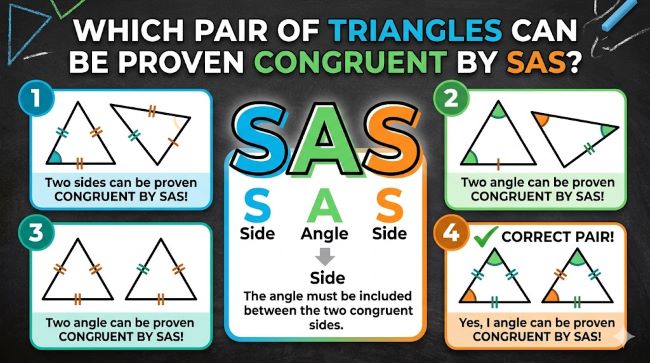
What Does SAS Mean in Geometry?
SAS stands for Side-Angle-Side. It is one of the five main congruence theorems used to prove that two triangles are identical in shape and size without measuring every single part.
The SAS congruence theorem states: if two sides and the included angle of one triangle are congruent to two sides and the included angle of another triangle, then the two triangles are congruent.
The key word here is included. The angle must sit between the two sides. This is what separates SAS from SSA (which is not a valid congruence theorem) and from other arrangements that look similar but don’t work.
Here’s what it looks like in notation. If triangle ABC and triangle DEF satisfy:
- AB = DE (first pair of sides)
- Angle B = Angle E (the included angle, sitting between the two sides)
- BC = EF (second pair of sides)
Then triangle ABC is congruent to triangle DEF by SAS.
Which Pair of Triangles Can Be Proven Congruent by SAS?
When a geometry question asks “which pair of triangles can be proven congruent by SAS,” it’s asking you to identify a triangle pair where two sides and the angle between them match across both triangles. Here’s how to scan a diagram or a list of triangle pairs systematically.
Step 1: Find two pairs of equal sides. Look for tick marks on sides (one tick = one unit, two ticks = another unit). Equal tick marks on sides of different triangles indicate those sides are congruent. You need exactly two pairs of equal sides, one in each triangle.
Step 2: Confirm the included angle. Check that the equal angle sits between the two equal sides in each triangle. An angle is “included” when both sides of the angle are the two sides you identified in step 1. If the equal angle is at the end of only one of the sides, or opposite to the sides, this is not SAS.
Step 3: Verify the angle marks match. Arc marks on angles in diagrams indicate equal angles. A single arc = one angle, double arc = another angle. The arcs must match across both triangles at the included position.
Common triangle pairs that qualify for SAS:
- Two triangles sharing a common side, where the shared side counts as one of the equal sides and the triangles have equal angles at the shared side’s endpoints. This setup appears often in problems involving diagonals of quadrilaterals or bisected segments.
- Two triangles created by a diagonal inside a rectangle or parallelogram, where opposite sides are equal by definition, and the angles formed by the diagonal create congruent included angles.
- Triangles formed by two line segments that bisect each other. When segments bisect each other at a point, the two halves of each segment are equal, and the vertical angles formed at the intersection are equal. Vertical angles are always congruent, and they sit between the two pairs of equal sides. This is a classic SAS setup.
- Triangles where two sides are given as equal in the problem statement and the angle between them is marked equal in the diagram.
What does not qualify for SAS:
- Two equal sides with a non-included angle (angle is not between the two sides). This is SSA and is not a valid congruence theorem.
- Two equal angles with only one equal side between them. This is ASA, a different valid theorem but not SAS.
- Equal sides with no information about any angle. This could be SSS if all three pairs of sides are equal.
SAS Congruence in Practice: A Worked Example
Imagine you have two triangles, PQR and XYZ, with the following information:
- PQ = XY (marked with single tick marks)
- QR = YZ (marked with double tick marks)
- Angle Q = Angle Y (marked with single arc marks)
Angle Q is the angle at vertex Q, which is formed by sides PQ and QR. Angle Y is the angle at vertex Y, formed by sides XY and YZ.
Check: Is the angle between the two given sides?
- In triangle PQR: angle Q sits between PQ and QR. Yes, it’s included.
- In triangle XYZ: angle Y sits between XY and YZ. Yes, it’s included.
Both sides and the included angle match. Triangle PQR is congruent to triangle XYZ by SAS congruence.
How Are Rigid Transformations Used to Justify the SAS Congruence Theorem?
How are rigid transformations used to justify the SAS congruence theorem is a deeper question that geometry courses increasingly ask, because understanding the proof behind the theorem is more useful than just memorising the rule.
A rigid transformation is any movement of a shape that preserves all distances and angles. The three rigid transformations are translation (sliding), rotation (turning), and reflection (flipping). Because rigid transformations don’t change the size or shape of a figure, any two shapes that can be mapped onto each other using only rigid transformations are congruent.
Here’s how rigid transformations justify SAS:
The argument runs like this. Suppose triangle ABC has two sides and an included angle that match triangle DEF by the SAS conditions. We want to show these triangles must be congruent.
- Translate triangle ABC so that vertex A maps onto vertex D. After the translation, side AB now starts at the same point as side DE.
- Rotate the translated triangle around point D so that side AB aligns with side DE. Because AB = DE, the endpoints now coincide exactly. Vertex B now sits at vertex E.
- Because angle A equals angle D (the included angles are congruent), and we’ve mapped side AB onto DE, the direction of side AC now matches the direction of side DF. Because AC = DF, vertex C maps exactly onto vertex F.
- All three vertices of triangle ABC now coincide with the three vertices of triangle DEF. Because only rigid transformations were used (translation and rotation), no distances or angles were changed. The triangles are congruent.
If the triangles are mirror images of each other, a reflection is added to the sequence before the rotation. The argument still holds because reflection is also a rigid transformation.
This is why SAS works as a proof: you can always find a sequence of rigid transformations that maps one triangle onto the other when the SAS conditions are met, and rigid transformations preserve congruence by definition.
SAS vs the Other Congruence Theorems
Knowing SAS clearly also means knowing what separates it from the others.
- SSS (Side-Side-Side): All three pairs of sides are equal. No angle information needed.
- SAS (Side-Angle-Side): Two pairs of sides equal, with the included angle equal between them.
- ASA (Angle-Side-Angle): Two pairs of angles equal, with the included side equal between them.
- AAS (Angle-Angle-Side): Two pairs of angles equal and one pair of non-included sides equal.
- HL (Hypotenuse-Leg): Right triangles only. Hypotenuse and one leg equal.
SSA is not on this list. Two sides and a non-included angle is not sufficient to guarantee congruence. Two different triangles can share the same two sides and non-included angle without being congruent. This is called the ambiguous case and is why SSA gets no theorem.
How to Approach SAS Questions on a Test
Geometry tests that ask “which pair of triangles can be proven congruent by SAS” typically give you four diagram options. Here’s the fastest approach:
- Eliminate any option where the angle is not between the two marked sides.
- Eliminate any option where only one pair of sides (or no sides) are marked equal.
- Of the remaining options, look for the one where both pairs of sides and the included angle are all clearly marked as congruent.
If you’re writing a proof rather than choosing from options, your statement-reason structure for SAS looks like this:
- Statement: AB = DE. Reason: Given.
- Statement: Angle B = Angle E. Reason: Given (or vertical angles, or definition of bisector, depending on the problem setup).
- Statement: BC = EF. Reason: Given.
- Statement: Triangle ABC is congruent to triangle DEF. Reason: SAS congruence theorem.
Clear and readable formatting matters when you’re writing out proofs, because a well-organised two-column proof is much easier to check and grade than scattered reasoning.
Key Takeaways
- Which pair of triangles can be proven congruent by SAS: look for two pairs of equal sides with the equal angle sitting directly between them in both triangles. All three must be marked in the diagram.
- SAS congruence requires the angle to be included (between the two equal sides). An angle at any other position means SAS does not apply.
- Vertical angles at a point of intersection are a common source of the included angle in SAS problems. They’re always equal, and they naturally sit between two pairs of sides in bisected-segment setups.
- How are rigid transformations used to justify the SAS congruence theorem: translation maps one triangle’s vertex onto another’s, rotation aligns the equal sides, and because the included angles match, the third vertex also coincides. Only rigid transformations are used, so congruence is preserved throughout.
- SSA is not a valid congruence theorem. The angle must be between the two sides, not outside them.
Geometry proofs reward careful reading of diagrams more than any other skill. Once you know what to look for, SAS pairs jump out quickly. Organising your study notes systematically for each theorem type makes practice problems faster and exam preparation much more focused.
If you have a specific diagram you’re unsure about, the three-step check works every time: find two equal sides, check that the equal angle is between them, confirm all three elements are marked. If they are, SAS applies.