How Is It Possible for Ski Jumpers to Stay in the Air So Long and How Do They Train for That?
If you have ever watched ski jumping and wondered how is it possible for ski jumpers to stay in the air so long and how do they train for that, you are asking the central question of the entire sport. These athletes sail the length of a football field through open air before touching down, and it looks like genuine flight. The reality combines physics, technique, equipment, and years of focused work. Ski jumping looks like flying, but the truth is more subtle and more interesting. This guide answers how is it possible for ski jumpers to stay in the air so long and how do they train for that, breaking down both the science of the flight and the training behind it.
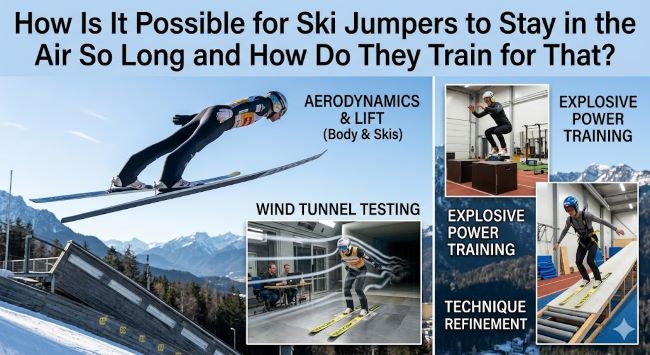
Ski Jumpers Glide Rather Than Fly
The first step in understanding how is it possible for ski jumpers to stay in the air so long and how do they train for that is recognizing that the athletes are not truly flying the way a bird or plane does. A ski jumper is always descending. From takeoff to landing, gravity pulls the athlete steadily downward. What looks like sustained flight is actually a long, controlled glide.
The key concept is the glide ratio, which describes how far an object travels forward for every unit it drops. A ski jumper works to maximize this ratio, traveling as far forward as possible while falling as slowly as possible. The longer and flatter the glide, the greater the distance achieved.
This is why ski jumping hills are shaped the way they are. The landing slope falls away steeply beneath the jumper, curving downward to match the natural arc of the flight. A jumper is rarely more than a few meters above the snow at any point, even while covering enormous horizontal distance. The hill drops away as fast as the athlete descends, creating the illusion of prolonged flight.
Picture a paper airplane thrown from a tall building. It does not hover, but a well-folded one glides far across the ground because it falls slowly while moving forward. A ski jumper applies the same principle with a human body, two skis, and refined technique replacing the paper.
Understanding ski jumping as gliding rather than flying changes how you watch the sport. The athletes are managing a controlled descent, squeezing every possible meter of forward travel out of the energy they carry off the takeoff.
The In-Run: Building the Speed That Makes Flight Possible
Everything begins with speed, and speed comes from the in-run, the steep ramp the athlete descends before takeoff. This is the first piece in answering how is it possible for ski jumpers to stay in the air so long and how do they train for that.
The jumper starts from a gate near the top and slides down the in-run in a tight, crouched position often called the egg. This position tucks the body into the smallest, most aerodynamic shape possible, reducing air resistance so the athlete accelerates as much as the ramp allows.
By the bottom of the in-run, ski jumpers reach speeds around 90 kilometers per hour, roughly 55 to 60 miles per hour, on large hills. This speed is the engine of the entire jump. The faster the athlete travels at takeoff, the more energy is available to convert into distance through the air.
The in-run position matters enormously. Any unnecessary drag, a raised head, loose clothing, or poor body alignment, costs speed that cannot be recovered. Ski jumpers practice holding the egg position perfectly still, since even small movements disturb airflow and reduce velocity.
The in-run sets up everything that follows. A jumper who reaches the takeoff with maximum speed and perfect body position has the foundation for a long flight. A jumper who loses speed through poor technique starts at a disadvantage no amount of in-air skill can recover.
The Takeoff: The Most Important Fraction of a Second
If the in-run builds the speed, the takeoff converts it into flight. This single explosive moment is widely considered the most important and most difficult element in the whole question of how is it possible for ski jumpers to stay in the air so long and how do they train for that.
At the edge of the ramp, the jumper extends the body upward and forward in a powerful, precisely timed jump. This takeoff adds vertical velocity and, more importantly, launches the athlete into the aerodynamic flight position as quickly as possible. The entire action happens in a fraction of a second.
Timing is everything. Jumping too early or too late by even a few hundredths of a second dramatically reduces distance. The athlete must explode upward at the exact instant the skis leave the ramp, neither anticipating nor lagging the edge.
The takeoff also begins the rotation into flight position. As the jumper extends, the body pitches forward over the skis, beginning the lean that generates lift during the glide. A clean takeoff flows directly into a stable flight position without wasted motion.
This is why ski jumpers devote enormous training time to the takeoff alone. The movement is counterintuitive, requiring an athlete traveling at highway speed to jump forward and downward rather than instinctively pulling back. Mastering this timing separates elite jumpers from the rest of the field.
The Flight Position and the V-Style Revolution
Once airborne, the ski jumper assumes the flight position that determines how far the glide will carry. This position is central to how is it possible for ski jumpers to stay in the air so long and how do they train for that, because it transforms the body and skis into a single lifting surface, essentially a low, wide wing.
In flight, the jumper leans far forward, nearly lying along the cushion of air rushing past. The body stays close to parallel with the skis, arms held back along the sides, head up just enough to see the landing. This forward lean creates a small angle relative to the oncoming air, generating lift across the body and skis.
The most important technical element is the V-style, in which the jumper spreads the ski tips wide apart in a V shape while keeping the tails close together. This style replaced the older technique of holding the skis parallel, and it changed the sport permanently.
The V-style works because it dramatically increases the surface area presented to the air and improves the lift the jumper generates. When a Swedish jumper named Jan Boklöv began using the V-style in the late 1980s, it initially looked strange and was penalized on style points. But the distances it produced were so much greater that the entire sport adopted it within a few years. Today every competitive ski jumper uses it.
The flight position requires constant micro-adjustments. The jumper subtly shifts the angle of the body and skis throughout the glide, responding to air conditions and managing the balance between lift and stability. Too aggressive an angle increases lift but risks instability; too conservative an angle sacrifices distance.
How Lift and Drag Actually Work
Understanding the aerodynamics clarifies how is it possible for ski jumpers to stay in the air so long and how do they train for that.
As air flows over the angled body and skis, it generates two forces. Lift pushes the jumper upward, opposing gravity and slowing the descent. Drag pushes backward, resisting forward motion. The art of ski jumping lies in maximizing lift while managing drag to achieve the best possible glide.
The forward lean and the V-style both serve to increase lift relative to drag. By presenting the body and skis to the air at the optimal angle, the jumper extracts the most upward force from the airflow without creating so much drag that forward speed collapses.
The skis themselves are large and wide, functioning as part of the lifting surface rather than just landing equipment. Combined with the body, they create a surprisingly effective wing for an object never designed by nature to fly.
Air conditions affect the flight significantly. A headwind increases lift and can extend distances, while a tailwind reduces lift and shortens jumps. This is why competitions monitor wind carefully and why modern scoring systems adjust for wind conditions to keep competition fair. The athlete must read and respond to the air in real time during every jump.
The interplay of lift, drag, gravity, and forward momentum makes ski jumping a continuous physics problem solved by the body in motion. Elite jumpers develop an intuitive feel for these forces that lets them optimize each glide.
The Role of Equipment
Equipment plays a major role in how is it possible for ski jumpers to stay in the air so long and how do they train for that, and the sport regulates it carefully to keep competition fair and safe.
Ski jumping skis are longer and wider than regular skis, designed to maximize the lifting surface. Their length is regulated relative to the athlete’s height, so taller jumpers may use longer skis. This rule connects equipment to body size in ways that shape competitive strategy.
The jumpsuits are equally important and tightly regulated. A baggy or overly large suit would catch more air and generate extra lift, effectively cheating the aerodynamics. Rules govern suit fit and the permeability of the fabric, requiring suits to conform closely to body measurements. Officials measure suits to ensure compliance, and violations bring disqualification.
Even small equipment details affect flight. Bindings, boots, and the connection between boot and ski are designed to allow the forward lean of the flight position while providing control. The whole system is engineered to support the aerodynamic glide.
Because equipment affects distance so directly, governing bodies continually refine the rules. The goal is to keep the sport about athletic skill and technique rather than equipment advantages, ensuring that training and ability determine results.
The Role of Body Composition and Safety Rules
Body weight affects the aerodynamics, since a lighter athlete has less mass to keep aloft relative to the lift generated. This created a difficult issue in the sport’s history that governing bodies addressed through safety rules, and it forms part of how is it possible for ski jumpers to stay in the air so long and how do they train for that.
Because lighter jumpers gained a distance advantage, the sport recognized a risk that athletes might pursue unhealthy weight loss to compete. To protect athlete health, ski jumping introduced rules linking ski length to body composition. Athletes below a certain healthy threshold must use shorter skis, which reduces their lifting surface and removes the advantage of being underweight.
These rules exist specifically to safeguard athlete wellbeing, removing the incentive for dangerous weight loss by ensuring that being too light no longer helps and may even hurt through shorter skis. The sport’s governing bodies treat athlete health as a priority alongside fair competition.
This balance between performance and health shows how the sport has evolved. The rules aim to reward training, technique, and skill rather than physical extremes that could endanger the athletes who compete.
The Landing: Ending the Flight Safely
The flight ends with the landing, which carries its own technique and risk. A jumper traveling well over highway speed must touch down and absorb tremendous force without falling.
The classic landing is the Telemark landing, in which the jumper lands with one foot ahead of the other and knees bent, absorbing impact through the legs while maintaining balance. A clean Telemark landing earns style points, while a fall or an unstable landing costs them.
The shaped landing hill helps enormously. Because the slope falls away at an angle matching the flight, the jumper touches down moving nearly parallel to the surface rather than dropping straight onto flat ground. This dramatically reduces the impact force compared to landing on level terrain.
After touchdown, the jumper transitions into the outrun, the flat or uphill section where the athlete slows and stops safely. Controlling speed and balance through the landing and outrun completes the jump.
The landing shows that ski jumping demands more than distance. Athletes must combine the longest possible flight with a controlled, stylish landing, since scoring rewards both distance and form.
How Ski Jumpers Train: Strength and Explosive Power
The second half of how is it possible for ski jumpers to stay in the air so long and how do they train for that comes down to specific physical training that builds power, balance, and body control.
Explosive leg power tops the list of training priorities. The takeoff demands a powerful, instantaneous extension of the legs, so jumpers train with squats, plyometric jumps, and other exercises building the fast, forceful muscle contraction the takeoff requires. The ability to generate maximum power in a fraction of a second is essential.
Core strength and stability matter enormously for holding the flight position. Maintaining a forward lean against rushing air requires a strong, stable core that keeps the body rigid and aligned throughout the glide. Jumpers dedicate significant training to core conditioning.
Balance training develops the fine control jumpers need throughout every phase. From the in-run through the flight to the landing, athletes constantly adjust their balance, and dedicated balance work builds this capacity. Many use unstable surfaces and balance exercises to sharpen this skill.
Flexibility and mobility support the extreme positions the sport demands. The deep forward lean and the takeoff extension require supple joints and muscles, so jumpers maintain flexibility through stretching and mobility work.
The physical training builds the engine that powers every jump. Without explosive power, stable core strength, refined balance, and adequate flexibility, even the best technique cannot produce elite results.
Dry-Land and Imitation Training
Much of the training happens away from the hill entirely, through dry-land practice that lets athletes refine technique safely and repeatedly. This is a major part of how is it possible for ski jumpers to stay in the air so long and how do they train for that.
Imitation jumps form a core part of dry-land training. Athletes practice the takeoff movement over and over on flat ground, rehearsing the precise timing and body action without the speed and risk of an actual jump. This repetition builds the muscle memory the takeoff demands.
Athletes also practice the in-run position and the transition to takeoff using specialized equipment. Some train on roller systems or simulators that mimic the in-run, letting them rehearse body position and timing in controlled conditions.
Video analysis supports dry-land training heavily. Coaches film jumps and imitation drills, then review the footage frame by frame with athletes to identify tiny errors in timing, position, or movement. Modern training relies on this detailed feedback to refine technique that happens too fast to perceive in real time.
Dry-land training allows the high-volume repetition that real jumps cannot provide safely. By drilling the takeoff and position movements thousands of times on the ground, ski jumpers build the consistency that translates to the hill.
Wind Tunnel and Aerodynamic Training
Because aerodynamics determine so much distance, some athletes train their flight position in wind tunnels that recreate the airflow of an actual jump, adding another answer to how is it possible for ski jumpers to stay in the air so long and how do they train for that.
In a wind tunnel, the jumper holds the flight position against a controlled stream of air matching the speed and conditions of a real glide. This lets athletes feel the aerodynamic forces and experiment with body and ski angles without leaving the ground.
Wind tunnel training offers a major advantage: unlimited time in the flight position. During a real jump, the flight lasts only seconds, giving little opportunity to feel and adjust. A wind tunnel lets the athlete hold and refine the position for as long as needed, accelerating learning.
Coaches and athletes use wind tunnel sessions to optimize the lift-to-drag balance, finding the body and ski angles that produce the best glide for each individual. Because every athlete has a slightly different build, this personalized aerodynamic tuning matters.
Not every program has wind tunnel access, but where available, it provides a powerful tool for the aerodynamic refinement that separates good jumpers from great ones.
Year-Round Training and Summer Jumping
Ski jumping is not limited to winter, and serious athletes train year-round using surfaces that allow jumping without snow, which extends the answer to how is it possible for ski jumpers to stay in the air so long and how do they train for that across the whole calendar.
Summer jumping takes place on hills covered with special materials. The in-run uses ceramic or porcelain tracks, and the landing hill is covered with plastic matting kept wet to mimic snow. These surfaces let athletes jump and compete through the warm months, maintaining and developing skills year-round.
This year-round capability transforms training. Rather than practicing only during winter, athletes jump throughout the year, accumulating far more repetitions and refining technique continuously. Major summer competitions exist alongside the winter season.
Combined with dry-land work, wind tunnel sessions, and physical conditioning, summer jumping creates a complete annual training cycle. Elite ski jumpers train essentially without interruption, which explains the high level of technical precision the sport demands.
The ability to train and compete year-round reflects how seriously the sport is pursued at the elite level, rewarding the consistency and refinement that only continuous practice can build.
Mental Training and Progression
Beyond the physical and technical, the sport demands significant mental preparation, which completes the picture of how is it possible for ski jumpers to stay in the air so long and how do they train for that.
Visualization is a common mental technique. Athletes mentally rehearse the entire jump in detail, picturing the in-run, takeoff, flight, and landing. This mental practice reinforces the physical training and prepares the mind to execute under competition pressure.
Managing fear is essential. Launching off a large hill at high speed runs against natural instinct, and athletes develop the mental discipline to commit fully despite the apparent danger. Confidence built through training and progression supports this commitment.
Progression matters greatly for both safety and skill. Ski jumpers begin on small hills and advance gradually to larger ones as their technique and confidence develop. Young athletes start with modest jumps and work upward over years, building the skills and nerve needed for the biggest hills. This careful progression protects athletes while developing ability.
The mental side completes the answer to how is it possible for ski jumpers to stay in the air so long and how do they train for that. Physical power, technical precision, aerodynamic understanding, and mental discipline combine to let athletes turn a controlled fall into a flight covering remarkable distance.
Key Takeaways
- Ski jumpers do not truly fly but execute a long controlled glide, always descending while maximizing forward distance through aerodynamic technique.
- Ski jumping hills are shaped so the landing slope falls away beneath the athlete, keeping jumpers close to the surface while covering great horizontal distance.
- The in-run builds speed of around 90 kilometers per hour through a tight aerodynamic crouch, providing the energy that powers the entire jump.
- The takeoff is the most important moment, requiring explosive extension timed to a fraction of a second at the edge of the ramp.
- The flight position turns the body and skis into a single lifting surface through a deep forward lean that generates lift from the rushing air.
- The V-style, spreading the ski tips wide, revolutionized the sport by greatly increasing lift and distance, and is now used by every competitor.
- Lift and drag govern the glide, and ski jumpers maximize lift relative to drag while reading wind conditions that significantly affect distance.
- Equipment including regulated ski length and tightly controlled jumpsuits affects flight, and the sport regulates gear to keep competition fair and safe.
- The sport introduced rules linking ski length to body composition specifically to protect athlete health and remove incentives for unhealthy weight loss.
- The Telemark landing absorbs impact through bent legs and a staggered stance, aided by the angled landing hill that reduces touchdown force.
- Training emphasizes explosive leg power, core stability, balance, dry-land imitation jumps, video analysis, and wind tunnel aerodynamic refinement.
- Athletes train year-round using summer hills with ceramic in-runs and wet plastic landings, combining physical, technical, and mental preparation through careful progression.