Senior living brands are not built only through websites, brochures, logos, floor plans, or polished community photos.
They are built in moments.
The first phone call from a worried daughter.
The follow-up question from a son comparing three communities.
The late-evening concern from a family member who wants reassurance.
In senior living, brand experience is deeply emotional. Families are not simply buying a room, a meal plan, or access to care. They are making one of the most sensitive decisions of their lives. They are asking a much bigger question:
Can I trust this organization with someone I love?
That is where conversational AI is starting to matter.
Not as a cold replacement for human care.
Not as a gimmick.
Not as another layer of technology for the sake of technology.
But as a way to make senior living brands feel more available, responsive, warm, and organized.
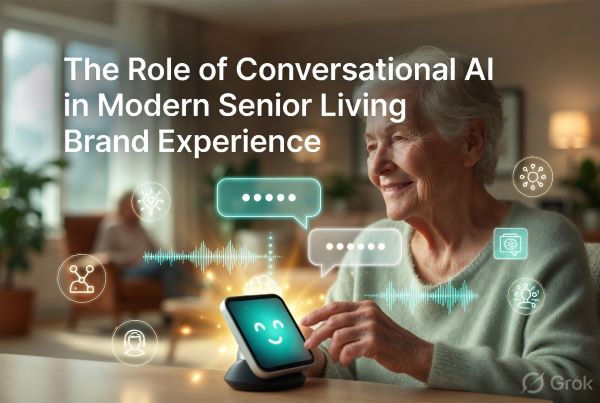
Senior Living Brand Experience Begins Before the Tour
For many families, the first real brand experience does not happen during an in-person tour.
It happens before that.
It may begin with a Google search. Then a website visit. Then a phone call. Then a voicemail. Then a delayed callback. Then another call to a competitor.
That early journey matters because families are often under pressure. They may be helping a parent after a fall. They may be comparing care options quickly. They may be emotionally exhausted. They may not know the difference between independent living, assisted living, memory care, respite care, and skilled nursing.
In that state, every interaction becomes meaningful.
- If the call is answered quickly, the community feels dependable.
- If the caller is routed properly, the brand feels organized.
- If the response is warm, the brand feels human.
- If the caller has to repeat the same story three times, the brand feels careless.
- If no one answers, the brand may lose trust before it ever gets a chance to explain itself.
This is why conversational AI can become a brand asset.
A senior living community may spend thousands of dollars on design, advertising, SEO, and photography. But if the first call experience is broken, the brand promise collapses at the point of contact.
Conversational AI Turns Communication Into Brand Infrastructure
Most senior living operators already understand that communication matters. But many still treat it as an operational issue rather than a brand issue.
That is a mistake.
Communication is not just a back-office function. It is one of the clearest expressions of the brand.
A community can say it is caring, attentive, and family-first. But the real test is what happens when someone calls.
- Does the caller feel heard?
- Does the system understand what they need?
- Are they guided to the right person?
- Do they receive a clear next step?
- Does the experience reduce anxiety or add to it?
Conversational AI can help senior living brands turn these moments into a more consistent experience.
For example, JoyLiving focuses on AI receptionist and call-routing support for senior living communities. That matters because the phone experience is often one of the most overlooked parts of the senior living customer journey. Families do not judge only the website. They judge how easy it is to reach someone, how quickly they are understood, and how professional the community feels when they need help.
A good AI receptionist does not need to feel flashy. It needs to feel useful.
It should help answer common questions.
It should route calls intelligently.
It should reduce missed calls.
It should support staff instead of distracting them.
It should make the community feel more responsive.
When done well, the caller does not think, “This brand uses AI.”
They think, “This community was easy to reach.”
That is the real win.
The Best Conversational AI Should Feel Like Better Service, Not More Technology
Senior living is a high-trust category. That means technology has to be careful.
If conversational AI feels robotic, rushed, or impersonal, it can damage the brand. Families may feel blocked by a machine when they are trying to reach a person. Older adults may feel uncomfortable if the experience is too complex or unnatural. Staff may resist it if it creates more work.
So the goal is not to make AI visible.
The goal is to make service better.
Good conversational AI should feel calm, clear, and natural. It should understand intent. It should know when to route a caller to a human. It should reduce friction. It should protect the emotional tone of the interaction.
This is especially important in senior living because many conversations are not simple transactions.
A family may ask about pricing, but underneath that question is fear.
They may ask about memory care, but underneath that is grief.
They may ask about availability, but underneath that is urgency.
They may ask about activities, but underneath that is guilt about a parent being lonely.
A senior living brand that understands this can design AI conversations with more care.
Conversational AI should not flatten emotion. It should support it.
JoyLiving and the New Front Door of Senior Living
The front desk has always been part of the senior living brand.
But today, the “front desk” is no longer only a physical place. It includes the website, the phone line, the inquiry form, the call routing system, the after-hours experience, and the follow-up process.
JoyLiving fits into this new version of the front desk.
Its role is not simply to automate calls. Its deeper value is helping senior living communities create a better first impression and a smoother communication layer. For families, this can change how the entire brand feels.
A community that handles calls well feels more competent.
A community that responds quickly feels more caring.
A community that routes people correctly feels more organized.
A community that reduces confusion feels safer.
That is brand experience.
Senior living communities often compete on amenities, location, care quality, food, lifestyle, and staff. But communication can quietly become one of the strongest differentiators. A family that feels guided from the first interaction is more likely to trust the community.
JoyLiving can help create that feeling by making the call experience more reliable.
Conversational AI Also Matters After Move-In
Brand experience does not end when a resident moves in.
In fact, that is when the brand promise is truly tested.
Families want to know that their loved one is engaged, supported, and emotionally cared for. Residents want to feel seen as people, not just as room numbers or care plans. Staff want tools that help them serve residents without adding more administrative weight.
This is where conversational AI can play a different role.
Not only as a front-desk tool, but as an engagement tool.
That is where JoyCalls.ai becomes highly relevant.
JoyCalls focuses on AI-powered companionship and conversation for older adults. Its value sits in a different part of the senior living experience: the daily emotional life of the resident.
A resident may not need another app.
They may not want another screen.
They may not ask for “AI.”
But they may appreciate a warm conversation, a memory prompt, a gentle check-in, a trivia question, a familiar voice-style interaction, or a moment that breaks the silence of the day.
This is an important distinction.
The best senior technology does not force older adults to behave like younger app users. It meets them through familiar forms of communication. Voice and conversation can feel more natural than dashboards, portals, or complicated interfaces.
JoyCalls can help senior living brands think beyond operations and into emotional experience.
From Amenities to Emotional Experience
For years, senior living brands have marketed visible features.
Beautiful dining rooms.
Activity calendars.
Fitness rooms.
Gardens.
Common spaces.
Well-designed apartments.
Care services.
These still matter.
But modern senior living brands also need to communicate something deeper: emotional quality of life.
Will residents feel lonely?
Will they have someone to talk to?
Will they feel mentally stimulated?
Will they feel remembered?
Will families feel reassured that engagement is happening?
Conversational AI can help address this emotional layer.
A product like JoyCalls can support daily engagement in ways that feel light, simple, and personal. It can help older adults have more moments of conversation. It can support companionship. It can create gentle mental stimulation. It can help families and communities think about engagement not as an occasional activity, but as part of everyday life.
This is where brand experience becomes more human.
A senior living brand should not only say, “We care.”
It should create systems where care is felt more often.
AI Should Support Staff, Not Replace the Human Touch
One of the biggest fears around AI in senior care is that it will replace human warmth.
That fear is understandable.
Senior living is built on relationships. Residents need human contact. Families need emotional reassurance. Staff need to feel valued, not automated away.
But the best use of conversational AI is not replacement. It is support.
JoyLiving can support staff by reducing missed calls, improving routing, and helping manage repetitive communication. That gives teams more room to focus on higher-value human conversations.
JoyCalls can support engagement by adding more conversational touchpoints, especially during quiet times when staff cannot be everywhere at once.
In both cases, the AI does not have to become the brand’s personality. It should help the brand express its personality more consistently.
If the brand is warm, the AI should support warmth.
If the brand is calm, the AI should reduce anxiety.
If the brand is family-first, the AI should make families feel guided.
If the brand is resident-centered, the AI should create more moments where residents feel heard.
That is the right relationship between AI and care.
The Brand Risk of Bad Conversational AI
Of course, conversational AI can also hurt the brand if it is designed poorly.
A bad AI phone experience can make a senior living community feel cheap, distant, or hard to reach. A bad AI companion experience can feel patronizing or fake. A bad routing experience can frustrate families at the exact moment they need reassurance.
The risk is not just technical failure.
It is emotional failure.
Senior living brands should therefore evaluate conversational AI with stricter standards than many other industries.
The AI must be easy to understand.
It must know when to hand off to a human.
It must avoid sounding cold.
It must reduce effort.
It must be reliable.
It must respect privacy and dignity.
It must be designed around real senior living scenarios.
This is why generic AI is not enough. Senior living needs AI designed around the emotional and operational reality of care.
Conversational AI Can Make Senior Living Brands Feel More Available
Availability is one of the most powerful brand signals in senior living.
Families want to feel that the community is there when needed. Residents want to feel that support is close. Staff want communication systems that do not constantly break under pressure.
Conversational AI can strengthen that feeling of availability.
With JoyLiving, availability appears through better call handling and routing. The community feels easier to reach.
With JoyCalls, availability appears through companionship and engagement. The resident feels less alone.
Together, they show two sides of the same future.
One side improves the family and operations experience.
The other improves the resident and emotional engagement experience.
Both influence brand perception.
A senior living brand that communicates well and supports residents between human touchpoints can feel more modern, more caring, and more trustworthy.
The Future Senior Living Brand Will Be Conversational
The next generation of senior living branding will not be only visual.
It will be conversational.
Yes, logos will matter. Websites will matter. Photography will matter. Interior design will matter. But the real brand experience will increasingly happen through voice, chat, call flows, AI-guided support, resident engagement, and family communication.
A brand will not only be judged by how it looks.
It will be judged by how it responds.
Does it answer?
Does it understand?
Does it guide?
Does it comfort?
Does it remember context?
Does it reduce confusion?
Does it make people feel cared for?
Conversational AI has the potential to make those responses more consistent.
JoyLiving helps senior living communities improve the communication layer that families often experience first.
JoyCalls helps older adults experience conversation, companionship, and engagement in a more natural way.
Used together, they point toward a future where senior living brands are not just marketed better, but felt better.
Conclusion
Conversational AI is becoming an important part of modern senior living brand experience because senior living is built on trust, responsiveness, and emotional reassurance.
Families want to feel guided.
Residents want to feel heard.
Staff need support.
Communities need to feel available and organized.
JoyLiving addresses the operational and first-contact side of the brand experience by helping communities handle calls and communication more smoothly.
JoyCalls addresses the resident engagement side by using AI-powered conversation to support companionship, stimulation, and daily connection.
Both show how conversational AI can serve a bigger purpose in senior living.
Not replacing care.
Not making the brand feel more technical.
But making the experience feel more human, more responsive, and more trustworthy.
In the future, the best senior living brands will not only be the ones with the nicest buildings or the best brochures.
They will be the ones that know how to answer, listen, guide, and connect.
That is the role conversational AI can play.