First Internship Interview Advice
Your first internship interview can feel like a big leap. You may not have much work experience, you might not know what to expect, and you probably want to make a great impression. The good news is that internship interviewers know you’re just starting out. They’re not looking for a polished professional. They’re looking for potential, curiosity, and a willingness to learn.
This guide shares first internship interview advice you can actually use. You’ll learn what the interview is like, how to prepare, how to answer common questions, how to talk about your skills without a job history, what to wear, what to avoid, and how to follow up so you stay on the hiring manager’s mind.
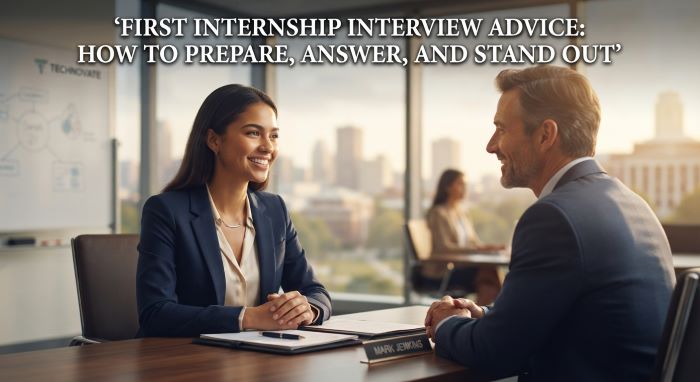
What Is a First Internship Interview Like?
Most internship interviews are friendly conversations designed to learn about you, your interests, and how you think. Interviewers want to see whether you’d be a good fit for the team and whether you’re eager to grow.
Common Interview Formats
| Format | What to expect |
|---|---|
| Phone screen | A short call, often 15 to 30 minutes, to check basic fit |
| Video interview | A live call on Zoom, Teams, or Google Meet |
| One way video | You record answers to preset questions |
| In person interview | A conversation at the office with one or more people |
| Panel interview | Several interviewers ask questions in one session |
| Group interview | Several candidates complete activities together |
| Technical or skills test | A short task, case, or assessment related to the role |
How Long Does an Internship Interview Usually Last?
Many internship interviews last about 20 to 60 minutes, depending on the company and format. Phone screens are usually shorter, while final rounds or panel interviews can run longer. For a closer look at timing and stages, read our guide on How Long Does an Internship Interview Take?.
What Employers Look for in Internship Candidates
Employers rarely expect interns to have years of experience. Instead, they focus on skills and attitude. According to the National Association of Colleges and Employers (NACE) Job Outlook 2026 Spring Update, the top skills employers want to see from college students include the ability to work in a team, problem solving, and communicating effectively. Employers also value technical skills, a strong work ethic, and analytical skills.
| What employers look for | How to show it |
|---|---|
| Teamwork | Share examples from group projects, clubs, or sports |
| Problem solving | Explain how you handled a challenge |
| Communication | Speak clearly and listen carefully |
| Work ethic | Talk about balancing school, jobs, or activities |
| Willingness to learn | Show curiosity and ask thoughtful questions |
| Interest in the company | Mention what you know about their work |
How to Prepare for Your First Internship Interview
Preparation is the single best way to reduce nerves and perform well. The most useful first internship interview advice is simple: the more you prepare, the more confident you’ll feel.
Researching the Company Before the Interview
Spend time learning about the organization. Look at:
- The company’s website, especially its mission and “About” page
- Recent news articles or press releases
- Social media accounts and blog posts
- Products, services, or projects related to the internship
- Employee profiles on LinkedIn
Write down two or three facts that interest you. You can mention them in your answers or use them to ask questions.
Reviewing the Internship Description
Read the job posting carefully. Highlight the main tasks and the skills they mention. Then match each skill to an example from your own life. If the posting mentions research, think of a class project where you gathered and analyzed information. If it mentions teamwork, think of a group assignment or club role.
Practicing Common Interview Questions
Practice out loud, not just in your head. You can:
- Ask a friend or family member to run a mock interview
- Record yourself answering questions on your phone
- Visit your school’s career center for a practice session
- Use online mock interview tools
For a broader checklist that applies to any role, see our guide on How to Prepare for a Job Interview.
What Should You Bring to Your First Internship Interview?
| Item | Why it helps |
|---|---|
| Several printed copies of your resume | Interviewers may not have one handy |
| A notebook and pen | Take notes and jot down names |
| A list of your questions | Helps you remember what to ask |
| A portfolio or work samples | Useful for design, writing, or tech roles |
| ID and directions | Helps you arrive on time and get through security |
| A water bottle | Keeps your voice clear |
How Early Should You Arrive?
Aim to arrive about 10 to 15 minutes early for in person interviews. Arriving too early can be awkward for the interviewer, while arriving late creates a poor first impression. For virtual interviews, log in about 5 minutes early to test your setup.
Common Internship Interview Questions and Answers
You can’t predict every question, but many come up again and again. Preparing for them is some of the best first internship interview advice you can follow.
| Question | What the interviewer wants to know |
|---|---|
| Tell me about yourself. | Your background and interests |
| Why do you want this internship? | Your motivation and fit |
| Why our company? | Whether you researched them |
| What are your strengths? | What you bring to the team |
| What is a weakness you’re working on? | Self awareness and growth |
| Tell me about a time you worked on a team. | Collaboration skills |
| Describe a challenge you overcame. | Problem solving and resilience |
| Where do you see yourself in five years? | Career goals and direction |
| Do you have any questions for us? | Curiosity and interest |
For model answers to the most frequent questions, read What Are the 7 Most Common Interview Questions and Answers?.
How to Answer “Tell Me About Yourself”
This question often opens the interview. Keep your answer to about one to two minutes and use a simple structure:
- Present: What you’re studying and your current focus.
- Past: A relevant project, class, or experience.
- Future: Why you want this internship and what you hope to learn.
Example: “I’m a junior studying marketing at State University. Last semester, I led a class project where my team created a social media campaign for a local café, and we grew their followers by about 20% in a month. I really enjoyed seeing how content can connect with people, so I’m excited about this marketing internship because it would let me learn from experienced professionals and work on real campaigns.”
How Do You Explain Why You Want an Internship?
Connect your answer to three things: your interests, the company, and your goals.
Example: “I’ve been interested in data analysis since my statistics class, and I’ve followed your company’s work on public health dashboards. This internship would let me apply what I’ve learned while gaining hands on experience with real data. Long term, I’d like to build a career in health analytics.”
What Are the Best Strengths to Mention?
Choose strengths that match the role and back each one with a quick example.
| Strength | Example to share |
|---|---|
| Fast learner | Learned a new software tool for a class project in a week |
| Organized | Managed deadlines for a club or group project |
| Strong communicator | Presented research to a class or community group |
| Team player | Helped a struggling teammate on a group assignment |
| Detail oriented | Edited a school newspaper or checked lab data |
What Weaknesses Should You Mention?
Pick a real but manageable weakness, then explain what you’re doing to improve. Avoid weaknesses that are core to the job.
Example: “I used to struggle with public speaking, so I joined a presentation workshop on campus and started volunteering to present in my classes. I’m much more comfortable now, though I still practice before big presentations.”
Using the STAR Method
For behavioral questions, use the STAR method:
- Situation: Set the scene briefly.
- Task: Explain what you needed to do.
- Action: Describe the steps you took.
- Result: Share the outcome and what you learned.
This structure keeps answers clear and focused, even when you’re nervous.
How to Talk About Your Skills Without Work Experience
Many students worry that a lack of work experience will hurt them. In reality, employers expect it. The key is to show transferable skills from other parts of your life.
Where to Find Experience You Already Have
- Class projects and research papers
- Clubs, student government, or organizations
- Sports teams and coaching
- Volunteer work and community service
- Part time jobs, such as retail, food service, or tutoring
- Personal projects, blogs, or online courses
- Family responsibilities, like caring for siblings
Highlighting Academic Achievements and Projects
Talk about your education in a way that connects to the job. Instead of only listing your major, explain what you did:
- “In my business strategy class, I analyzed a real company’s competitors and presented recommendations.”
- “For my capstone project, I built a simple app that helps students track assignments.”
- “I wrote a 20 page research paper that required gathering data from several sources.”
Mention honors, awards, or a strong GPA if they’re relevant, but focus more on what you learned and accomplished.
Demonstrating Communication and Teamwork Skills
Use stories that show you can work with others. For example, describe how you resolved a disagreement in a group project, divided tasks fairly, or helped a team meet a deadline. Concrete details make your answer believable.
Showing Enthusiasm and Willingness to Learn
Interns are expected to learn on the job. Show that you’re excited about that. Phrases like “I’d love to learn how your team approaches this” or “I’m eager to build my skills in this area” show the right attitude.
What to Wear to Your First Internship Interview
Clothing is a small but important part of first internship interview advice. Your outfit should look clean, professional, and comfortable. A good rule is to dress one step more formal than the company’s everyday dress code.
Choosing Appropriate Interview Attire
| Company type | Suggested outfit |
|---|---|
| Corporate (finance, law, consulting) | Suit or blazer, dress pants or skirt, dress shoes |
| Business casual (most offices) | Collared shirt or blouse, slacks or skirt, clean shoes |
| Creative or startup | Neat, polished casual, like a sweater and dark jeans or chinos |
| Virtual interview | Professional top, neat hair, simple background |
When in doubt, it’s better to be slightly overdressed than underdressed. You can also check the company’s social media or careers page to get a sense of how employees dress.
How to Dress Professionally on a Student Budget
- Shop at thrift or consignment stores.
- Borrow a blazer or shoes from a friend or family member.
- Check if your school offers a free career closet.
- Choose a few versatile pieces, like a navy blazer and neutral pants, that work for many interviews.
- Make sure clothes are clean, wrinkle free, and fit well.
How to Make a Good First Impression and Show Confidence
Making a Good First Impression
First impressions form quickly. Small details make a big difference:
- Be on time. Arrive early or log in a few minutes ahead.
- Greet everyone politely. Be friendly to receptionists and staff too.
- Smile and make eye contact. It shows warmth and interest.
- Offer a firm, friendly handshake if meeting in person.
- Sit up straight. Good posture shows confidence.
- Put your phone away. Silence it completely.
How to Overcome Nervousness Before an Internship Interview
Feeling nervous is completely normal. Try these tips:
- Prepare well. Confidence grows with practice.
- Breathe slowly. Take a few deep breaths before you start.
- Reframe nerves as excitement. Both feelings are similar in the body.
- Remember it’s a conversation. The interviewer wants you to do well.
- Get rest and eat well. A good night’s sleep helps you think clearly.
- Arrive early. Rushing increases stress.
How to Show Confidence During the Interview
- Speak clearly and at a steady pace.
- Pause briefly before answering to gather your thoughts.
- Use specific examples instead of vague claims.
- Be honest about what you don’t know.
- Show genuine interest in the work.
Confidence doesn’t mean having all the answers. It means staying calm, honest, and engaged.
How to Handle Difficult Internship Interview Questions
Some questions can catch you off guard. Here’s how to handle the most common tricky ones.
What Should You Do If You Don’t Know the Answer?
Stay calm and be honest. You can say, “That’s a great question. I haven’t worked with that yet, but here’s how I’d approach learning it.” For technical questions, talk through your thinking. Interviewers often care more about how you reason than whether you get the perfect answer.
How to Respond When Asked About Salary Expectations
Many internships have set pay rates. If asked, you can:
- Say you’re flexible and more focused on the learning experience.
- Ask what range the company has budgeted for the role.
- Research typical pay for similar internships in your area before the interview.
Example: “I’m mainly focused on the learning opportunity, but I’d be happy to hear the range you have in mind for this role.”
Should You Mention Your Career Goals?
Yes, briefly. Share goals that connect to the internship. Avoid saying the internship is just a stepping stone to a completely different field. Interviewers like candidates who seem genuinely interested in their industry.
Handling Gaps or Low Grades
If asked about a low grade or gap, be honest and focus on what you learned. Explain any steps you took to improve, and steer the conversation back to your strengths.
Questions to Ask at the End of the Interview
At the end, most interviewers ask if you have questions. Always say yes. Asking thoughtful questions shows interest and preparation, and it’s a piece of first internship interview advice that many students forget.
Preparing Questions for the Hiring Manager
| Question | Why it’s a good choice |
|---|---|
| What would a typical day look like for an intern? | Shows interest in the actual work |
| What projects might I work on? | Shows eagerness to contribute |
| How will my performance be measured? | Shows you care about doing well |
| What skills do your most successful interns have? | Helps you understand expectations |
| Is there mentorship or training for interns? | Shows a desire to learn |
| What do you enjoy most about working here? | Builds rapport with the interviewer |
| What are the next steps in the hiring process? | Clarifies the timeline |
Avoid asking about pay, vacation, or remote work too early unless the interviewer brings it up.
Common Mistakes to Avoid
Even strong candidates can slip up. Avoid these common mistakes:
| Mistake | Why it hurts | What to do instead |
|---|---|---|
| Not researching the company | Shows low interest | Spend time learning about them |
| Arriving late | Creates a poor first impression | Plan your route and leave early |
| Giving vague answers | Makes you forgettable | Use specific examples |
| Speaking negatively about others | Seems unprofessional | Stay positive about past experiences |
| Memorizing answers word for word | Sounds robotic | Practice key points instead |
| Not asking questions | Suggests low interest | Prepare three to five questions |
| Checking your phone | Seems disrespectful | Silence and put it away |
| Forgetting to follow up | Misses a chance to stand out | Send a thank you email |
Virtual Interviews and Multiple Interviews
Many internships now hold video interviews. This part of our first internship interview advice covers the tech and setup.
Tips for Virtual Interviews
- Test your technology. Check your camera, microphone, and internet connection ahead of time.
- Choose a quiet space. Let others know you need privacy.
- Use good lighting. Face a window or lamp so your face is clearly visible.
- Keep a simple background. Tidy the area behind you or use a plain virtual background.
- Look at the camera. This creates eye contact.
- Close other apps. Turn off notifications to avoid distractions.
- Have notes nearby. Keep a short list of key points, but don’t read from it.
What to Do If You Have Multiple Internship Interviews
- Keep a spreadsheet of companies, dates, interviewers, and status.
- Research each company separately so you don’t mix them up.
- Tailor your answers to each role.
- Be honest if you receive an offer and need time to decide. Many companies will give you a few days.
What to Do After Your First Internship Interview
Your work isn’t finished when the interview ends. Strong follow up can help you stand out.
Following Up With a Thank You Email
Send a short thank you email within 24 hours. Include:
- A thank you for their time
- A specific detail from the conversation
- A reminder of why you’re excited about the role
- Your name and contact information
Example:
“Hi Ms. Lopez, thank you for taking the time to speak with me today about the marketing internship. I especially enjoyed hearing about your team’s upcoming product launch. Our conversation made me even more excited about the chance to learn from your team. Please let me know if I can share anything else. Best regards, Jordan Smith.”
How to Follow Up If You Don’t Hear Back
If the interviewer gave you a timeline, wait until it passes. Then send a polite follow up email asking about the status of your application. Keep it short and friendly. If you still don’t hear back after a second follow up, it’s usually best to move on and focus on other opportunities.
Reflect on the Experience
After each interview, write down:
- Questions you were asked
- Answers that went well
- Answers you’d like to improve
- What you learned about the company
This reflection makes every future interview easier.
How to Increase Your Chances of Getting an Offer
- Apply to several internships, not just one.
- Tailor your resume and cover letter to each role.
- Network with professionals through LinkedIn, career fairs, and alumni.
- Practice interviews regularly with your career center.
- Build skills through online courses and personal projects.
- Follow up professionally after every interview.
Good first internship interview advice also includes this reminder: rejection is part of the process. Every interview is practice, and each one makes you stronger for the next.
Frequently Asked Questions
What is the best first internship interview advice? Prepare thoroughly. Research the company, review the internship description, practice common questions out loud, and prepare a few questions to ask.
How long does an internship interview usually last? Many last about 20 to 60 minutes, depending on the format and company.
What should I wear to an internship interview? Dress one step more formal than the company’s normal dress code. Business casual works for most offices.
How do I answer questions without work experience? Use examples from classes, clubs, sports, volunteer work, part time jobs, and personal projects.
Should I send a thank you email after the interview? Yes. Send a short, personalized thank you email within 24 hours.
What questions should I ask at the end? Ask about daily tasks, projects, training, success measures, and next steps in the process.
Is it normal to be nervous before a first interview? Yes. Preparation, deep breathing, and remembering that interviewers want you to succeed can help.
Key Takeaways
- The core first internship interview advice is to prepare well, because interviewers look for potential, curiosity, and a willingness to learn, not years of experience.
- Research the company and study the internship description before the interview.
- Practice common questions out loud and use the STAR method for behavioral answers.
- Use examples from classes, clubs, volunteering, and part time jobs to show your skills.
- NACE reports that employers value teamwork, problem solving, and communication in college candidates.
- Dress one step more formal than the company’s normal dress code.
- Arrive early, make eye contact, and prepare thoughtful questions to ask.
- Send a personalized thank you email within 24 hours and follow up politely if needed.