Greg Hayes and David Swensen
Greg Hayes and David Swensen both built their reputations on smart use of money, but in very different worlds. Hayes was a finance executive who became CEO of United Technologies and then RTX, one of the largest aerospace and defense companies on Earth. Swensen ran Yale University’s endowment for 36 years and created an investing style so successful that it became known as the Yale Model.
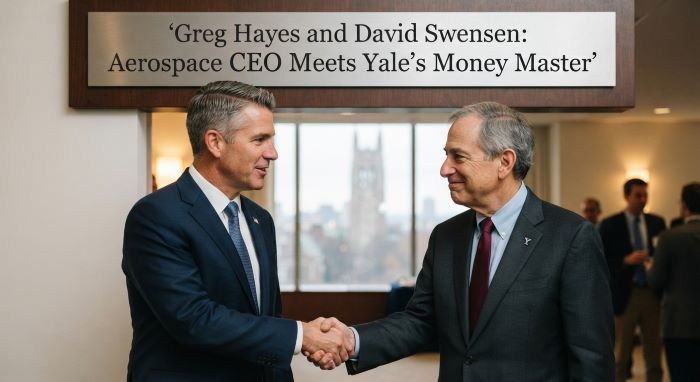
There’s no known personal or business link between them. This guide compares Greg Hayes and David Swensen across their backgrounds, careers, and legacies, and explains what each can teach about managing money and big organizations.
Greg Hayes and David Swensen at a Glance
| Detail | Greg Hayes | David Swensen |
|---|---|---|
| Full name | Gregory J. Hayes | David Frederick Swensen |
| Born | United States (birth date not widely published) | January 26, 1954, Ripon, Wisconsin |
| Died | Living | May 5, 2021, at age 67 |
| Age | In his sixties (as of November 2026) | 67 at death |
| Education | Trained in accounting and finance | University of Wisconsin River Falls (BS and BA); Yale University (PhD in economics, 1980) |
| Known for | Building RTX | Creating the Yale Model of investing |
| Top role | CEO of United Technologies and RTX | Chief Investment Officer of Yale University |
| Years in top role | 2014 to May 2024 | 1985 to 2021 |
| Books | None | Pioneering Portfolio Management; Unconventional Success |
Who Is Greg Hayes?
Greg Hayes trained in accounting and finance and spent his early career in aerospace. He worked at Sundstrand, a maker of aircraft parts, and joined United Technologies (UTC) when UTC bought Sundstrand in 1999.
He rose fast. UTC named him chief financial officer in 2008, and in November 2014 he became CEO. He later added the role of chairman.
As CEO, Hayes made some of the biggest moves in aerospace history. UTC bought Rockwell Collins for about $30 billion in 2018. He then split UTC into three companies, spinning off Otis elevators and Carrier air conditioning in 2020. At the same time, he merged UTC’s aerospace businesses with Raytheon to create Raytheon Technologies, now called RTX.
He led RTX through the pandemic, when air travel collapsed, and through a later engine problem at Pratt and Whitney that required costly inspections. He handed the CEO job to Christopher Calio in May 2024 and left the RTX board on April 30, 2025.
Who Was David Swensen?
David Swensen grew up in River Falls, Wisconsin, where his father was a chemistry professor. He studied at the University of Wisconsin River Falls and then earned a doctorate in economics at Yale under James Tobin, a Nobel Prize winner.
After working on Wall Street at Salomon Brothers and Lehman Brothers, he returned to Yale in 1985 at age 31 to run its endowment. At the time, it was worth about $1 billion. When he died in 2021, it was worth over $31 billion.
Swensen changed how universities invest. Instead of holding mostly stocks and bonds, he moved Yale’s money into private equity, venture capital, hedge funds, real estate, and natural resources. This approach became known as the Yale Model, and many endowments and foundations copied it. He also trained a generation of investment chiefs who went on to lead other endowments.
He wrote two books. Pioneering Portfolio Management (2000) explains the Yale Model for institutions. Unconventional Success (2005) advises ordinary investors to use low cost index funds. He kept working until shortly before his death from cancer in May 2021.
What Connects Greg Hayes and David Swensen?
There’s no known meeting, deal, or friendship between Greg Hayes and David Swensen. Still, their careers share some themes:
- Finance at the core: Hayes rose through accounting and corporate finance. Swensen was a trained economist and investor.
- Long term thinking: Hayes reshaped UTC for decades of growth. Swensen invested for an endowment meant to last forever.
- Big bets: Hayes made giant deals. Swensen made bold moves into assets most schools avoided.
- Lasting influence: RTX still reflects Hayes’s design, and the Yale Model still shapes how endowments invest.
Career Comparison
| Area | Greg Hayes | David Swensen |
|---|---|---|
| Field | Aerospace and defense | Endowment investing |
| Early career | Aerospace finance at Sundstrand | Wall Street at Salomon Brothers |
| Big moment | Raytheon merger in 2020 | Building the Yale Model |
| Style | Practical and direct | Disciplined and patient |
| Measure of success | Company growth and stock value | Endowment returns |
Early Lives in Detail
Hayes built his career step by step inside industry. He has said that finance work taught him how every part of a business fits together, from factories to customers. That wide view helped him run a huge company with many moving parts.
Swensen grew up in an academic home and was drawn to economics in college. At Yale, he worked closely with James Tobin, who encouraged him to think about markets in new ways. Swensen later said he took the Yale job partly because he loved the idea of serving a school rather than chasing personal wealth. He took a much smaller salary than he could have earned on Wall Street.
Leadership Styles
Hayes was known as blunt and plainspoken. He often gave direct answers to investors and reporters. He focused on execution, cost control, and building a company that could compete in both defense and commercial aviation.
Swensen was known as thoughtful, demanding, and loyal. He set high standards for the outside managers Yale hired. He also taught a popular Yale course on investing and mentored many students who later ran billions of dollars.
Similarities
- Numbers people: Both relied on deep financial skill.
- Long tenures: Hayes spent about 25 years at UTC and RTX. Swensen spent 36 years at Yale.
- Bold strategies: Both made choices that surprised their peers.
- Mentors: Both developed future leaders.
Differences
| Area | Greg Hayes | David Swensen |
|---|---|---|
| Organization | Public company | University endowment |
| Goal | Profits for shareholders | Funding for education and research |
| Public profile | Known in business and defense | Legend in the investing world |
| Pay | Very high CEO pay | Modest compared with Wall Street |
Wealth and Pay
Hayes earned large pay packages as CEO, often reported at more than $20 million in a year in salary, bonus, and stock. His exact net worth is not public. Swensen earned a good salary at Yale, but it was far less than he could have made running a hedge fund. He chose service over riches, which is part of why he was so admired.
Timeline at a Glance
| Year | Event |
|---|---|
| 1954 | Swensen is born in Wisconsin |
| 1980 | Swensen earns his Yale doctorate |
| 1985 | Swensen becomes Yale’s chief investment officer |
| 1999 | Hayes joins UTC through the Sundstrand deal |
| 2000 | Swensen publishes Pioneering Portfolio Management |
| 2008 | Hayes becomes UTC’s CFO |
| 2014 | Hayes becomes UTC’s CEO |
| 2018 | UTC buys Rockwell Collins |
| 2020 | UTC merges with Raytheon |
| 2021 | Swensen dies at 67 |
| 2024 | Hayes hands the RTX CEO role to Christopher Calio |
| 2025 | Hayes leaves the RTX board |
Lessons From Their Careers
- Think in decades. Both planned far beyond the next quarter.
- Diversify. Swensen spread money across many assets. Hayes balanced defense and commercial aviation.
- Keep costs low. Swensen told regular investors to choose low fee funds. Hayes pushed cost discipline at RTX.
- Serve something bigger. Swensen’s work funded scholarships and research for generations.
Why People Compare Them
People pair these names because both are respected for financial discipline at the highest level. One shows how finance skills can lead a giant industrial company. The other shows how patient investing can grow a school’s fortune many times over.
Where Their Legacies Stand in 2026
RTX continues to grow on strong demand for jet engines, radar, and missile defense, built on the structure Hayes created. The Yale Model faces new debate as private equity and venture returns have slowed in recent years, but Swensen’s ideas remain central in endowment management, and his former staff lead many of the country’s largest funds.
Fun Facts
- Swensen grew Yale’s endowment from about $1 billion to over $31 billion.
- Hayes split UTC into three separate companies.
- Swensen’s book for ordinary investors favored simple index funds.
- RTX includes Pratt and Whitney, Collins Aerospace, and Raytheon.
Frequently Asked Questions
Did Greg Hayes and David Swensen know each other? There’s no public record of a meeting or link between them.
What is the Yale Model? An investing approach that spreads money across private equity, venture capital, hedge funds, real estate, and natural resources, not just stocks and bonds.
When did David Swensen die? He died on May 5, 2021, at age 67.
Is Greg Hayes still RTX’s CEO? No. Christopher Calio became CEO in May 2024, and Hayes left the board in April 2025.
Final Thoughts
Greg Hayes and David Swensen show two ways finance skill can shape the world. Hayes used it to rebuild a giant aerospace company. Swensen used it to fund one of the world’s great universities. Both left marks that will last for decades.
Key Takeaways
- Greg Hayes and David Swensen have no known personal or business link.
- Hayes led UTC’s merger with Raytheon in 2020, creating RTX.
- Swensen ran Yale’s endowment from 1985 to 2021 and created the Yale Model.
- Yale’s endowment grew from about $1 billion to over $31 billion under Swensen.
- Greg Hayes and David Swensen both built legacies through long term thinking.
- Hayes left the RTX board in April 2025, and Swensen died in May 2021.