How Long Does an Internship Interview Take
META DESCRIPTION: How long does an internship interview take? Most last 20 to 45 minutes. See typical times by format and industry, a minute-by-minute breakdown, common questions, and how to prepare.
You got the email. A company wants to interview you for an internship. After the first rush of joy comes a practical question: how long does an internship interview take? You need to know so you can plan around class, pick a quiet room, and pace your answers.
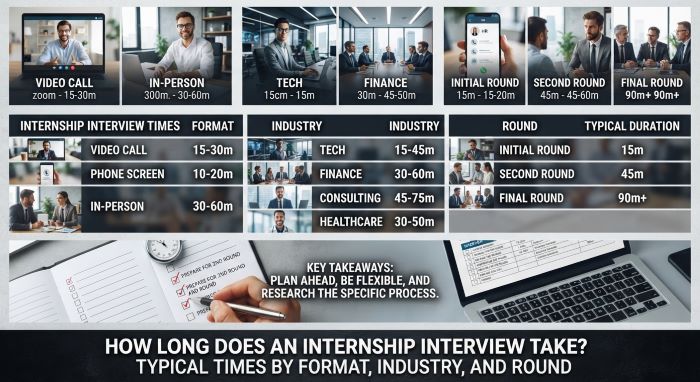
The short answer is that most internship interviews last between 20 and 45 minutes. A quick phone screen can take 15 minutes. A final round with several interviewers can fill half a day. This guide breaks down the timing by format, round, and industry. It also covers what happens in each part of the interview, what a short or long interview might mean, and how to get ready.
The Short Answer
| Interview Type | Typical Length |
|---|---|
| Recruiter phone screen | 15 to 30 minutes |
| One-way recorded video interview | 15 to 30 minutes |
| Live video interview | 30 to 45 minutes |
| In-person interview with one person | 30 to 60 minutes |
| Panel interview | 45 to 60 minutes |
| Technical or coding interview | 45 to 60 minutes |
| Case interview | 30 to 45 minutes |
| Group interview | 45 to 90 minutes |
| Final round, “superday,” or assessment center | 2 to 5 hours |
So when someone asks how long does an internship interview take, the honest reply is “it depends on the format.” These are common ranges, not fixed rules. Your invitation usually states the planned length. If it does not, ask the recruiter. It is a normal question.
Why Internship Interviews Are Usually Shorter
Interviews for full-time roles often run an hour or more per round. Internship interviews tend to be shorter for a few reasons.
- Less history to cover. Students have short resumes, so there is less to discuss.
- Lower stakes for the employer. An internship lasts a few months.
- High volume. Large programs interview hundreds of students in a short season.
- Focus on potential. Interviewers look for attitude, curiosity, and basic skills more than a long track record.
How Long Each Format Takes
Phone Screen: 15 to 30 Minutes
A recruiter calls to confirm the basics. Expect questions about your school, major, graduation date, availability, work authorization, and interest in the role. You may get one or two behavioral questions. The goal is to decide whether to move you to the next round.
One-Way Video Interview: 15 to 30 Minutes
You record answers to preset questions on a platform such as HireVue. Each question gives you a short time to prepare, often 30 seconds to a minute, and one to three minutes to answer. Most sets have three to six questions. You can usually complete it any time before a deadline.
Live Video Interview: 30 to 45 Minutes
This is now the most common format. You meet one or two people on Zoom, Microsoft Teams, or Google Meet. The flow matches an in-person interview. Log in five to ten minutes early to test your sound and camera.
In-Person Interview: 30 to 60 Minutes
The talk itself often lasts 30 to 45 minutes. Add time for check-in, a short wait, and perhaps a quick tour. Arrive 10 to 15 minutes early, and plan to be on site for about an hour.
Panel Interview: 45 to 60 Minutes
Two to five people take turns asking questions. Panels run longer because each person has topics to cover.
Technical Interview: 45 to 60 Minutes
Common for software, data, and engineering internships. You solve one or two problems while you explain your thinking. A few minutes go to introductions and your questions at the end.
Case Interview: 30 to 45 Minutes
Used in consulting and some finance and strategy roles. You work through a business problem with the interviewer. Many firms pair a case with a short behavioral section.
Group Interview or Assessment Center: 45 Minutes to Half a Day
Several candidates work on a task together while staff observe. Assessment centers combine group exercises, a presentation, tests, and individual interviews. They can last three to five hours.
Final Round or Superday: 2 to 5 Hours
Banks, consulting firms, and large tech companies often hold a block of back-to-back interviews. Each one lasts 30 to 45 minutes, with short breaks between them.
Timing by Interview Round
| Round | Who You Meet | Typical Length | Purpose |
|---|---|---|---|
| Online assessment | No one, it is automated | 20 to 90 minutes | Test skills or fit |
| First round | Recruiter | 15 to 30 minutes | Screen for basics and interest |
| Second round | Hiring manager or team member | 30 to 45 minutes | Assess skills and fit |
| Final round | Several team members or leaders | 1 to 4 hours in total | Make the decision |
The round you are in changes the answer to how long does an internship interview take more than any other factor. Small companies often use just one or two steps. Large programs may use all four.
Timing by Industry
| Industry | Common Process | Typical Interview Length |
|---|---|---|
| Technology | Online coding test, then one to three technical interviews | 45 to 60 minutes each |
| Investment banking | Recorded video, then a superday | 30 minutes each, several in a row |
| Consulting | Two rounds of case and fit interviews | 30 to 45 minutes each |
| Accounting | Campus interview, then an office visit | 30 minutes, then a half day |
| Marketing and media | One or two conversations, sometimes a small assignment | 30 to 45 minutes |
| Engineering | Behavioral and technical mix | 30 to 60 minutes |
| Healthcare and research | Interview with a supervisor or lab head | 30 to 45 minutes |
| Nonprofit and government | Structured panel with set questions | 30 to 45 minutes |
| Startups | Informal chat with a founder or team lead | 20 to 45 minutes |
A Minute-by-Minute Breakdown of a 30-Minute Interview
Knowing the shape of the conversation helps you pace yourself.
| Segment | Time | What Happens |
|---|---|---|
| Greeting and small talk | 2 to 3 minutes | Introductions and a quick overview of the plan |
| “Tell me about yourself” | 2 to 3 minutes | Your short pitch |
| Resume and background | 5 minutes | Classes, projects, jobs, and activities |
| Behavioral questions | 10 to 12 minutes | Three or four examples from your experience |
| Role or skill questions | 3 to 5 minutes | Basic technical or situational questions |
| Your questions | 3 to 5 minutes | You ask two or three questions |
| Wrap-up | 1 to 2 minutes | Next steps and thanks |
A 45-minute or 60-minute interview follows the same order with more time for behavioral and skill questions.
What Affects the Length
- Company size. Big firms keep strict schedules. Startups are looser.
- Number of interviewers. More people means more questions.
- Role type. Technical and case interviews need time to solve problems.
- Your answers. Clear, focused answers keep things on schedule. Long ones use up the clock.
- Rapport. A good conversation may run over.
- Interviewer’s calendar. A busy manager may need to stop on time or even early.
- Stage in the process. Later rounds are longer.
Is a Short Interview a Bad Sign?
Not on its own. Many students worry when a 30-minute interview ends at 20 minutes. Here are common, harmless reasons.
- It was a screening call, and the recruiter got what they needed.
- The interviewer has a tight schedule with many candidates.
- Your answers were clear and complete.
- The company uses a fixed set of questions.
A short interview is more worrying when the interviewer skips the chance for you to ask questions, says little about next steps, and seems to lose interest. Even then, you cannot know. Send your thank-you note and keep applying.
Is a Long Interview a Good Sign?
Often, but not always. Positive signs include an interviewer who goes past the planned time, describes the team and projects in detail, introduces you to others, or explains next steps and timing. Still, a long interview can also mean the interviewer is talkative or running behind. Judge the full picture, and do not count on an offer until you have one in writing.
Common Internship Interview Questions
Most internship interview questions fall into a few groups. Prepare two or three answers for each.
About you:
- Tell me about yourself.
- Why did you choose your major?
- What are your strengths and weaknesses?
Motivation:
- Why do you want this internship?
- Why our company?
- What do you hope to learn?
Behavioral:
- Tell me about a time you worked on a team.
- Describe a challenge you faced and how you handled it.
- Tell me about a time you made a mistake.
- Give an example of when you showed leadership.
- How do you manage several deadlines at once?
Situational:
- What would you do if you did not know how to complete a task?
- How would you handle feedback you disagreed with?
Skills:
- What tools or software have you used?
- Walk me through a project you are proud of.
Logistics:
- When can you start, and how many hours can you work?
- Are you able to work on site?
Keep each answer to about one or two minutes. In a 30-minute interview, that pace lets the interviewer ask six to eight questions, which gives you more chances to make a good impression.
How to Prepare for an Internship Interview
Good preparation makes the time feel shorter and go better. Here is how to prepare for an internship interview in the days before.
- Research the company. Read its website, recent news, and the internship description. Know what it sells and who its customers are.
- Study the posting. Match each listed skill to something you have done.
- Know your resume. Be ready to talk about every line.
- Build stories with the STAR method. Describe the situation, your task, the action you took, and the result. Prepare five or six stories from class projects, jobs, clubs, sports, or volunteer work.
- Practice your introduction. Aim for 60 to 90 seconds on who you are, what you have done, and why you want this role.
- Prepare your own questions. Bring three to five.
- Do a mock interview. Ask a friend or your campus career center. Time your answers.
- Test your tech. Check your camera, microphone, internet, and the meeting link.
- Plan your outfit. Business casual is safe for most roles. Dress a step up if you are unsure.
- Confirm the details. Know the time, time zone, format, and names of your interviewers.
- Rest. Sleep well and eat before the interview.
Students who ask how to prepare for an internship interview with no work experience should lean on coursework, group projects, clubs, and part-time jobs. Interviewers know you are early in your career. They want to see effort, reliability, and a wish to learn.
Questions to Ask the Interviewer
- What would a typical day look like for an intern on this team?
- What projects have past interns worked on?
- How do you measure success in this role?
- Who would I work with most closely?
- What do you enjoy most about working here?
- What are the next steps, and when might I hear back?
Have more questions ready than you need. Some may be answered during the interview.
How to Manage Your Time During the Interview
- Answer the question first, then add detail.
- Watch for cues. If the interviewer nods and looks ready to move on, wrap up.
- Pause before you answer. A few seconds of thought is fine.
- If you have gone on too long, finish your sentence and stop.
- Keep a clock in view on video calls, but do not stare at it.
- Save time for your questions. If time is short, ask your best one.
Plan Your Schedule Around the Interview
Once you know how long does an internship interview take on paper, block more time than the invitation states.
- For a video or phone interview: Add 15 minutes before and 15 to 30 minutes after.
- For an in-person interview: Add travel time, 15 minutes for early arrival, and 30 minutes after.
- For a final round: Keep the whole half day free.
Do not book a class, exam, or shift right after. Running out of time looks worse than ending early.
What Happens After the Interview
- Thank-you email: Send one within 24 hours. Keep it short, mention one thing you discussed, and restate your interest.
- Response time: Many employers reply within one to two weeks. Large programs can take longer, and some make offers within days.
- Follow-up: If the date they gave you passes, wait a few business days, then send a polite note.
- Keep going: Continue to apply and interview elsewhere until you accept an offer.
Common Mistakes That Waste Interview Time
- Showing up late or fighting with a video link
- Giving five-minute answers to simple questions
- Reciting your resume line by line
- Having no questions at the end
- Knowing nothing about the company
- Checking your phone
- Speaking badly about a past employer or professor
- Forgetting to mute notifications
Frequently Asked Questions
How long does an internship interview take on Zoom? Most live video interviews last 30 to 45 minutes.
How long does a phone interview for an internship take? Usually 15 to 30 minutes.
How many rounds are there? One to three for most internships. Competitive programs may add an online test and a final round.
Is a 15-minute interview bad? No. Screening calls are often that short.
Is a 20-minute interview enough to get an offer? Yes. Many internship offers follow short interviews, mainly at small companies and in high-volume programs.
How long should my answers be? About one to two minutes each.
How early should I arrive? Ten to 15 minutes early in person, and five to ten minutes early on video.
How long until I hear back? Often one to two weeks. Ask at the end of the interview so you know what to expect.
What should I bring? Copies of your resume, a notebook, a pen, and your list of questions. For video, have your resume open and a glass of water nearby.
Final Thoughts
So, how long does an internship interview take? Plan on 20 to 45 minutes for a standard interview, 15 to 30 minutes for a phone screen, and several hours for a final round. The exact length depends on the company, the format, and the role.
Time matters less than what you do with it. Research the employer, practice your stories, review common internship interview questions, and prepare a few questions of your own. Block extra time on your calendar, log in early, and keep your answers focused. If a friend ever asks you how long does an internship interview take, you can give the numbers and add the real lesson: come prepared, and even a short interview can lead to an offer.
Key Takeaways
- The answer to “how long does an internship interview take” is usually 20 to 45 minutes.
- Phone screens run 15 to 30 minutes. Technical and panel interviews run 45 to 60 minutes. Final rounds can take two to five hours.
- A short interview is not a bad sign by itself, and a long one is not a promise of an offer.
- Keep answers to one or two minutes so the interviewer can cover more ground.
- Prepare with company research, STAR stories, a practiced introduction, and a mock interview.
- Bring three to five questions for the interviewer.
- Block extra time before and after, and send a thank-you email within 24 hours.