How to Prepare for a Job Interview: A Step-by-Step Plan From Research to Follow-Up
You sent the application, and the reply came back: they want to meet you. The excitement lasts about a minute. Then the nerves arrive. What will they ask? What should you wear? How do you talk about that gap in your resume? The best cure for interview nerves is preparation. When you know how to prepare for a job interview, you walk in with answers ready and a clear idea of what you offer.
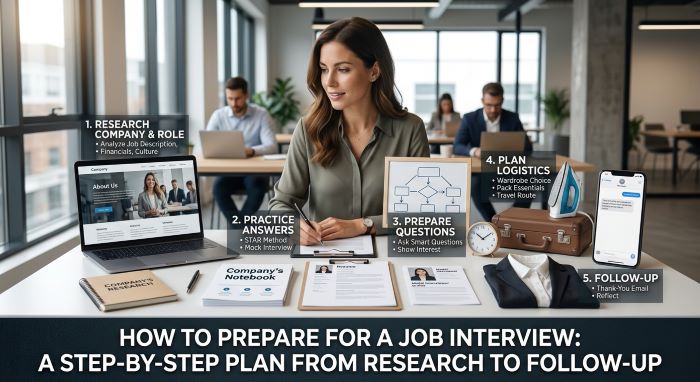
This guide gives you a step-by-step plan. It covers research, practice, common questions, what to wear, what to bring, and what to do on the day and after. A timeline and a checklist keep you on track.
Why Preparation Matters
Interviewers meet many candidates. Most have similar degrees and skills. What sets people apart is how well they connect their experience to the job, how clearly they speak, and how much they seem to want the role. All three come from preparation.
Learning how to prepare for a job interview also calms you. Much of the fear around interviews comes from not knowing what to expect. Every hour you spend getting ready removes some of that unknown.
A Preparation Timeline
| When | What to Do |
|---|---|
| As soon as you are invited | Confirm the date, time, format, and names of interviewers |
| 5 to 7 days before | Research the company and study the job description |
| 4 to 5 days before | Build your stories and draft answers to common questions |
| 2 to 3 days before | Practice out loud and do a mock interview |
| The day before | Choose your outfit, print your documents, plan your route, and test your tech |
| The day of | Eat, review your notes, arrive early, and breathe |
| Within 24 hours after | Send a thank-you email |
This timeline shows how to prepare for a job interview when you have a full week. If you have only a day or two, focus on the job description, your introduction, three strong stories, and two or three questions to ask.
Step 1: Confirm the Details
Reply to the invitation promptly and politely. Make sure you know:
- The date, time, and time zone
- The format: phone, video, or in person
- The address or meeting link
- Who you will meet, with names and job titles
- How long it will last
- Whether you need to prepare anything, such as a presentation or work samples
If any of these are missing, ask. It shows care, not weakness.
Step 2: Research the Company
You should be able to explain what the company does, who its customers are, and why you want to work there.
- Read the website. Focus on the “About” page, products or services, and mission.
- Check recent news. Look for launches, growth, funding, or changes in leadership.
- Look at social media. Company posts show its tone and priorities.
- Know the competitors. Name two or three and how this company differs.
- Look up your interviewers. Their profiles on LinkedIn can show their roles and background.
- Read employee reviews. Sites such as Glassdoor offer a view of culture and sometimes of interview questions. Treat single reviews with caution.
- Use the product or service if you can.
Write down three facts you can mention and one thing that excites you about the company.
Step 3: Study the Job Description
The job posting is your study guide. It tells you what they will ask about.
- Print it or copy it into a document.
- Highlight each required skill, duty, and quality.
- Next to each one, write an example from your own experience.
- Note any gaps, and plan how you will address them.
Use the same words the posting uses. If it says “stakeholder management,” use that phrase when you describe your work.
Step 4: Know Your Own Story
Be ready to talk about every line on your resume. Review dates, job titles, and key results. Prepare short, honest answers for anything that might raise a question, such as a gap, a short stay, or a career change.
Build a short introduction for “Tell me about yourself.” Aim for 60 to 90 seconds.
- Present. Your current role or study and one strength.
- Past. One or two experiences that led you here.
- Future. Why this job is the right next step.
Step 5: Build Your Stories With the STAR Method
Many questions start with “Tell me about a time when.” These are behavioral questions. The STAR method gives your answer a clear shape.
- Situation. Set the scene in a sentence or two.
- Task. Explain what you had to do.
- Action. Describe the steps you took. This should be the longest part.
- Result. Share what happened. Use numbers when you can, and add what you learned.
Prepare five to seven stories that cover common themes:
- Teamwork
- Leadership or taking initiative
- Solving a hard problem
- Handling conflict
- A mistake or failure and what you learned
- Working under pressure or a tight deadline
- An achievement you are proud of
One story can answer several questions. Keep each answer to about two minutes.
Step 6: Practice Common Questions
You cannot predict every question, but some appear in almost every interview.
- Tell me about yourself.
- Why do you want this job?
- Why do you want to work here?
- What are your greatest strengths?
- What is your greatest weakness?
- Why are you leaving your current job?
- Tell me about a challenge you faced at work.
- Where do you see yourself in five years?
- Why should we hire you?
- What are your salary expectations?
For sample answers to the questions that come up most, see this guide to what are the 7 most common interview questions and answers.
Tips for strong answers:
- Answer the question that was asked.
- Lead with your main point, then give an example.
- For weaknesses, name a real one and explain what you are doing to improve.
- Speak well of past employers, even if you left unhappy.
- For salary, research the market range for the role and location ahead of time, and give a range.
Step 7: Prepare Questions to Ask
Almost every interview ends with “Do you have any questions for us?” Saying “no” can look like a lack of interest. Bring three to five.
- What does a typical day or week look like in this role?
- What are the biggest challenges for the person in this job?
- How do you measure success in the first six months?
- How would you describe the team and its culture?
- What opportunities are there for learning and growth?
- What do you enjoy most about working here?
- What are the next steps in the process?
Avoid asking about pay, vacation, or perks in a first interview unless the interviewer raises them.
Step 8: Practice Out Loud
Reading your notes is only half of how to prepare for a job interview. Speaking is a different skill.
- Say your answers aloud several times.
- Do a mock interview with a friend, a mentor, or a career coach.
- Record yourself on your phone. Watch for filler words, speed, and eye contact.
- Time your answers.
- Practice in the format you will face. If it is on video, practice on video.
Do not memorize scripts word for word. Learn the key points, so you sound natural.
Step 9: Plan What to Wear
Dress one step above the company’s daily style.
| Workplace Style | What to Wear |
|---|---|
| Formal, such as law, finance, or consulting | A suit in a dark, neutral color |
| Business casual, such as most offices | A blazer with dress pants or a skirt, or a simple dress |
| Casual, such as startups and creative fields | Neat dark jeans or chinos with a collared shirt or a smart top |
- Choose clean, pressed clothes that fit well.
- Keep jewelry and fragrance light.
- Wear comfortable, clean shoes.
- Try the full outfit on the day before.
- When in doubt, dress up. You can also ask the recruiter about the dress code.
Step 10: Gather What to Bring
- Several printed copies of your resume
- A notebook and pen
- Your list of questions
- A list of references
- A portfolio or work samples, if relevant
- Photo ID, if the building requires it
- Directions and the contact number of your recruiter
- Water, tissues, and breath mints
Put everything in a neat folder or bag the night before.
Step 11: Prepare for the Format
Phone Interviews
- Find a quiet place with strong signal.
- Keep your resume and notes in front of you.
- Smile as you speak. It changes your tone.
- Stand up if it helps your energy.
Video Interviews
- Test your camera, microphone, and internet a day ahead.
- Download or update the meeting app.
- Use a plain, tidy background and face a window or lamp for light.
- Place the camera at eye level and look into it when you speak.
- Close other apps and silence notifications.
- Log in five to ten minutes early.
- Dress fully, in case you need to stand.
In-Person Interviews
- Plan your route and parking. Do a trial run if you can.
- Arrive 10 to 15 minutes early.
- Be polite to everyone you meet, including reception staff.
- Offer a firm handshake if it is the custom, make eye contact, and smile.
Panel, Group, and Assessment Days
- Learn the names and roles of each panel member.
- Speak to the whole panel, not only the person who asked.
- In group tasks, contribute, listen, and include others.
Interview length varies with the format and the level of the job. If you are a student, this guide explains how long does an internship interview take and how to plan your day around it.
Step 12: The Day Before
- Review your notes once. Do not cram.
- Lay out your clothes.
- Pack your bag.
- Charge your phone and laptop.
- Confirm the time and place.
- Go to bed at a normal hour.
Step 13: The Day of the Interview
- Eat a proper meal.
- Leave early.
- Turn your phone to silent.
- Take a few slow breaths before you go in.
- Sit up straight, and keep your hands relaxed.
- Listen fully to each question. Pause before you answer.
- If you do not understand a question, ask the interviewer to repeat or clarify it.
- If you do not know an answer, say so, and explain how you would find out.
- Close by restating your interest and thanking them for their time.
Step 14: Follow Up
Send a thank-you email within 24 hours.
- Thank the interviewer for their time.
- Mention one thing you discussed.
- Restate your interest in the role.
- Keep it to a few sentences.
If you hear nothing by the date they gave, wait a few business days and send a short, polite check-in. Meanwhile, keep applying elsewhere. Write down the questions you were asked while they are fresh. They will help you next time.
How to Calm Interview Nerves
- Prepare well. It is the strongest remedy.
- Practice slow breathing: in for four counts, out for six.
- Arrive early so you are not rushed.
- Remember that the interview goes both ways. You are also deciding whether the job suits you.
- Think of nerves as energy. A little adrenaline keeps you sharp.
- Have water at hand.
- Accept that you may stumble on one answer. Interviewers expect it.
Common Mistakes to Avoid
Part of knowing how to prepare for a job interview is knowing what to avoid.
- Arriving late
- Knowing little about the company
- Giving long, rambling answers
- Speaking badly of a former boss
- Having no questions to ask
- Checking your phone
- Lying or stretching the truth
- Focusing only on what you want, not on what you offer
- Dressing too casually
- Forgetting to follow up
Final Checklist
- I know the time, place, format, and names of my interviewers.
- I can explain what the company does and why I want to work there.
- I have matched my experience to the job description.
- My 60 to 90 second introduction is ready.
- I have five to seven STAR stories.
- I have practiced common questions out loud.
- I have three to five questions to ask.
- My outfit is clean and ready.
- My documents are printed and packed.
- My tech is tested, or my route is planned.
- I know when and how I will send a thank-you note.
Frequently Asked Questions
How long should I spend preparing? Plan for five to ten hours spread across several days for a role you want. Even two focused hours help.
What is the most important thing to prepare? Clear examples that show you can do what the job description asks.
What is the STAR method? A way to structure answers: Situation, Task, Action, Result.
How early should I arrive? Ten to 15 minutes early in person, and five to ten minutes early for video.
What should I say about my weaknesses? Name a real, non-critical weakness and describe the steps you are taking to improve.
How do I answer “Tell me about yourself”? Give a short summary of your present, your past, and why you want this role.
Is there a quick way to learn how to prepare for a job interview the night before? Study the job description, prepare your introduction and three stories, and write two questions to ask.
Should I bring notes? Yes. A notebook with a few key points and your questions is fine.
What if I do not know an answer? Stay calm, be honest, and describe how you would approach the problem.
Final Thoughts
Knowing how to prepare for a job interview turns a stressful event into a manageable one. Research the company, study the job description, and build stories that prove your skills. Practice out loud. Plan your clothes, your documents, and your route or your tech. On the day, listen, pause, and answer with clear examples. Afterward, send a thank-you note.
No one gives perfect answers to every question. Interviewers look for people who are prepared, honest, and keen to do the work. Follow the steps in this guide, and you will know how to prepare for a job interview for any role, at any stage of your career.
Key Takeaways
- The foundation of how to prepare for a job interview is research: know the company, the role, and your interviewers.
- Match each requirement in the job description to an example from your own experience.
- Use the STAR method to build five to seven stories that show your skills.
- Practice answers to common questions out loud, and time them at about one to two minutes.
- Prepare three to five thoughtful questions to ask the interviewer.
- Plan your outfit, documents, route, or tech the day before, and arrive early.
- Send a short thank-you email within 24 hours.