
Which of the Following Is True About the Management of Conflicts of Interest?
If you are taking a course on research ethics or the responsible conduct of research, you have probably met this multiple-choice question: which of the following is true about the management of conflicts of interest? It appears in widely used training programs for researchers, students, and staff. The question looks simple, but each wrong option reflects a common misunderstanding.
This guide gives the correct answer, explains why the other choices are wrong, and then goes deeper. It covers what a conflict of interest is, how organizations manage one, what a management plan contains, and what the rules require.
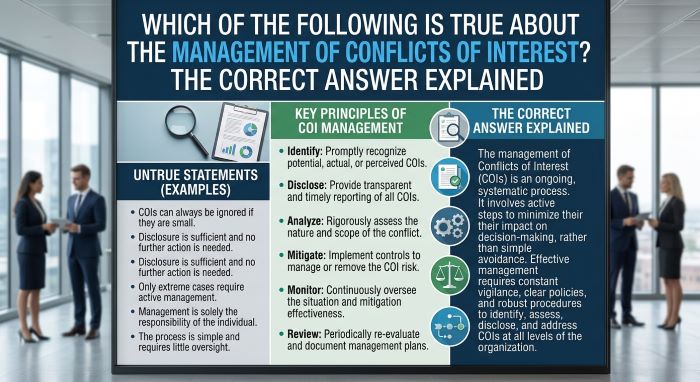
The Short Answer
The question usually appears with these four options.
| Option | Statement | Correct? |
|---|---|---|
| A | Researchers are required to eliminate all conflicts of interest that they have. | No |
| B | Management plans are often created to reduce the impact of conflicts of interest. | Yes |
| C | Organizations do not require that conflicts of interest are managed as long as researchers disclose them. | No |
| D | Researchers are typically permitted to judge for themselves whether a conflict of interest needs to be managed. | No |
The correct answer is B: management plans are often created to reduce the impact of conflicts of interest.
The wording and order of the options may differ slightly from one course to another. Read each option with care, and choose the one that describes management plans.
Why the Correct Answer Is Right
A conflict of interest is not proof of wrongdoing. It is a situation that creates a risk of bias. Since many conflicts cannot or need not be removed, organizations manage them. The main tool is a written management plan.
A management plan sets out the steps that will limit the effect of the conflict on the work. It may require the researcher to disclose the interest in papers and talks, bring in an independent person to review the data, or step back from certain decisions. The aim is to protect the integrity of the research, the safety of participants, and public trust, while allowing useful work to go on.
Why the Other Options Are Wrong
To see which of the following is true about the management of conflicts of interest, it helps to test each wrong option against how policies work.
“Researchers are required to eliminate all conflicts of interest.”
This is false. Elimination is one possible response, and it is sometimes required in serious cases. But it is not the general rule. Many conflicts are minor or can be handled with safeguards. If every conflict had to be eliminated, a scientist could never consult for a company, hold a patent, or start a business based on a discovery. Policy in most countries encourages those links, since they help move research into real use. The goal is to manage the risk, not to remove every tie.
“Organizations do not require management as long as researchers disclose.”
This is false. Disclosure is the first step, not the last. It tells the organization that a conflict may exist. The organization must then review it and decide what to do. In some cases, disclosure to the public is enough. In many others, more action is needed. Disclosure alone does not remove bias. Some studies suggest it can even make things worse, since people may feel free to act on a bias once they have declared it.
“Researchers may judge for themselves whether a conflict needs to be managed.”
This is false. People are poor judges of their own bias. Most of us believe that a financial interest would not affect our judgment, yet research on behavior shows that it can, often without our knowing. For that reason, the decision belongs to someone independent, such as a conflict of interest committee or a designated official. The researcher’s duty is to disclose fully and honestly. The organization’s duty is to review and decide.
What Is a Conflict of Interest?
A conflict of interest exists when a person’s secondary interest could unduly influence, or could appear to influence, their primary professional duty.
In research, the primary duties include:
- Designing, conducting, and reporting research honestly
- Protecting the welfare of human participants and animals
- Teaching and mentoring students fairly
- Using public or sponsor funds properly
Secondary interests can be financial gain, career advancement, personal relationships, or strong personal beliefs.
Three points are worth remembering.
- A conflict is a situation, not a behavior. Having one does not mean you did something wrong.
- Appearance matters. Even if no bias occurs, the appearance of a conflict can damage trust.
- Conflicts are common. Active, successful researchers often have them.
Types of Conflicts of Interest
| Type | What It Means | Example |
|---|---|---|
| Financial | A monetary interest could affect the work | A researcher owns stock in the company whose drug she is testing |
| Personal or relational | A close relationship could affect judgment | A professor supervises a spouse, or reviews a grant from a close friend |
| Intellectual | A strong commitment to a theory or to one’s own past work | A reviewer rejects a paper that challenges his best-known finding |
| Conflict of commitment | Outside activities take time and effort owed to the employer | A faculty member spends most of the week running a private consulting firm |
| Institutional | The organization itself, or its leaders, have a financial stake | A university holds equity in a startup whose product is being tested in its hospital |
Financial conflicts get the most attention since they are easier to measure and regulate. The others can be just as important.
How Conflicts of Interest Are Managed: The Process
The process itself explains which of the following is true about the management of conflicts of interest. Most organizations follow the same basic steps.
- Training. Researchers learn the rules and their duties.
- Disclosure. Researchers report their significant financial interests and outside activities, usually once a year and again whenever something changes.
- Review. A designated official or committee compares the disclosed interests with the person’s research and other duties.
- Determination. The reviewer decides whether an interest is related to the work and whether it amounts to a conflict.
- Management. If a conflict exists, the organization decides whether to manage, reduce, or eliminate it, and writes a plan.
- Reporting. Where required, the organization reports the conflict to the funding agency or other bodies.
- Monitoring. The organization checks that the researcher follows the plan.
- Enforcement. Failure to disclose or to follow the plan can lead to sanctions.
What Goes Into a Management Plan?
A plan is tailored to the case. Common elements include the following.
| Strategy | What It Involves |
|---|---|
| Public disclosure | Stating the interest in publications, presentations, and press releases |
| Disclosure to participants | Telling human research participants in the consent form |
| Disclosure to the research team | Informing students, staff, and collaborators |
| Independent monitoring | Appointing an unconflicted person or committee to review the design, data, or analysis |
| Changing the research plan | Altering the design to reduce the chance of bias |
| Changing roles | Removing the researcher from recruiting participants, obtaining consent, or analyzing data |
| Protecting trainees | Giving students an independent advisor and a route to raise concerns |
| Reducing the interest | Selling some stock or limiting consulting income |
| Eliminating the interest | Selling all equity or ending the relationship |
| Recusal | Stepping aside from specific decisions, such as purchasing or hiring |
A plan often combines several of these. It names who is responsible, sets dates for review, and is signed by the researcher.
An Example
Dr. Lee is a professor of engineering. She invented a new sensor, and her university patented it. She founded a small company to develop it and owns 30 percent of the shares. She now wants to run a federally funded study in her university lab to test the sensor. Two of her graduate students would work on the project.
Dr. Lee has a clear financial conflict. A good result would raise the value of her company. She is not required to sell her company or give up the research. She is also not allowed to decide alone that there is no problem. Instead, she discloses the interest. The conflict of interest committee reviews it and issues a management plan. The plan requires her to:
- Disclose her stake in all papers and talks
- Tell her students and collaborators about the company
- Let an independent faculty member review the data and analysis
- Keep her students’ thesis work separate from company work, with a second advisor for each student
- Avoid using university resources for company business without an agreement
- Report to the committee each year
This example shows why option B is the right answer when a quiz asks which of the following is true about the management of conflicts of interest. The plan reduces the impact of the conflict without ending valuable work.
What the Rules Say
In the United States, several rules shape how research conflicts are handled.
- Public Health Service regulations. Institutions that receive funding from agencies such as the National Institutes of Health must have a written policy. Researchers must disclose significant financial interests. The general threshold is 5,000 dollars in payments or equity from a single entity over 12 months, or any equity in a company that is not publicly traded. The institution must review disclosures, manage financial conflicts, report them to the funding agency, and make certain information available to the public. Researchers must complete training at least every four years.
- National Science Foundation policy. Institutions must maintain a policy that requires disclosure and management of significant financial interests.
- Food and Drug Administration rules. Sponsors of drugs and devices must report the financial interests of clinical investigators.
- Journals. Most journals require authors to disclose competing interests, often using a standard form.
- Institutional policies. Universities and hospitals often set stricter rules than the law requires.
Other countries have their own frameworks, built on the same ideas of disclosure, independent review, and management.
Why Management Matters
- Research integrity. Bias can shape the design of a study, the analysis of data, and the reporting of results. Reviews of the literature have found that industry-funded studies report results favorable to the sponsor more often than independent ones.
- Participant safety. A conflicted researcher may be tempted to enroll people who do not qualify or to downplay risks. The death of Jesse Gelsinger in a gene therapy trial in 1999, where the lead investigator and the university held financial stakes, led to major reforms.
- Public trust. People support science with their taxes and their participation. Hidden conflicts erode that support.
- Fairness to students. Trainees should not have their education shaped by a mentor’s business needs.
- Legal compliance. Institutions can lose funding if they fail to follow the rules.
Common Myths
| Myth | Reality |
|---|---|
| Having a conflict means you did something unethical | A conflict is a situation that creates risk. It is not misconduct |
| Disclosure solves the problem | Disclosure starts the process. Review and management follow |
| Only money creates conflicts | Relationships, beliefs, and career goals also create them |
| I would know if I were biased | Bias often works without awareness |
| Small gifts do not matter | Even small gifts can influence decisions |
| All conflicts must be eliminated | Most are managed. Some are reduced or eliminated |
| It is a private matter | Organizations and funders have a duty to oversee it |
Each myth matches a wrong option in the quiz. Clearing them up makes it plain which of the following is true about the management of conflicts of interest.
Tips for Similar Quiz Questions
Ethics training often tests the same ideas in different words. When you see a question such as which of the following is true about the management of conflicts of interest, keep these rules in mind.
- Be wary of absolute words. Options with “all,” “always,” “never,” or “only” are often wrong. Real policies leave room for judgment.
- Look for independent oversight. Correct answers usually place decisions with a committee or official, not the conflicted person.
- Remember that disclosure is necessary but not sufficient.
- Favor managing over banning. Policies aim to reduce risk while allowing useful work.
- Think about appearance. A perceived conflict can matter as much as a real one.
Related questions you may meet, with the usual correct ideas:
- What is the main purpose of conflict of interest policies? To protect the objectivity of research and the people involved, and to maintain public trust.
- Who decides whether a conflict exists? The institution, through a designated official or committee.
- When must a researcher update a disclosure? At least once a year, and promptly when a new significant interest arises.
Use these as a study aid. The best way to pass is to understand the reasoning, and to answer the questions in your own course yourself.
What Happens if a Conflict Is Not Managed?
- Corrective action plans and retraining
- A retrospective review of the research for bias
- Reports to the funding agency
- Suspension or loss of funding
- Correction or retraction of published papers
- Disciplinary action, up to dismissal
- Damage to the reputation of the researcher and the institution
- In serious cases, civil or criminal penalties
Frequently Asked Questions
Which of the following is true about the management of conflicts of interest? Management plans are often created to reduce the impact of conflicts of interest.
Do researchers have to get rid of every conflict? No. Most conflicts are managed. Elimination is used when the risk cannot be controlled another way.
Is disclosure enough? No. The organization must review the disclosure and manage any conflict it finds.
Who decides how a conflict is managed? The organization, usually through a conflict of interest committee or official.
What is a management plan? A written set of steps that limits the effect of a conflict, such as disclosure, independent review, and changes in roles.
Is having a conflict of interest misconduct? No. Hiding one, or ignoring a management plan, can be.
What is a significant financial interest? Under U.S. Public Health Service rules, it generally means more than 5,000 dollars from one entity in a year, or any equity in a private company, when related to the researcher’s institutional duties.
What is the difference between a conflict of interest and a conflict of commitment? The first concerns competing interests that could bias judgment. The second concerns competing demands on time and effort.
Do these rules apply to students? Yes, when students take part in designing, conducting, or reporting research.
Final Thoughts
When a test asks which of the following is true about the management of conflicts of interest, the correct choice is the statement about management plans. They are often created to reduce the impact of a conflict. Researchers do not have to eliminate every conflict. Disclosure by itself is not enough. And researchers do not get to decide alone whether their own conflicts need attention.
Behind the quiz question is a practical idea. Conflicts are a normal part of professional life. What matters is that they are disclosed openly, reviewed by someone independent, and handled with a clear plan. That approach protects participants, students, the quality of the research, and the trust that science depends on.
Key Takeaways
- The answer to which of the following is true about the management of conflicts of interest is that management plans are often created to reduce the impact of conflicts of interest.
- Researchers are not required to eliminate all conflicts. Most are managed with safeguards.
- Disclosure is the first step. The organization must still review and manage the conflict.
- Researchers do not judge their own conflicts. An independent committee or official decides.
- Management plans may include public disclosure, independent monitoring, changed roles, protection for students, or reducing the financial interest.
- U.S. Public Health Service rules require disclosure of significant financial interests, generally above 5,000 dollars, plus review, management, reporting, and training.
- A conflict of interest is a risk to be handled openly, not proof of misconduct.