How to Read Nutrition Labels
You pick up two boxes of cereal. Both say “healthy” on the front. One has a smiling sun, the other a heart. Which is the better choice? The answer is not on the front of the box. It is on the back, in the black and white Nutrition Facts panel. Once you know how to read nutrition labels, you can compare foods in seconds and see past the marketing.
This guide walks through the label from top to bottom. It explains serving size, calories, percent Daily Value, the nutrients to limit and the ones to seek out, the ingredient list, and common claims. Tables give you quick reference numbers.
This article is general education. If you have a medical condition, ask your doctor or a registered dietitian for advice that fits your needs.
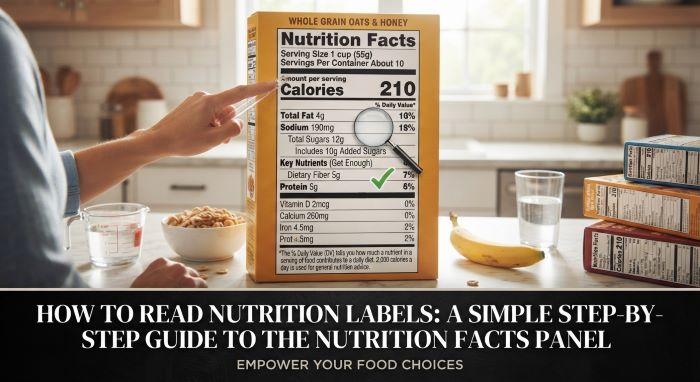
What Is the Nutrition Facts Label?
In the United States, the Food and Drug Administration requires a Nutrition Facts label on most packaged foods and drinks. The label was redesigned in 2016. The current version uses larger type for calories, lists added sugars, and updates serving sizes to reflect what people really eat.
Fresh produce, raw meat, and foods from small businesses may not carry a label. Restaurant chains must post calories on menus.
The Five-Step Method
- Check the serving size and servings per container.
- Look at the calories.
- Use the percent Daily Value as your guide.
- Limit saturated fat, sodium, and added sugars.
- Get enough fiber, vitamin D, calcium, iron, and potassium.
Then read the ingredient list. The sections below explain each step.
Step 1: Start With the Serving Size
Everything on the label is based on one serving. The serving size appears at the top, in a familiar unit such as cups or pieces, followed by grams.
Two points matter.
- Serving size is not a recommendation. It reflects the amount people typically eat, not how much you should eat.
- Check servings per container. A bottle or bag that looks like one portion may hold two or three.
If you eat two servings, you get double the calories and double every nutrient. Some packages show two columns: one for a single serving and one for the whole package. This makes the math easy.
Step 2: Check the Calories
Calories measure the energy in a serving. The number is printed in large, bold type.
The label uses 2,000 calories a day as a general guide. Your needs may be higher or lower, based on age, sex, size, and activity.
As a rough guide for a single serving:
- About 100 calories is moderate
- About 400 calories or more is high
Calories alone do not tell you whether a food is nourishing. A handful of nuts has more calories than a handful of candy, but it also brings protein, fiber, and healthy fats.
Step 3: Use the Percent Daily Value
The percent Daily Value, shown as %DV, tells you how much one serving contributes to a day’s total for each nutrient.
The FDA offers a simple rule.
- 5 percent DV or less is low.
- 20 percent DV or more is high.
Aim low for nutrients you want to limit and high for nutrients you want more of. This rule is the fastest way to learn how to read nutrition labels properly, since you do not need to remember any gram amounts.
Daily Values at a Glance
| Nutrient | Daily Value | Goal |
|---|---|---|
| Total fat | 78 g | Stay within |
| Saturated fat | 20 g | Less than |
| Cholesterol | 300 mg | Less than |
| Sodium | 2,300 mg | Less than |
| Total carbohydrate | 275 g | Stay within |
| Dietary fiber | 28 g | At least |
| Added sugars | 50 g | Less than |
| Protein | 50 g | At least |
| Vitamin D | 20 mcg | At least |
| Calcium | 1,300 mg | At least |
| Iron | 18 mg | At least |
| Potassium | 4,700 mg | At least |
These values are based on a 2,000-calorie diet for adults and children aged four and older.
Step 4: Nutrients to Limit
Saturated Fat
Saturated fat is found in fatty meats, butter, cheese, and many baked goods. Diets high in saturated fat are linked with higher LDL cholesterol. Compare products and choose the lower percent Daily Value.
Trans Fat
Trans fat has no Daily Value, since experts advise eating as little as possible. A label can list 0 grams if a serving has less than 0.5 grams. Check the ingredient list for “partially hydrogenated oil,” which signals trans fat. Most of it has been removed from the food supply in recent years.
Sodium
Most sodium in the diet comes from packaged and restaurant foods, not the salt shaker. Soups, breads, deli meats, sauces, and snacks are common sources. A serving with 20 percent DV or more is high.
Added Sugars
The label lists total sugars and, below that, added sugars. Total sugars include natural sugars in milk and fruit. Added sugars are those put in during processing, such as table sugar, syrups, and honey.
Dietary guidelines advise keeping added sugars below 10 percent of daily calories, which is the 50 gram Daily Value. Sweet drinks, desserts, flavored yogurt, and cereal add up fast.
Step 5: Nutrients to Get More Of
- Dietary fiber supports digestion and helps you feel full. Whole grains, beans, fruit, and vegetables provide it.
- Vitamin D and calcium support bone health.
- Iron helps carry oxygen in the blood.
- Potassium helps balance sodium and supports blood pressure.
Many Americans fall short on these four vitamins and minerals, which is why they are required on the label.
Understanding the Other Lines
Total fat includes all fats. Unsaturated fats from nuts, seeds, fish, and plant oils are part of a healthy diet, so a higher number here is not always bad.
Total carbohydrate includes starch, fiber, and sugars. Look at the fiber and added sugar lines beneath it to judge quality.
Protein usually has no percent Daily Value listed. Most adults in the United States get enough.
Cholesterol is found only in animal foods.
How to Read the Ingredient List
The ingredient list sits below or beside the Nutrition Facts panel.
- Ingredients are listed by weight, from most to least. The first three make up most of the food.
- A shorter list is not always better, but it is easier to understand.
- Look for whole foods near the top, such as “whole wheat,” “oats,” or “beans.”
- Watch for many forms of sugar. Splitting sugar into several types can move each one lower on the list.
Common Names for Added Sugar
| Syrups | Sugars | Other |
|---|---|---|
| High fructose corn syrup | Cane sugar | Honey |
| Corn syrup | Brown sugar | Agave nectar |
| Brown rice syrup | Coconut sugar | Molasses |
| Maple syrup | Dextrose | Fruit juice concentrate |
| Malt syrup | Sucrose, glucose, fructose, maltose | Evaporated cane juice |
Words that end in “ose” are usually sugars.
Allergens
United States law requires labels to declare nine major allergens: milk, eggs, fish, shellfish, tree nuts, peanuts, wheat, soybeans, and sesame. They appear in the ingredient list or in a “Contains” statement. Phrases such as “may contain” are voluntary and are not regulated in the same way.
What Front-of-Package Claims Really Mean
Many claims have legal definitions.
| Claim | What It Means per Serving |
|---|---|
| Calorie free | Fewer than 5 calories |
| Low calorie | 40 calories or fewer |
| Fat free | Less than 0.5 g of fat |
| Low fat | 3 g of fat or less |
| Sugar free | Less than 0.5 g of sugars |
| No added sugars | No sugars added in processing, though natural sugars may be present |
| Low sodium | 140 mg or less |
| Reduced | At least 25 percent less than the regular product |
| Good source of | 10 to 19 percent of the Daily Value |
| High in, or excellent source of | 20 percent or more of the Daily Value |
Other words carry less weight.
- “Natural” has no strict definition for most foods.
- “Multigrain” means more than one grain. It does not mean whole grain.
- “Made with real fruit” can mean a small amount.
- “Lightly sweetened” has no legal meaning.
- “Organic” refers to how food is grown and processed. It says nothing about calories or sugar.
A “reduced” product can still be high. Reduced-sodium soy sauce still has a great deal of sodium. Always check the panel.
How to Compare Two Products
- Make sure the serving sizes match. If they differ, adjust the numbers.
- Compare calories.
- Compare the percent Daily Value for saturated fat, sodium, and added sugars. Lower is better.
- Compare fiber and protein. Higher is usually better.
- Scan the first three ingredients.
Example: Cereal A has 12 grams of added sugar and 2 grams of fiber per cup. Cereal B has 4 grams of added sugar and 6 grams of fiber per cup. Cereal B is the stronger pick for most people.
Reading Labels for Specific Goals
| Goal | Focus On |
|---|---|
| Weight management | Serving size, calories, fiber, and protein |
| Heart health | Saturated fat, trans fat, and sodium |
| Blood sugar control | Total carbohydrate, fiber, and added sugars |
| Blood pressure | Sodium and potassium |
| Bone health | Calcium and vitamin D |
| Muscle building | Protein and calories |
| Food allergies | Ingredient list and “Contains” statement |
| Children’s snacks | Added sugars, sodium, and portion size |
People with diabetes, kidney disease, or other conditions should follow the targets set by their care team.
Common Mistakes
- Ignoring the serving size
- Looking only at calories
- Trusting claims on the front of the package
- Assuming “fat free” means healthy, when sugar may be added
- Forgetting drinks, which can hold a meal’s worth of sugar
- Confusing total sugars with added sugars
- Reading “0 g trans fat” as “none” without checking ingredients
- Comparing products with different serving sizes
Avoiding these errors is most of what it takes to learn how to read nutrition labels correctly.
Tips for Faster Shopping
- Decide what matters most to you, such as sodium or added sugar, and check that line first.
- Use the 5 and 20 rule.
- Compare two or three similar products, not the whole shelf.
- Read the label on foods you buy every week. Small changes there add up.
- Take a photo of a label to compare at home.
- Remember that whole foods without labels, such as vegetables, fruit, beans, and plain grains, are a strong base for any diet.
Labels Outside the United States
Other countries use different formats. In the United Kingdom and the European Union, nutrients are listed per 100 grams or 100 milliliters, which makes direct comparison easy. Many European packages also carry color codes on the front: green for low, amber for medium, and red for high. Canada’s table is close to the American one. The same core skill applies everywhere: check the portion, then the numbers.
A Worked Example
Picture a bag of crackers. The label lists a serving size of 6 crackers, 4 servings per container, 140 calories, 6 grams of total fat, 250 milligrams of sodium at 11 percent of the Daily Value, 2 grams of added sugars, and 1 gram of fiber.
If you eat half the bag, you have had 2 servings. That means 280 calories, 12 grams of fat, 500 milligrams of sodium, and 22 percent of your daily sodium limit. The label did not hide anything. You only needed to do the multiplication. Working through one real package like this is the fastest way to learn how to read nutrition labels correctly, and it takes less than a minute.
Frequently Asked Questions
What should I look at first? The serving size and the number of servings in the package.
What does percent Daily Value mean? It shows how much one serving adds to a day’s total, based on 2,000 calories.
What is the 5 and 20 rule? Five percent DV or less is low. Twenty percent or more is high.
What is the difference between total sugars and added sugars? Total sugars include natural sugars. Added sugars are put in during processing.
How much sodium is too much? The Daily Value is less than 2,300 milligrams a day.
Are the ingredients listed in order? Yes, from the largest amount by weight to the smallest.
Is there a quick way to learn how to read nutrition labels properly? Use the five steps: serving size, calories, percent Daily Value, nutrients to limit, and nutrients to get more of.
Why is there no percent Daily Value for trans fat or total sugars? No daily amount has been set for them.
Do I need to count every number? No. Focus on the few lines that matter for your goals.
Final Thoughts
Learning how to read nutrition labels gives you a clear view of what is in your food. Start with the serving size. Check the calories. Use the percent Daily Value to spot what is high and what is low. Keep saturated fat, sodium, and added sugars down, and look for fiber and key vitamins and minerals. Then read the ingredient list.
You do not need to study every package. Pick the foods you buy most, compare a few options, and make one better choice at a time. With practice, you will know how to read nutrition labels correctly in a few seconds, and you will rely on facts, not on the claims printed on the front of the box. Sharing how to read nutrition labels properly with your family is a good next step.
Key Takeaways
- Always start with the serving size, since every number on the label depends on it.
- The key to how to read nutrition labels is the 5 and 20 rule: 5 percent Daily Value or less is low, and 20 percent or more is high.
- Limit saturated fat, sodium, and added sugars.
- Look for more fiber, vitamin D, calcium, iron, and potassium.
- Added sugars are listed separately from natural sugars, and the Daily Value is 50 grams.
- Ingredients are listed by weight, so the first few make up most of the product.
- Front-of-package claims can mislead, so trust the Nutrition Facts panel and the ingredient list.