
When Did Women Get the Right to Vote in America
Ask most people when American women won the vote, and they will say 1920. That answer is correct, but it leaves out most of the story. The fight took more than 70 years. Some women voted long before 1920, and millions of others could not vote until decades after. So when did women get the right to vote in America? The short answer is August 18, 1920, when the 19th Amendment was ratified. The full answer covers a longer and more complicated history.
This guide gives the key dates, explains how the amendment passed, introduces the leaders of the movement, and looks at the women who had to keep fighting after 1920.
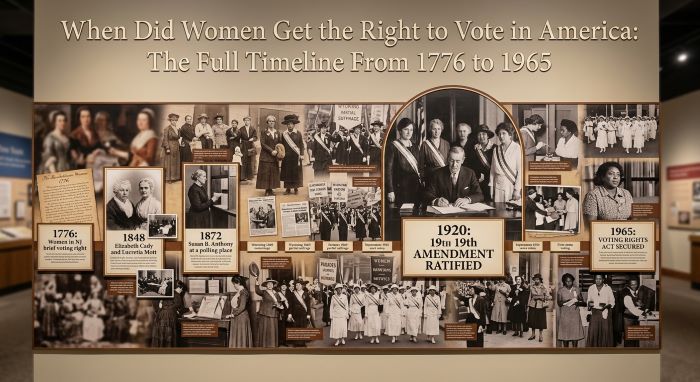
The Short Answer
| Event | Date |
|---|---|
| Congress passed the amendment (House) | May 21, 1919 |
| Congress passed the amendment (Senate) | June 4, 1919 |
| Tennessee became the 36th state to ratify | August 18, 1920 |
| The amendment was certified | August 26, 1920 |
| First presidential election with women voting nationwide | November 2, 1920 |
The amendment’s text is brief:
“The right of citizens of the United States to vote shall not be denied or abridged by the United States or by any State on account of sex. Congress shall have power to enforce this article by appropriate legislation.”
August 26 is now marked each year as Women’s Equality Day.
Before the Movement: Women Who Voted Early
Anyone who asks when did women get the right to vote in America should start before the movement itself. The Constitution of 1787 did not define who could vote. It left that to the states, and nearly all of them limited the vote to white men who owned property.
There was one exception. New Jersey’s constitution of 1776 gave the vote to “all inhabitants” who met a property requirement. Unmarried women and widows who owned property could and did vote there. In 1807, the state legislature limited voting to white men, and that early opening closed.
1848: The Seneca Falls Convention
The organized movement for women’s suffrage began in July 1848 in Seneca Falls, New York. Elizabeth Cady Stanton and Lucretia Mott, who had met through the campaign against slavery, called the first women’s rights convention. About 300 people attended.
Stanton drafted the Declaration of Sentiments, modeled on the Declaration of Independence. It stated that “all men and women are created equal.” It listed grievances and resolutions. The demand for the vote was the most disputed of them. It passed narrowly, with support from Frederick Douglass, the abolitionist leader and former slave.
1850s to 1870: Allies, War, and a Split
Through the 1850s, women’s rights conventions met almost every year. Susan B. Anthony joined Stanton in 1851, and the two formed a partnership that lasted half a century. Sojourner Truth, a formerly enslaved woman, gave her famous speech on women’s rights in Ohio in 1851.
The Civil War paused the campaign. Afterward, the country debated the rights of freed slaves. The 14th Amendment, ratified in 1868, used the word “male” in the Constitution for the first time. The 15th Amendment, ratified in 1870, barred denying the vote on account of race but did not mention sex.
The movement split over whether to support the 15th Amendment.
- The National Woman Suffrage Association, led by Stanton and Anthony, opposed it unless it included women and pushed for a federal amendment.
- The American Woman Suffrage Association, led by Lucy Stone, Henry Blackwell, and Julia Ward Howe, supported it and worked state by state.
The two groups merged in 1890 as the National American Woman Suffrage Association.
The West Leads the Way
Western territories and states gave women the vote first.
| Year | Place | Milestone |
|---|---|---|
| 1869 | Wyoming Territory | First to grant women full voting rights |
| 1870 | Utah Territory | Granted the vote. Congress revoked it in 1887, and it was restored in 1896 |
| 1890 | Wyoming | Entered the Union as the first state with full voting rights for women |
| 1893 | Colorado | First state to adopt it by popular vote |
| 1896 | Utah and Idaho | Full voting rights |
| 1910 | Washington | Full voting rights |
| 1911 | California | Full voting rights |
| 1912 | Oregon, Kansas, Arizona | Full voting rights |
| 1914 | Montana, Nevada | Full voting rights |
| 1917 | New York | First eastern state with full voting rights |
| 1918 | Michigan, Oklahoma, South Dakota | Full voting rights |
These dates show why the question of when did women get the right to vote in America has more than one answer. By 1919, women had full voting rights in 15 states and partial rights, such as voting for president or in school elections, in many others. Jeannette Rankin of Montana became the first woman elected to Congress in 1916, four years before the national amendment.
Testing the Law in Court
In 1872, Susan B. Anthony voted in the presidential election in Rochester, New York. She argued that the 14th Amendment made her a citizen with the right to vote. She was arrested, tried, and fined 100 dollars, which she refused to pay.
In 1875, the Supreme Court ruled in Minor v. Happersett that citizenship did not give women the right to vote. That closed the legal route. From then on, the movement needed either state laws or a constitutional amendment.
A federal amendment was first introduced in Congress in 1878. Its wording stayed the same for 41 years until it passed.
1900 to 1917: New Leaders and New Tactics
A new generation took over after Stanton died in 1902 and Anthony in 1906.
- Carrie Chapman Catt led the National American Woman Suffrage Association. Her “Winning Plan” of 1916 combined state campaigns with pressure for a federal amendment.
- Alice Paul and Lucy Burns had worked with militant activists in Britain. They organized a huge parade in Washington on March 3, 1913, the day before Woodrow Wilson’s inauguration. Crowds attacked the marchers, and the news coverage won public sympathy.
- Ida B. Wells marched in that parade with the Illinois delegation after organizers asked Black women to walk at the back. She had founded the Alpha Suffrage Club in Chicago.
- Mary Church Terrell led the National Association of Colored Women and campaigned for the vote for decades.
In 1916, Paul formed the National Woman’s Party. In January 1917, its members began to picket the White House. They were known as the Silent Sentinels. They stood at the gates six days a week with banners that asked, “Mr. President, how long must women wait for liberty?”
After the United States entered World War I, police began to arrest the pickets for “obstructing traffic.” Many were sent to the Occoquan Workhouse in Virginia. They went on hunger strikes and were force-fed. On November 14, 1917, known as the “Night of Terror,” guards beat and abused dozens of the prisoners. Public outrage grew when the news came out.
1918 to 1920: Passing the 19th Amendment
Women’s work during the war strengthened the case. In January 1918, President Wilson announced his support for the amendment as a war measure. The House passed it. The Senate fell two votes short.
After the 1918 elections, the new Congress acted. The House passed the amendment on May 21, 1919, and the Senate on June 4, 1919. It then needed approval from 36 of the 48 states.
Illinois, Wisconsin, and Michigan ratified within days. By the summer of 1920, 35 states had approved. Most southern states had rejected it. Tennessee became the deciding state.
The Tennessee House was closely divided. Harry T. Burn, a 24-year-old member, had been expected to vote no. That morning, he received a letter from his mother, Febb Burn, urging him to “be a good boy” and vote for ratification. He changed his vote, and the measure passed on August 18, 1920.
Secretary of State Bainbridge Colby certified the result on August 26, 1920. The 19th Amendment was now part of the Constitution. About 26 million women became eligible to vote, and more than 8 million voted in the presidential election on November 2, 1920.
Who Was Still Left Out After 1920
The amendment said that sex could not be used to deny the vote. It did not remove other barriers. Millions of women still could not vote.
Black women. In the South, poll taxes, literacy tests, white primaries, and violence kept most Black men and women from voting. That lasted until the civil rights movement. The 24th Amendment of 1964 banned poll taxes in federal elections. The Voting Rights Act of 1965 outlawed literacy tests and put federal oversight in place.
Native American women. Many Native Americans were not U.S. citizens in 1920. The Indian Citizenship Act of 1924 made them citizens, but states still set the rules for voting. Arizona and New Mexico barred Native Americans from voting until court rulings in 1948. Utah did so until 1957.
Asian American women. Immigrants from Asia were barred from becoming citizens under federal law. Chinese immigrants gained the right to naturalize in 1943. The McCarran-Walter Act of 1952 ended racial bars to citizenship for other Asian immigrants.
Latina women. In the Southwest, literacy tests and intimidation limited voting. The 1975 extension of the Voting Rights Act required voting materials in other languages in many areas.
Women in Puerto Rico. Literate women there won the vote in 1929. All women gained it in 1935.
So when did women get the right to vote in America in practice? For many American women, the real date of access to the ballot was 1924, 1948, 1952, or 1965.
Key Leaders of the Movement
| Leader | Known For |
|---|---|
| Elizabeth Cady Stanton | Organized Seneca Falls and wrote the Declaration of Sentiments |
| Lucretia Mott | Quaker minister and co-organizer of Seneca Falls |
| Susan B. Anthony | Lead organizer for 50 years. Arrested for voting in 1872 |
| Lucy Stone | Led the American Woman Suffrage Association |
| Sojourner Truth | Abolitionist and speaker for the rights of Black women |
| Frederick Douglass | Supported the vote for women at Seneca Falls |
| Carrie Chapman Catt | Designed the plan that won ratification. Founded the League of Women Voters |
| Alice Paul | Led the National Woman’s Party and the White House pickets |
| Ida B. Wells | Journalist and founder of the Alpha Suffrage Club |
| Mary Church Terrell | Leader of the National Association of Colored Women |
Neither Stanton nor Anthony lived to see the amendment pass. It was often called the “Susan B. Anthony Amendment” in her honor.
Why Did It Take So Long?
- Custom and law. Under the legal doctrine of coverture, a married woman’s legal identity was merged with her husband’s. Many people believed that men represented their families at the polls.
- Opposition from business. The liquor industry feared that women would vote for prohibition. Some factory owners feared that women would back labor laws.
- Regional politics. Many southern leaders opposed any federal role in voting rules, in part to protect laws that kept Black citizens from voting.
- Splits in the movement. Disagreements over race, tactics, and strategy slowed progress.
- Organized opponents. Anti-suffrage groups, some led by women, campaigned against the change.
- A high bar. A constitutional amendment needs two thirds of both houses of Congress and three fourths of the states.
How America Compares With Other Countries
| Country | Year Women Gained the National Vote |
|---|---|
| New Zealand | 1893 |
| Australia | 1902, with Aboriginal women excluded until 1962 |
| Finland | 1906 |
| Norway | 1913 |
| Canada | 1918, with exclusions by race |
| United Kingdom | 1918 for women over 30, and 1928 on equal terms |
| Germany | 1918 |
| United States | 1920 |
| France | 1944 |
| Switzerland | 1971 |
Looking abroad puts the question of when did women get the right to vote in America in context. For the wider story, including more countries and dates, see this guide: When Did Women Get the Right to Vote.
What Changed After 1920
- The National American Woman Suffrage Association became the League of Women Voters, which still educates voters today.
- Alice Paul drafted the Equal Rights Amendment in 1923. Congress passed it in 1972, but it was not ratified by enough states before its deadline, and its status remains disputed.
- Women’s turnout grew slowly. Since 1980, women have voted at higher rates than men in every presidential election.
- The number of women in office has risen from one member of Congress in 1917 to more than a quarter of Congress today.
- Mississippi was the last state to ratify the amendment, in 1984. Its vote was symbolic.
Frequently Asked Questions
When did women get the right to vote in America? On August 18, 1920, when the amendment was ratified. It was certified on August 26, 1920.
Which amendment gave women the vote? The 19th Amendment.
Which state was first? Wyoming Territory, in 1869. Wyoming kept the right when it became a state in 1890.
Which state cast the deciding vote? Tennessee, the 36th state to ratify.
Could all women vote in 1920? No. Many Black, Native American, Asian American, and Latina women faced barriers for decades.
Who led the movement for women’s suffrage? Elizabeth Cady Stanton, Susan B. Anthony, Lucy Stone, Carrie Chapman Catt, Alice Paul, Ida B. Wells, and many others.
How long did the fight take? About 72 years, counting from Seneca Falls in 1848.
Which president signed it? None. Presidents do not sign constitutional amendments. Woodrow Wilson supported it from 1918.
What is Women’s Equality Day? August 26, the anniversary of certification.
Final Thoughts
When did women get the right to vote in America? The landmark date is August 18, 1920, when Tennessee’s vote completed the ratification of the 19th Amendment. Behind that date lie 72 years of conventions, petitions, state campaigns, parades, pickets, and prison terms. The win came through the work of thousands of women, and of the men who stood with them.
The history of women’s suffrage does not end in 1920. Black women in the South, Native American women, and Asian American women waited years or decades more for the ballot. Knowing both parts of the story gives a truer picture of how the right to vote was won, and why it is worth using.
Key Takeaways
- When did women get the right to vote in America? The amendment was ratified on August 18, 1920, and certified on August 26, 1920.
- The organized movement began at the Seneca Falls Convention in 1848.
- Wyoming Territory granted women the vote in 1869, and 15 states had full voting rights for women before the national amendment.
- Tennessee cast the deciding vote after Harry Burn changed his position on his mother’s advice.
- Leaders included Elizabeth Cady Stanton, Susan B. Anthony, Carrie Chapman Catt, Alice Paul, and Ida B. Wells.
- Many Black, Native American, and Asian American women could not vote freely until 1924, 1948, 1952, or the Voting Rights Act of 1965.
- August 26 is marked each year as Women’s Equality Day.