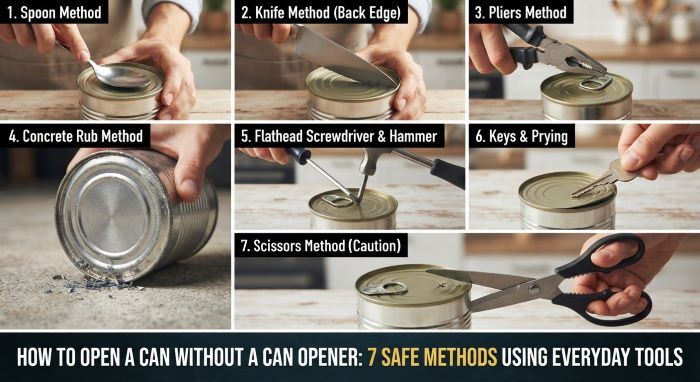
How to Open a Can Without a Can Opener: 7 Safe Methods Using Everyday Tools
It happens to almost everyone. You are at a campsite, in a new apartment, or in the middle of a power outage, and dinner is sealed inside a steel can. The can opener is missing or broken. Before you give up on the beans, know that people opened cans for decades before the modern opener existed. Learning how to open a can without a can opener takes a few minutes, and you likely have the tools within reach.
This guide covers seven methods, from a simple metal spoon to a flat rock. A comparison table ranks them by safety, speed, and effort. You will also find clear safety rules, a list of things you should never try, and tips for handling sharp lids.
How a Can Is Built
It helps to know what you are up against. A standard food can is a steel cylinder with a flat lid at each end. The lid is not welded on. It is folded over the edge of the can wall and crimped tight. That folded edge is the raised rim you feel at the top.
Just inside the rim, the lid is thin, often thinner than the can wall. Every method in this guide works in one of two ways. It either cuts through that thin metal next to the rim, or it wears the rim away until the seal lets go.
Safety First
Cut metal is sharp. A fresh can edge can slice skin as easily as a knife. Follow these rules with every method.
- Work on a firm, flat, non-slip surface at about waist height.
- Put a damp towel under the can so it cannot slide.
- Keep the hand that holds the can well away from the tool’s path.
- Never hold the can between your knees or against your body.
- Wear work gloves or wrap a towel around your holding hand if you can.
- Go slowly. Firm, controlled pressure beats force.
- Keep children and pets out of the way.
- Never put your fingers inside the can or along the cut edge.
- Check the food for metal bits before you eat.
If you have other food on hand and feel unsure, waiting until you can borrow or buy an opener is a fine choice.
Comparison Table: 7 Ways to Open a Can
| Method | Tool | Time | Effort | Risk Level | Best Situation |
|---|---|---|---|---|---|
| Spoon | Sturdy metal spoon | 2 to 5 minutes | Medium to high | Low | Home, the safest first choice |
| Concrete or flat rock | Rough flat surface | 2 to 4 minutes | Medium | Low to medium | Camping and outdoors |
| Chef’s knife heel | Heavy chef’s knife | 1 to 2 minutes | Medium | Medium to high | Kitchen, confident adults only |
| Pocket knife | Sturdy folding or fixed knife | 3 to 5 minutes | Medium | Medium to high | Camping |
| Multi-tool can opener | Swiss Army knife or multi-tool | 1 to 3 minutes | Low | Low | Anywhere you carry one |
| Flathead screwdriver and hammer | Screwdriver, hammer or mallet | 2 to 4 minutes | Medium | Medium | Garage or workshop |
| Pliers or tin snips | Needle-nose pliers, snips | 3 to 6 minutes | High | Medium | Workshop, last resort |
Method 1: Use a Metal Spoon
The spoon method is the safest because the tool has no blade. It works by rubbing the thin part of the lid until the metal wears through.
- Place the can on a stable surface. Hold it firmly with one hand, low on the can’s side.
- Grip a sturdy metal spoon in your fist, with the bowl facing in and the tip pointing down. Choke up so your hand is close to the bowl.
- Set the tip of the spoon in the groove just inside the rim.
- Rub the tip back and forth over a small spot, about half an inch long. Press down hard.
- After a minute or so, the metal will thin and the spoon will break through.
- Move the spoon along the groove and repeat, or push the spoon into the hole and work it around the edge like a lever, cutting as you go.
- When you have cut most of the way around, pry the lid up with the spoon. Do not use your fingers.
Use a strong spoon. A thin one will bend. This method takes effort, and your hand may tire, but it carries the least risk of a serious cut.
Method 2: Use Concrete or a Flat Rock
This method removes the rim itself. It is ideal outdoors, where rough surfaces are easy to find.
- Find a flat, rough surface. A concrete step, a paving stone, or a large flat rock works well. Brush off loose dirt.
- Turn the can upside down, so the lid you want to open faces the surface.
- Press down and rub the can back and forth, or in circles, with steady pressure.
- Check the rim every 20 seconds or so. Stop as soon as you see moisture on the stone or on the rim. That means the seal has broken.
- Turn the can upright. Wipe the rim clean with a cloth.
- Squeeze the sides of the can gently to pop the lid up, or slip a spoon or a blunt knife under the edge to lift it.
Do not grind too long, or liquid will leak out and grit may get in. Wipe the top well before you lift the lid, and check the food for bits of grit or metal.
Method 3: Use the Heel of a Chef’s Knife
This method is fast, but it uses a sharp blade and real force. Only adults who are comfortable with knives should try it. Use the heel of the blade, which is the back corner near the handle. Never use the tip, which can slip or snap.
- Set the can on a sturdy surface at waist height, on a damp towel.
- Hold the knife handle firmly, with the blade pointing away from you and the heel just inside the rim of the can.
- Keep your other hand flat on top of the handle or off the can entirely. Do not hold the can near the blade.
- Press straight down with firm, steady pressure until the heel punctures the lid. Do not stab or swing.
- Lift the knife, move it about half an inch along the rim, and puncture again.
- Repeat all the way around the lid.
- Slide the tip of a butter knife or spoon into one of the holes and pry the lid up.
This will dull your knife. Do not use a thin, flexible, or prized blade. A heavy, inexpensive chef’s knife is the right tool.
Method 4: Use a Pocket Knife
A pocket knife works much like the chef’s knife, with small punctures around the rim. A fixed blade or a locking blade is safer than a folding blade that can close on your fingers.
- Place the can on a stable surface.
- Hold the knife upright, with the tip resting just inside the rim.
- Tap the top of the handle with the palm of your other hand until the tip punches through. Light taps are enough.
- Pull the blade out and move over a short distance.
- Repeat around the whole lid.
- Pry the lid up with a spoon or the flat of the blade.
If the blade does not lock, do not use this method. A folding knife that closes under pressure causes deep cuts.
Method 5: Use the Can Opener on a Multi-Tool
Many Swiss Army knives and multi-tools include a small can opener. It is a short, hooked blade. If you carry one, this is the best option of all.
- Unfold the can opener blade.
- Hook the small lip under the rim of the can, with the sharp point resting on the lid.
- Push the handle to press the point through the lid.
- Rock the tool forward a short step and press again.
- Work around the lid until it is free.
Military P-38 and P-51 openers work the same way. They are tiny, cost very little, and fit on a key ring. One of these in a camping kit or emergency bag solves the problem for good.
Method 6: Use a Flathead Screwdriver and a Hammer
This is the workshop version of the knife method. A flathead screwdriver acts as a chisel.
- Clean the screwdriver tip well with soap and hot water.
- Set the can on a solid surface.
- Place the tip of the screwdriver just inside the rim, straight up and down.
- Tap the handle with a hammer, a mallet, or a block of wood until the tip breaks through.
- Move along the rim and repeat until you have a ring of holes.
- Pry the lid up with the screwdriver.
Keep your holding hand low on the can and away from the top. Tap gently. Hard blows can dent the can and spray its contents.
Method 7: Use Pliers or Tin Snips
This is a last resort, since it is slow and leaves jagged edges.
- Grip the rim of the can with needle-nose pliers.
- Twist and bend the rim back and forth until the metal tears.
- Peel a section of the rim away, then grip the next section.
- Work around until the lid lifts.
Tin snips or strong kitchen shears can cut the lid once you have made a starter hole with another method. Wear gloves. The edges will be very rough.
What About Pull-Tab Cans With a Broken Tab?
When a pull tab snaps off, the lid is already scored, which helps.
- Slide the tip of a spoon under the edge of the scored line and press down to break the seal, then lever the lid up.
- Use the spoon method along the scored groove. It breaks through faster than on a regular can.
- Turn the can over and use any method above on the plain bottom lid.
Methods You Should Never Try
Some ideas you see online are dangerous.
- Do not heat a sealed can. Pressure builds inside, and the can may burst and spray scalding food.
- Do not stab down with the tip of a knife. Tips slip and snap.
- Do not smash the can with a rock or hammer. You will crush the food and send metal flying.
- Do not use your teeth. You can break a tooth or cut your mouth.
- Do not use a power saw or grinder. It fills the food with metal dust.
- Do not shoot or throw the can. No explanation needed.
- Do not hold the can in your lap. A slip sends the tool into your leg.
How to Handle the Opened Can
- Lift the lid with a tool, not your fingers.
- Pour the food into a bowl or pot right away.
- Look closely for metal slivers or grit. Remove any that you see. If you find many, throw the food out.
- Do not drink or eat straight from a can with a rough edge.
- Wrap the lid and the can in paper or put the lid inside the can and crush the top shut before you throw it away, so no one gets cut.
- Wash your hands and tools.
Check the Can Before You Open It
No method is worth it if the food inside is unsafe. Do not open or eat from a can that shows these signs.
- A bulging or swollen lid or side
- Leaks or dried food on the outside
- Deep dents, most of all on the seam or rim
- Heavy rust
- Liquid that spurts out under pressure when opened
- A foul smell, cloudy liquid, or mold
These can be signs of spoilage, including the bacteria that cause botulism. When in doubt, throw it out. Do not taste food to test it.
If You Cut Yourself
- Rinse the cut under clean running water.
- Press a clean cloth on it until the bleeding stops.
- Cover it with a clean bandage.
Seek medical care if the cut is deep, will not stop bleeding after about 10 minutes of pressure, gapes open, or has metal in it. Ask a doctor about a tetanus shot if yours is not up to date.
Which Method Should You Choose?
- At home: Start with the spoon. It is slow but safe.
- At a campsite: Use a multi-tool opener if you have one. If not, use a flat rock or concrete.
- In a workshop: Use the screwdriver and hammer.
- In a hurry, with knife skills: The heel of a chef’s knife is the quickest.
- With children nearby: Use the spoon or the stone method only.
The best answer to how to open a can without a can opener is the method that matches your tools and your comfort level. Speed matters far less than keeping all your fingers intact.
How to Avoid This Problem Next Time
A little planning means you will not need to recall how to open a can without a can opener at the worst moment.
- Keep a spare manual opener in a kitchen drawer.
- Put a P-38 opener on your key ring.
- Pack a multi-tool in your camping gear and your car.
- Add a manual opener to your emergency kit. Electric openers do not work in a power outage.
- Buy pull-tab cans for trips and emergency supplies.
- Replace a dull or rusty opener before it fails.
A Short History of the Problem
Canned food came first, and the opener came much later. Early cans in the 1810s were thick iron, and labels told people to cut around the top with a chisel and hammer. Dedicated can openers did not appear until the 1850s, and the familiar rotating wheel design followed later still. In other words, people spent decades working out how to open a can without a can opener because they had no other choice.
Frequently Asked Questions
What is the easiest way to open a can with no opener? The spoon method is the easiest safe way at home. Outdoors, rubbing the can on concrete works well.
Can you really open a can with a spoon? Yes. A sturdy metal spoon wears through the thin metal just inside the rim in a minute or two.
Is it safe to open a can with a knife? It carries real risk. Use the heel of a heavy knife, press straight down, and keep your other hand clear. Choose the spoon if you are unsure.
How do you open a can while camping? Use the opener on a multi-tool, or rub the can upside down on a flat rock until the seal breaks.
Will these methods leave metal in the food? They can. Always check and remove any bits before you eat.
Can I open a can with scissors? Strong kitchen shears can punch and cut a lid, but they may break or slip. Other methods are safer.
Can I boil the can to pop it open? No. Never heat a sealed can.
How long does it take? Most methods take two to five minutes.
What is the safest lesson on how to open a can without a can opener for kids? Children should not do this. An adult should use the spoon or stone method.
Final Thoughts
Now you know how to open a can without a can opener in seven ways. A metal spoon is the safest choice at home. A rough stone works anywhere outdoors. A knife or a screwdriver is faster but calls for more care. A small multi-tool or key ring opener is best of all.
Whatever you pick, set the can on a firm surface, keep your free hand out of the way, and never touch the cut edge. Check the food for metal, and toss any can that bulges, leaks, or smells off. Then put a spare opener in your drawer and your camping bag. Knowing how to open a can without a can opener is a useful skill, and the best outcome is that you rarely need it.
Key Takeaways
- The safest way to learn how to open a can without a can opener is the spoon method, which wears through the thin metal inside the rim.
- Outdoors, rub the can upside down on concrete or a flat rock until the seal breaks.
- Knife methods are faster but risky. Use the heel of a heavy knife, never the tip.
- A multi-tool or a P-38 key ring opener is the best backup to carry.
- Never heat a sealed can, smash it, or hold it in your lap.
- Lift the lid with a tool, check the food for metal, and wrap sharp edges before disposal.
- Do not eat from cans that bulge, leak, or smell bad.