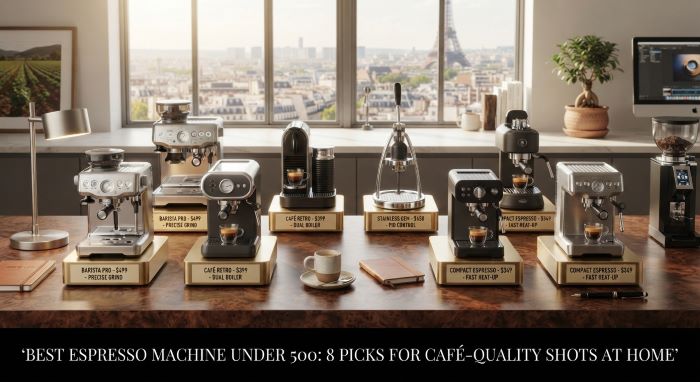
Best Espresso Machine Under 500: 8 Picks for Café-Quality Shots at Home
A daily café habit adds up fast. Five dollars a latte, five days a week, and you have spent well over a thousand dollars a year on coffee you could make yourself. The good news is you do not need a two-thousand-dollar machine to pull a genuinely good shot at home. Under 500 dollars, you can get a machine that heats in seconds, steams silky milk, and rewards you with rich, balanced espresso once you dial it in. This guide covers the best espresso machine under 500 dollars for different kinds of home baristas, plus what to look for and the extras you will need.
What to look for in a budget espresso machine
Before the list, it helps to know which features actually matter at this price. Here is what separates a great budget machine from a frustrating one.
- Heating system: Thermoblock and ThermoJet systems heat in seconds, while traditional boilers take several minutes but hold steadier temperature.
- Portafilter size: A 58mm commercial-size portafilter gives you more accessory options and more even extraction than smaller 51mm or 54mm baskets.
- Temperature control: PID control keeps water temperature stable, which makes shots more consistent.
- Steam wand: A manual wand gives you full control for latte art, while an automatic wand does the work for you.
- Pressurized versus non-pressurized baskets: Pressurized baskets forgive a poor grind, while non-pressurized ones reward good technique with better flavor.
- Build quality: Metal housings and brass or steel components last longer than all-plastic builds.
Keep these in mind as you read, since the best espresso machine under 500 dollars for you depends on whether you value speed, control, or simplicity most.
The 8 best espresso machines under 500 dollars
Prices below are approximate and shift with sales, so check current listings before you buy.
1. Breville Bambino Plus (about 400 to 500 dollars)
The Bambino Plus is the most popular pick in this range for good reason. Its ThermoJet heating system reaches brewing temperature in about three seconds, so you go from cold machine to espresso almost instantly. It has digital temperature control, low-pressure pre-infusion that gently soaks the coffee before full pressure hits, and an automatic steam wand that textures milk to your chosen temperature and foam level with no skill required.
It uses a 54mm portafilter and comes with both single and double baskets. The compact footprint fits small kitchens easily.
Pros: Near-instant heat-up, hands-free milk frothing, consistent shots, small size.
Cons: Small water tank, 54mm portafilter limits some accessories, mostly plastic in places.
Best for: Latte and cappuccino lovers who want great milk drinks with minimal effort. For most people, this is the best espresso machine under 500 dollars.
2. Gaggia Classic Pro (about 450 to 500 dollars)
The Gaggia Classic Pro is the enthusiast’s choice. Made in Italy with a sturdy brushed steel body, it uses a commercial-style 58mm chrome-plated brass portafilter and group head, the same size you find in cafés. It has a traditional single boiler and a manual commercial steam wand that can produce excellent microfoam once you learn it.
It takes longer to heat than the Breville, and you have to wait between brewing and steaming. But it has a huge modding community, with upgrades like PID kits and pressure adjustments that can turn it into a near-prosumer machine over time.
Pros: Durable metal build, 58mm commercial portafilter, excellent manual steam wand, highly upgradeable.
Cons: Several minutes to heat, steep learning curve, temperature can drift without a PID mod.
Best for: Hobbyists who want to learn real espresso technique and upgrade their machine over the years.
3. Breville Bambino (about 300 to 350 dollars)
The standard Bambino is the Bambino Plus with a few conveniences removed. You still get the three-second ThermoJet heat-up, PID temperature control, and pre-infusion, but the steam wand is manual rather than automatic, and there is no drip tray auto-sensing. That makes it cheaper while keeping the core shot quality.
For people who mostly drink straight espresso or Americanos, or who want to learn milk steaming by hand, it is a smart way to save money.
Pros: Fast heat-up, same shot quality as the Plus, lower price, compact.
Cons: Manual wand takes practice, small tank, 54mm portafilter.
Best for: Straight espresso drinkers and budget buyers who still want Breville’s speed.
4. De’Longhi Dedica EC685 (about 200 to 250 dollars)
The Dedica is famous for being slim. At about six inches wide, it slips into the tightest counter space. It heats quickly with a thermoblock, includes a manual steam wand with a panarello tip that makes frothing easier for beginners, and comes with pressurized baskets that forgive an imperfect grind.
It will not match the Gaggia or Bambino for shot quality at the top end, but it produces solid espresso and good milk drinks for a very reasonable price.
Pros: Very narrow footprint, fast heat, easy frothing, affordable.
Cons: Small portafilter, plastic build, limited control for advanced users.
Best for: Small kitchens, apartments, and beginners on a budget.
5. De’Longhi Stilosa EC260 (about 100 to 150 dollars)
If you want to try espresso at home without spending much, the Stilosa is the entry ticket. It uses a stainless steel boiler, a 15-bar pump, and a manual steam wand. The included pressurized baskets make it forgiving, so even pre-ground coffee produces a passable shot.
It is basic, and serious enthusiasts will outgrow it. But as a first machine or a budget gift, it delivers real espresso for very little money.
Pros: Very low price, simple to use, includes a steam wand.
Cons: Basic build, less consistent temperature, limited upgrade path.
Best for: First-time home baristas testing the waters.
6. Casabrews CM5418 (about 100 to 150 dollars)
Casabrews has become a popular budget brand online, and the CM5418 packs a lot into a low price: a 20-bar pump, a built-in pressure gauge, a manual steam wand, and a stainless finish that looks more expensive than it is. The pressure gauge helps beginners see what is happening during extraction.
Like other entry machines, it relies on pressurized baskets and is best treated as a starter. Still, the value is strong.
Pros: Low price, pressure gauge, steam wand, attractive look.
Cons: Lighter build, less precise temperature, not built for heavy daily use.
Best for: Budget buyers who want a pressure gauge and steam wand.
7. Flair Classic (about 170 to 200 dollars)
The Flair is something completely different: a manual lever espresso maker with no pump and no electricity. You heat water in a kettle, pour it into the brewing chamber, and press a lever to generate up to nine bars of pressure. The result, once you master it, can rival much more expensive machines.
It has no steam wand, so milk drinks require a separate frother. But for pure espresso lovers who enjoy the ritual, it offers exceptional shot quality for the money and a generous parts warranty.
Pros: Excellent shot potential, no electricity needed, portable, very durable.
Cons: No steam wand, slower workflow, hands-on process each time.
Best for: Espresso purists who enjoy a manual ritual and do not need milk drinks.
8. Breville Barista Express (about 500 to 600 dollars, often on sale near 500)
The Barista Express sits right at the edge of this budget, but frequent sales pull it close to 500 dollars. Its big advantage is a built-in conical burr grinder, which saves you from buying a separate one. It also has a 54mm portafilter, PID temperature control, pre-infusion, and a manual steam wand.
Because the grinder is included, it can be the most cost-effective all-in-one setup if you catch it on sale.
Pros: Built-in grinder, all-in-one convenience, solid shot quality.
Cons: Often priced above 500 dollars, grinder is less precise than a standalone unit, larger footprint.
Best for: Buyers who want one machine that grinds and brews, and who can wait for a sale.
Quick comparison table
| Machine | Approx. price | Heat-up | Portafilter | Steam wand | Best for |
|---|---|---|---|---|---|
| Breville Bambino Plus | 400 to 500 dollars | 3 seconds | 54mm | Automatic | Easy milk drinks |
| Gaggia Classic Pro | 450 to 500 dollars | Several minutes | 58mm | Manual, commercial | Enthusiasts |
| Breville Bambino | 300 to 350 dollars | 3 seconds | 54mm | Manual | Straight espresso |
| De’Longhi Dedica | 200 to 250 dollars | Fast | 51mm | Manual, panarello | Small kitchens |
| De’Longhi Stilosa | 100 to 150 dollars | Moderate | 51mm | Manual | First-timers |
| Casabrews CM5418 | 100 to 150 dollars | Fast | 51mm | Manual | Budget with gauge |
| Flair Classic | 170 to 200 dollars | Kettle | Manual lever | None | Espresso purists |
| Breville Barista Express | 500 to 600 dollars | Fast | 54mm | Manual | All-in-one with grinder |
Which type of machine fits your routine?
Before you buy, think honestly about how you drink coffee. Your habits point to the right machine faster than any spec sheet.
If you make one or two milk drinks every morning before work, speed and easy steaming matter most. A machine that heats in seconds and froths milk for you, like the Bambino Plus, saves real time on busy days. If you mostly drink straight espresso or Americanos, you can skip automatic frothing and put your money into shot quality instead, which makes the Gaggia Classic Pro or standard Bambino a better fit.
If you enjoy tinkering and learning, a machine with a 58mm portafilter and an upgrade path rewards that curiosity for years. If you want minimal effort and no extra purchases, an all-in-one with a grinder saves hassle. And if counter space is tight, measure first, since the slim Dedica fits spots where others will not.
Thinking this through keeps you from paying for features you will never use. The best espresso machine under 500 dollars is the one that fits your mornings, not the one with the longest feature list. Match the machine to your routine and you will actually use it every day, which is the whole point of buying one.
How long a budget machine lasts
A common worry is durability. With regular cleaning and descaling, a quality machine in this range can last five years or more. Metal-bodied machines like the Gaggia often run much longer, and many parts are replaceable. Budget models with more plastic may wear sooner, so factor in warranty length when you compare. Choosing the best espresso machine under 500 dollars with a solid warranty and available spare parts protects your investment.
Do not forget the grinder
Here is the truth most buyers learn the hard way: the grinder matters as much as the machine. Espresso needs a fine, consistent grind, and blade grinders or pre-ground coffee cannot deliver it for non-pressurized baskets. Unless you buy the Barista Express, plan to budget around 100 to 250 dollars for a burr grinder built for espresso.
A good pairing is to put most of your budget into the machine and a solid entry-level espresso grinder. Pair the best espresso machine under 500 dollars with a poor grinder and you will get sour, thin shots no matter how good the machine is.
Beans and caffeine: getting the most from every shot
Great equipment only shines with great coffee. Fresh, properly roasted beans make the biggest difference to flavor, and not every bean suits espresso. This guide to the Best Coffee Beans for Espresso is worth reading once your machine arrives, since the right roast brings out sweetness and body.
If you are curious how much of a kick your new habit carries, this breakdown of How Much Caffeine in a Shot of Espresso explains what is really in each shot, which helps if you are pulling doubles every morning. And once your shots are dialed in, try a classic Cuban-style pairing. A strong cafecito next to a flaky guava pastry is hard to beat, and this guide to the Best Pastelitos de Guayaba Near Me shows where to find the perfect companion for your coffee.
Tips for better espresso at home
Once you have the best espresso machine under 500 dollars on your counter, these habits improve every cup:
- Use fresh beans: Buy whole beans roasted within the last few weeks.
- Weigh your dose: A small digital scale helps you use the same amount every time, usually 16 to 18 grams for a double.
- Time your shot: Aim for roughly 25 to 30 seconds for a standard double shot.
- Tamp evenly: Press firmly and level so water flows evenly through the coffee.
- Preheat everything: Run hot water through the portafilter and cup before brewing.
- Clean regularly: Backflush, wipe the steam wand after each use, and descale on schedule.
Small adjustments to grind size make the biggest difference. If your shot runs too fast and tastes sour, grind finer. If it runs too slow and tastes bitter, grind coarser.
Common mistakes to avoid
Budget buyers often trip over the same issues. Avoid these when choosing and using the best espresso machine under 500 dollars:
- Skipping the grinder budget. The machine cannot fix a bad grind.
- Chasing bar numbers. A “20-bar” label is marketing. Good espresso brews at around 9 bars at the puck.
- Ignoring size. Measure your counter and cabinet height before you buy.
- Neglecting cleaning. Old coffee oils make shots bitter and shorten machine life.
- Expecting instant perfection. Dialing in takes a few days of practice. Stick with it.
The bottom line
You do not need to spend thousands for café-quality coffee at home. The best espresso machine under 500 dollars for most people is the Breville Bambino Plus, thanks to its instant heat-up and hands-free milk frothing. Enthusiasts who want to learn and upgrade should choose the Gaggia Classic Pro. Budget buyers can start with the Bambino, Dedica, Stilosa, or Casabrews, while purists will love the manual Flair. If you want a grinder built in, watch for a sale on the Barista Express. Pair your machine with a good grinder and fresh beans, practice a little, and your morning coffee will soon beat most cafés.
Key Takeaways
- The Breville Bambino Plus is the best overall pick under 500 dollars, with a three-second heat-up and an automatic steam wand for easy milk drinks.
- The Gaggia Classic Pro suits enthusiasts, offering a 58mm commercial portafilter, a metal build, and a large upgrade community.
- Budget options include the Breville Bambino, De’Longhi Dedica, De’Longhi Stilosa, and Casabrews CM5418, all solid starter machines.
- The Flair Classic is a manual lever maker with excellent shot quality for purists, but it has no steam wand.
- The Breville Barista Express includes a built-in grinder and often drops close to 500 dollars on sale.
- Budget 100 to 250 dollars for a proper burr grinder, since grind quality matters as much as the machine.
- Use fresh beans, weigh your dose, aim for a 25 to 30 second shot, and clean the machine regularly for the best results.