Estwing 20 oz Bricklayer Hammer E3-20BLC: A Mason’s Workhorse Reviewed
A good masonry hammer does two jobs at once: it strikes clean and it splits precisely. Cheap hammers fail at both, loosening at the head and beating up your hand with every swing. The Estwing 20 oz bricklayer hammer E3-20BLC solves those problems with a design that has barely changed in decades because it simply works. If you lay brick, set stone, or crack rocks, this tool belongs in your bag. Here is a close look at what makes it a favorite.
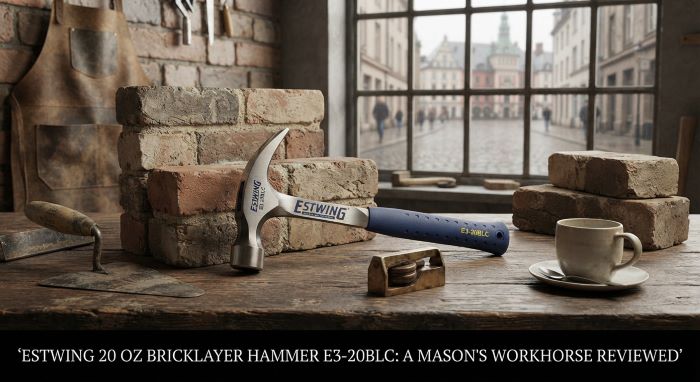
One-piece forged steel
The biggest selling point is the construction. The Estwing 20 oz bricklayer hammer E3-20BLC is forged from a single piece of solid American steel, head and handle together. There is no joint where the head meets the handle, which is exactly where wooden and cheaper hammers eventually fail. That one-piece design means the head will never fly off or work loose, no matter how many blows you land.
The whole tool is also double tempered for added strength and fully polished for a clean finish. This is the same building philosophy Estwing has used for generations, and it is the main reason these hammers last for decades and often get handed down.
The chisel edge and striking face
A bricklayer’s hammer is not a general-purpose hammer, and its shape tells you why. The Estwing 20 oz bricklayer hammer E3-20BLC pairs a flat, smooth striking face on one end with a sharp chisel edge on the other. You use the face to set and tap bricks or blocks into place, then flip the tool and use the chisel edge to score and split them cleanly.
The striking face is a bit wider than on some older models, which helps you land accurate hits at the worksite. The chisel edge is where the precision lives. Score a line across a brick, give it a firm tap, and it breaks along the line. For masons, that combination of set-and-split in one tool is the whole point.
Comfort and the shock reduction grip
Swinging any steel hammer all day can punish your hand and wrist. Estwing addresses this with its bonded and molded Shock Reduction Grip, the familiar blue cushioned handle. The Estwing 20 oz bricklayer hammer E3-20BLC uses this grip to soak up much of the vibration that travels up the handle on each strike, which cuts fatigue over a long shift.
The grip is molded directly onto the steel, not slipped on, so it will not spin or peel away. Estwing also added a patented nylon end cap that improves durability at the base of the handle, a spot that takes plenty of abuse. Together these details make the tool comfortable enough for full days of work.
Size and weight
The specs are simple and practical. The Estwing 20 oz bricklayer hammer E3-20BLC has a 20-ounce head and an overall length of 11.25 inches. That weight sits in a sweet spot for masonry: heavy enough to break brick and block with authority, but light enough to control for precise, repeated strikes.
| Specification | Detail |
|---|---|
| Head weight | 20 oz |
| Overall length | 11.25 inches |
| Material | Solid American steel, one-piece forged |
| Face | Smooth striking face |
| Edge | Chisel edge |
| Grip | Bonded Shock Reduction Grip with nylon end cap |
| Origin | Made in USA |
What you can use it for
While it is built for brick and block, this hammer earns its keep across several trades and hobbies. Common uses for the Estwing 20 oz bricklayer hammer E3-20BLC include:
- Setting and leveling bricks, pavers, and concrete blocks
- Scoring and splitting brick or stone along a clean line
- Chipping away excess mortar
- Light demolition of masonry
- Rock and mineral collecting, where the chisel edge splits soft or sedimentary rock
That last use is worth noting. Rockhounds and geology students often reach for this exact model because the chisel edge is ideal for prying apart layered stone, and the balance makes it easy to carry in the field.
Strengths and trade-offs
No tool is perfect for everyone, so here is the honest picture. The strengths of the Estwing 20 oz bricklayer hammer E3-20BLC are obvious: near-indestructible one-piece build, a comfortable grip that fights vibration, a versatile face-and-chisel design, and a made-in-USA reputation that has held up for generations.
The trade-offs are minor. Solid steel transmits more vibration than a fiberglass or wood handle even with the shock grip, so on very heavy, all-day demolition some people prefer a different handle material. The chisel edge also needs occasional sharpening to stay effective. And because it is a specialized masonry tool, it is not the hammer you grab for driving nails. None of these are dealbreakers for the job it is made to do.
Is it worth it
For the price, usually somewhere around thirty to thirty-five dollars, this hammer is easy to recommend. You are buying a tool that will likely outlast every other hammer you own. The Estwing 20 oz bricklayer hammer E3-20BLC does not rely on gimmicks. It relies on solid forging, a smart shape, and a comfortable grip, and it delivers all three.
If you work with masonry or you split rock, this is a buy-it-once tool. Pair it with safety goggles, since striking brick and stone sends chips flying, and you will have a dependable companion for years of work.
The bottom line
The Estwing 20 oz bricklayer hammer E3-20BLC is a classic for good reason. Its one-piece steel construction means it will not fail at the head, the chisel edge makes clean splits, and the Shock Reduction Grip keeps your hand comfortable. It is specialized, so it will not replace a claw hammer, but for brick, block, and rock work it is one of the best values in the trade. Buy it, take care of the edge, and it will serve you for a very long time.
Key Takeaways
- The Estwing 20 oz bricklayer hammer E3-20BLC is forged from one piece of solid American steel, so the head can never loosen or fly off.
- It has a 20-ounce head and an 11.25-inch overall length, a balanced weight for breaking masonry while staying easy to control.
- A smooth striking face lets you set bricks, while the chisel edge scores and splits brick, block, and stone along clean lines.
- The bonded Shock Reduction Grip and patented nylon end cap reduce vibration and boost durability for all-day comfort.
- Beyond masonry, it is a popular rock and geology hammer because the chisel edge splits soft and sedimentary stone well.
- The main trade-offs are that steel transmits more vibration than fiberglass handles, the chisel edge needs occasional sharpening, and it is not made for driving nails.
- At roughly thirty to thirty-five dollars, it is a buy-it-once tool that should last for decades with basic care, and safety goggles are a must when using it.