
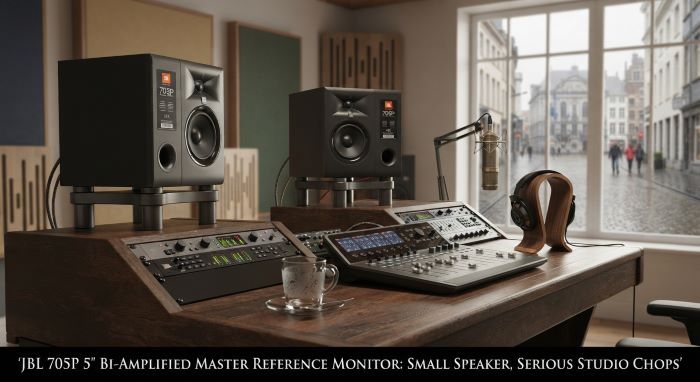
JBL 705P 5″ Bi-Amplified Master Reference Monitor: Small Speaker, Serious Studio Chops
Studio monitors live by one rule: tell the truth. A good one shows you exactly what is on the recording, flaws and all, so you can fix problems before they reach the listener. The JBL 705P 5″ bi-amplified master reference monitor was built for that job. It is compact enough for tight rooms yet loud and accurate enough for mastering, film post, and broadcast work. Here is a straight look at what it does and who it serves.
Reference monitor, not a hi-fi speaker
First, a quick distinction. A hi-fi speaker is tuned to sound pleasing. A reference monitor is tuned to sound honest. The JBL 705P 5″ bi-amplified master reference monitor sits firmly in the second camp. It aims for a flat, neutral response so mixing and mastering engineers hear the recording as it truly is. If you want a speaker that flatters everything you play, this is not it. If you want one that reveals every detail so you can make real decisions, it fits the brief.
The drivers and the waveguide
The technical story starts with two custom transducers. The 2409H high-frequency compression driver uses a low-mass annular diaphragm to deliver smooth response beyond 36 kHz with very low distortion. The 725G low-frequency transducer moves 14mm peak to peak, which lets a 5-inch woofer reach down below 39 Hz with real control. That reach is impressive for a monitor this size.
Tying them together is the JBL Image Control Waveguide, the same technology first seen in the flagship M2 and shared with the larger 708P. The waveguide creates a seamless handoff between the low and high drivers and widens the sweet spot. In practice, that means the JBL 705P 5″ bi-amplified master reference monitor holds its accuracy across a wider listening area and behaves well in a range of rooms, not just perfectly treated ones.
Power and output
This is a self-powered, or active, monitor, so the amplification lives inside the cabinet. The JBL 705P 5″ bi-amplified master reference monitor carries a dual amplification system with a 250-watt amp for the high-frequency driver and a 250-watt amp for the low-frequency driver. That is a lot of clean power for a compact box.
The payoff is headroom. It hits a maximum output above 101 dB SPL and can deliver two to three times the output of many comparable studio monitors its size. For engineers, that headroom means the speaker stays clean and composed during loud passages instead of straining. It also supports greater listening distances, which suits larger control rooms and post-production suites.
Inputs and rear-panel control
Connectivity is built for professional workflows. The JBL 705P 5″ bi-amplified master reference monitor gives you both analog and digital options:
- 1 x XLR to 1/4-inch balanced combination analog input
- 1 x XLR AES3 format digital input with a pass-through output
- Digital input that accepts sample rates up to 192 kHz
- Internal sample rate converters for uncommon digital signals
On the back you also get a small LCD and multi-function controls. These let you set input sensitivity and trim, apply Room EQ and User EQ, and dial in Room Delay and AV Sync Delay. There are factory presets plus user-defined slots, so you can tune the monitor to your space and save the setup. That level of onboard control is a real advantage when you move the speaker or change rooms.
Build and mounting
The cabinet uses reinforced birch plywood with protective steel grilles, and it includes top, bottom, and rear mounting points with a two-hole pattern. That flexibility matters in broadcast and post environments where speakers often go on stands, brackets, or soffit mounts rather than a desk. One thing to note: the JBL 705P 5″ bi-amplified master reference monitor is usually sold as a single unit, so a stereo pair means buying two.
Quick spec snapshot
| Feature | Detail |
|---|---|
| Type | 5″ active bi-amplified reference monitor |
| HF driver | 2409H compression driver, response beyond 36 kHz |
| LF driver | 725G, output below 39 Hz |
| Amplification | 250W high frequency + 250W low frequency |
| Max SPL | Above 101 dB SPL at 1 meter |
| Waveguide | JBL Image Control Waveguide |
| Inputs | XLR/TRS analog, XLR AES3 digital up to 192 kHz |
Who should buy it
This monitor targets professionals and serious project studios. Consider the JBL 705P 5″ bi-amplified master reference monitor if you:
- Mix, master, or edit and need an honest, neutral reference
- Work in film post or broadcast and want accuracy plus real output
- Have a small to mid-size room but still need headroom and low-end reach
- Value onboard EQ and delay controls to tune the speaker to your space
- Want JBL’s flagship waveguide technology in a compact footprint
It is overkill for casual listening and the wrong tool if you want a warm, forgiving sound. The price and precision only make sense when accuracy is the goal.
The bottom line
The JBL 705P 5″ bi-amplified master reference monitor packs flagship driver design, generous power, and pro-grade connectivity into a compact cabinet. It reaches lower and plays louder than its size suggests, and the Image Control Waveguide keeps it accurate across a wide sweet spot. For engineers who need the truth from a speaker that fits a real-world room, it is a compelling choice. Buy it for the work, not for easy listening, and it will earn its keep.
Key Takeaways
- The JBL 705P is a 5-inch active, bi-amplified studio reference monitor built for honest, neutral sound in mixing, mastering, film post, and broadcast work.
- It uses a 2409H high-frequency compression driver reaching beyond 36 kHz and a 725G low-frequency driver that reaches below 39 Hz, impressive for a 5-inch design.
- The JBL Image Control Waveguide, borrowed from the flagship M2, widens the sweet spot and keeps the monitor accurate across a range of rooms.
- A built-in 250W plus 250W dual amplification system delivers strong headroom, hitting above 101 dB SPL and supporting greater listening distances.
- Inputs include balanced XLR/TRS analog and XLR AES3 digital up to 192 kHz, with sample rate converters and rear-panel EQ, delay, and preset controls.
- The reinforced birch plywood cabinet has top, bottom, and rear mounting points, and the monitor is typically sold singly, so a stereo pair needs two units.
- It is a strong pick for professionals who need accuracy and output, and a poor fit for anyone seeking a warm, flattering casual listening speaker.