What I Learned About Modern Search After Using Semrush One
**This post is sponsored by Semrush. When you purchase through links in this article, we may earn an affiliate commission from Semrush.**
For a long time, I thought I had marketing figured out.
My routine was simple. Find a promising keyword, create something useful around it, optimize the page, publish it, and then watch the rankings. If the position improved, I felt like the work was paying off. If traffic followed, even better.
Then I noticed something that made me question the whole process.
Some of the content I was working on was getting impressions without producing the clicks I expected. At the same time, people were increasingly asking questions directly inside AI platforms instead of clicking through several pages of search results. I could see our rankings, but I could not easily tell whether our brand was showing up when those same questions were being answered by AI.
That was when I realized I had been measuring only one part of visibility.
Search had not disappeared. It had simply become bigger.
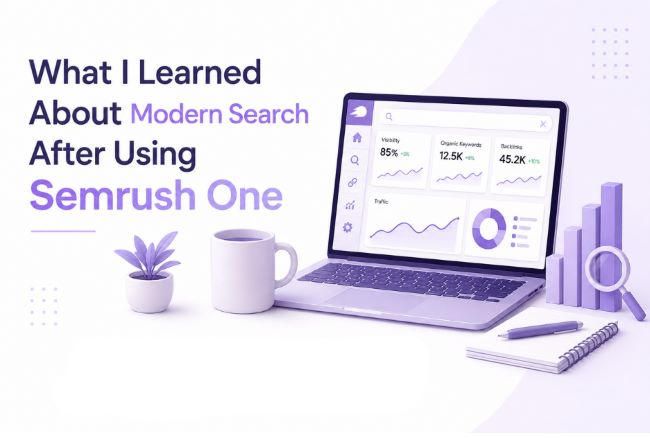
I Had Been Looking at Only Half the Picture
The change was easy to miss because traditional SEO still works. Keywords still matter. Technical problems can still prevent pages from ranking. Competitor research is still valuable. Backlinks still influence authority.
But there is now another layer to consider.
When someone asks ChatGPT, Gemini, Perplexity, or Google’s AI features for recommendations, they are not necessarily looking at the same list of links I have been monitoring. They are seeing an answer assembled from different sources, with certain brands and websites receiving attention while others disappear from the conversation.
That raised a question I had not been asking before: if my competitors are being mentioned in those answers and I am not, what am I missing?
I started looking for a way to connect the traditional data with this new kind of discovery instead of managing two completely separate workflows.
That is where Semrush One caught my attention.
Rather than treating AI search as an entirely different discipline, Semrush One brings SEO and AI visibility into the same subscription and workflow. It is designed to show how a brand performs across traditional search as well as AI driven discovery.
For me, the important part was not having another dashboard to check. It was having a better question to ask.
Instead of only asking, “Where do I rank?” I could start asking, “Where am I being discovered?”
The Data Started Making More Sense
The more I thought about it, the more I appreciated the difference between ranking and visibility.
With Semrush One, I could look at traditional SEO information alongside AI visibility data. Its AI Visibility Toolkit can track brand mentions, citations, prompts, competitors, and visibility across platforms such as Google AI, ChatGPT, Gemini, and Perplexity.
That made the process feel much more practical.
If a competitor appeared frequently in AI answers around a topic I cared about, that was something I could investigate. If an AI platform was repeatedly citing certain sources while overlooking my content, I had a reason to look more closely at those pages. If the way my brand was being described did not match how I wanted customers to see it, that was another problem I could address.
Semrush One also connects these insights with familiar SEO work such as keyword research, competitor analysis, position tracking, and site auditing. That connection matters because AI visibility should not become an excuse to abandon the fundamentals.
I also became more aware that having all these capabilities comes with a cost. Semrush One currently starts at $199 per month when billed monthly, with Starter, Pro+, and Advanced plans offering progressively higher limits for websites, keywords, and AI prompts. Annual billing reduces the equivalent monthly price.
So I would not recommend it simply because it has a long list of features. For a small project with basic SEO needs, that investment may not make sense.
For teams already spending significant time monitoring rankings, competitors, content performance, and emerging AI search behavior, however, Semrush One makes more sense as a way to bring those pieces together.
What changed for me was not the amount of data.
It was the way I interpreted it.
I stopped seeing search as a single results page and started seeing it as a much wider discovery journey. A customer might discover a company through Google, ask an AI platform for alternatives, read a cited article, and then search the brand directly. Every one of those moments can influence the final decision.
That is why Semrush One feels relevant to where marketing is heading. It does not make the fundamentals of SEO obsolete. Instead, it gives them a wider context.
I still check rankings. I still care about traffic. I still want content to perform well.
I just no longer assume those numbers tell me everything.
If your marketing reports look healthy on paper but you still feel uncertain about where your brand is actually being discovered, it may be time to look beyond rankings. Semrush One offers a practical starting point for seeing traditional search and AI discovery together, and that broader view could be what helps turn scattered marketing data into a clearer direction.