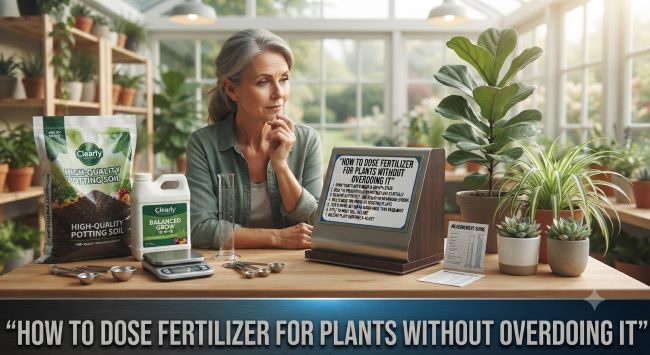
How to Dose Fertilizer for Plants Without Overdoing It
More houseplants and garden plants are killed by too much fertilizer than too little. It is a counterintuitive truth that trips up well-meaning plant owners: fertilizer feels like care, so more must be better, right? Not at all. Over-fertilizing burns roots, damages plants, and can be far worse than skipping feeding altogether. Getting the dose right is the key to healthy, thriving plants, and it is not complicated once you understand a few basics. Here is a clear guide on how to dose fertilizer for plants correctly, without the guesswork that leads to burned roots and yellow leaves.
Understanding What Fertilizer Actually Does
Before learning how to dose fertilizer for plants, it helps to understand what you are feeding them. Fertilizer provides nutrients that plants need to grow, primarily the three shown as N-P-K on every label:
- N (Nitrogen), for leafy green growth.
- P (Phosphorus), for roots, flowers, and fruit.
- K (Potassium), for overall health and disease resistance.
The N-P-K numbers on a fertilizer label (like 10-10-10) show the percentage of each nutrient. A balanced fertilizer has equal numbers, while specialized ones emphasize different nutrients for different purposes. Understanding these numbers is the foundation of correct dosing, since it tells you what you are actually giving them.
The Golden Rule: Follow the Label
The single most important principle in how to dose fertilizer for plants is to follow the label instructions, and if anything, err on the side of less. Fertilizer labels specify the correct dilution and frequency for their product, and these instructions exist for a reason.
A widely used approach is to dilute to the recommended strength or even weaker, since many experienced growers deliberately use fertilizer at half the recommended strength to avoid any risk of burning plants. Here, “less is more” is a genuinely reliable guideline, because you can always add more nutrients, but you cannot easily undo the damage from too much.
How to Dose Correctly
Here is a practical approach to how to dose fertilizer for plants:
- Read the label for the specific dilution ratio and frequency for your fertilizer and plant type.
- Measure precisely, using the recommended amount rather than eyeballing it, since over-application is the main danger.
- Dilute in water for liquid fertilizers, mixing to the correct (or slightly weaker) strength.
- Apply to moist soil, never dry soil, since fertilizing dry roots increases the risk of burn. Water first if the soil is dry.
- Follow the frequency, typically during the growing season, and less or not at all during dormancy.
- Consider halving the strength if you are unsure, which protects against over-fertilizing while still feeding the plant.
This measured approach is the safest way to feed your plants.
Matching the Dose to the Plant and Season
A key part of how to dose fertilizer for plants is recognizing that needs vary:
By season. Most plants grow actively in spring and summer and need feeding then, while many go dormant in fall and winter and need little or no fertilizer. Feeding a dormant plant is a common mistake.
By plant type. Heavy feeders like many vegetables and flowering plants need more, while slow-growing plants and succulents need very little. Match the frequency and strength to the plant.
By growth stage. Young, actively growing plants and those flowering or fruiting have different needs than established, resting ones.
By fertilizer type. Liquid fertilizers act fast but need frequent application, while slow-release granular fertilizers feed gradually over time with less frequent application.
Understanding these variations prevents the one-size-fits-all mistake and is central to feeding plants well.
Signs You’re Over-Fertilizing
Recognizing the warning signs helps you correct course when learning how to dose fertilizer for plants:
- Brown, burned leaf edges or tips, a classic sign of fertilizer burn.
- A white crust of fertilizer salts on the soil surface.
- Yellowing or wilting despite regular feeding.
- Stunted or distorted growth.
- Leaf drop in otherwise healthy conditions.
If you see these signs, stop fertilizing and flush the soil with plenty of water to leach out excess salts. This is exactly why the cautious, “less is more” approach to how to dose fertilizer for plants is so valuable, since it avoids these problems in the first place.
How Plants Use What You Feed Them
Understanding a little plant biology makes dosing more intuitive, since it helps to know what happens to the nutrients you provide. Plants make their own food through photosynthesis and store energy for later use, and the nutrients from fertilizer support these processes rather than serving as food themselves. Learning about the processes involved, such as the one in Which Involves Food Storage in Plants, gives useful context for how plants grow and use resources, which helps you appreciate why balanced, measured feeding supports healthy growth better than dumping on excess fertilizer the plant cannot use.
The bottom line on how to dose fertilizer for plants is that careful, conservative feeding beats generous feeding every time. Understand the N-P-K basics, follow the label (or dilute even weaker), apply to moist soil during the growing season, match the dose to your specific plants, and watch for signs of over-fertilizing. Remember that too much fertilizer is far more dangerous than too little, so when in doubt, use less. Your plants will reward the restraint with healthy, steady growth.
Key Takeaways
- Over-fertilizing kills more plants than under-fertilizing, so careful, conservative dosing is essential.
- Fertilizer provides N-P-K nutrients: nitrogen for leaves, phosphorus for roots and flowers, potassium for overall health.
- The golden rule is to follow the label and, if anything, dilute to half the recommended strength.
- Measure precisely, dilute in water, and apply to moist soil rather than dry roots to avoid burn.
- Match the dose to the season (feed during growth, not dormancy), plant type, and growth stage.
- Liquid fertilizers act fast but need frequent application, while slow-release granular types feed gradually.
- Watch for over-fertilizing signs like burned leaf edges, white salt crust, and yellowing, and flush the soil if they appear.
- When in doubt, use less, since too much fertilizer is far more dangerous than too little.