What Is a Major Difference Between Retail Banks and Credit Unions?
Retail banks and credit unions both offer checking accounts, savings accounts, loans, and other financial services, and on the surface they can look nearly identical to a consumer. But the structural differences between them are significant and produce real differences in how they operate, who they serve, what they charge, and what they offer. Understanding what the major difference between retail banks and credit unions is helps you make a more informed decision about which type of institution is better suited to your financial life.
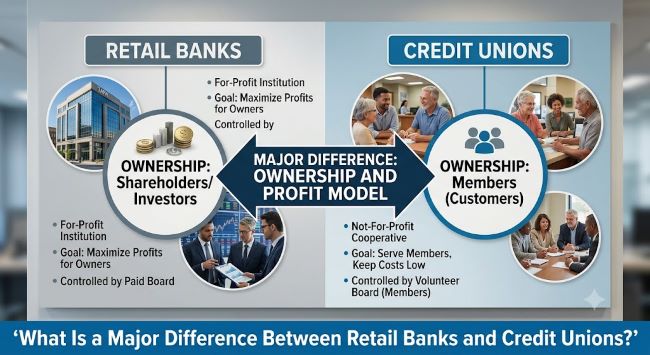
The Major Difference: Ownership and Profit Structure
The single most fundamental difference between retail banks and credit unions is ownership structure. Retail banks are for-profit corporations owned by shareholders. Credit unions are nonprofit cooperatives owned by their members.
This structural difference drives almost every other distinction between the two institution types.
Retail banks exist to generate profit for shareholders. Revenue above operating costs flows to shareholders as dividends or is reinvested to grow the business and increase shareholder value. Decisions about interest rates, fees, product offerings, and branch locations are made with profitability as a primary consideration.
Credit unions exist to serve their members. Because members are both the customers and the owners, any surplus revenue (after operating expenses and reserve requirements) is returned to members in the form of lower loan rates, higher savings rates, reduced fees, or improved services. There are no outside shareholders to pay.
This is why the same financial product often looks different at a bank versus a credit union:
- Credit union savings accounts typically offer higher interest rates because the surplus that would go to bank shareholders instead stays in the system to benefit members
- Credit union loan rates (mortgages, auto loans, personal loans, credit cards) tend to be lower for the same reason
- Credit union fees are generally lower and overdraft policies tend to be more forgiving
Membership Requirements
Retail banks are open to anyone who meets basic eligibility requirements (a valid ID and a minimum opening deposit in most cases). There are no membership criteria beyond that.
Credit unions require you to be a member, and membership is defined by a common bond among members. Originally this meant working for the same employer or being part of the same trade union. The concept has broadened significantly over time.
Common membership criteria today include:
- Working for a specific employer or industry (a teachers’ credit union, a federal employees’ credit union)
- Living, working, or worshipping in a specific geographic area (many community credit unions now use this as the primary requirement)
- Being a member of a particular organization, association, or alumni group
- Being related to an existing member (family membership is standard at most credit unions)
The membership requirement was once a significant practical barrier. Today, many credit unions have broadened their field of membership to the point where joining is straightforward for most people: many allow you to join simply by making a small donation to a partner organization if you don’t meet the standard criteria.
FDIC vs. NCUA Insurance
Retail bank deposits are insured by the Federal Deposit Insurance Corporation (FDIC) up to $250,000 per depositor per institution per account category. This is a federal guarantee that your deposits are safe even if the bank fails.
Credit union deposits are insured by the National Credit Union Administration (NCUA) up to the same $250,000 per depositor per institution per account category. The NCUA is the federal equivalent of the FDIC for credit unions. From a deposit safety standpoint, federally insured credit unions are as safe as FDIC-insured banks.
A small number of credit unions carry private insurance rather than NCUA insurance. These are state-chartered credit unions in states that permit private deposit insurance alternatives. When evaluating a credit union, confirming it’s NCUA-insured is the equivalent of confirming a bank is FDIC-insured.
Technology, Branch Access, and Convenience
Retail banks, particularly large national banks, have historically had significant advantages in technology, branch networks, and ATM availability. A large bank might have thousands of branches nationwide and tens of thousands of ATMs. A small credit union might have one branch and a limited ATM network.
This gap has narrowed considerably in recent years through two developments:
Shared branching and ATM networks. Most credit unions participate in shared networks (CO-OP Financial Services being the largest) that allow members to conduct transactions at other participating credit union branches and use tens of thousands of fee-free ATMs nationwide. This gives credit union members access to a network comparable in geographic reach to large banks.
Digital banking. Many credit unions have invested substantially in mobile banking apps and online services that match or exceed what large banks offer. The digital experience gap that existed a decade ago is much smaller today for most credit unions.
That said, if you travel extensively or need frequent in-person banking across different cities, a large retail bank’s physical network may still offer a practical convenience advantage.
Business Banking and Complex Financial Products
Retail banks, particularly large commercial banks, have advantages in the breadth of financial products available, particularly for business customers, high-net-worth individuals, and those needing complex financial instruments. Investment banking, corporate treasury services, international wire capabilities at scale, and sophisticated lending structures are areas where large retail banks maintain leadership.
For the everyday consumer needs that most people have — checking, savings, auto loans, mortgages, credit cards, personal loans — credit unions often match or beat retail banks on rates and fees while providing comparable or superior customer service.
Customer Service Differences
Credit unions consistently score higher than retail banks in customer satisfaction surveys. The J.D. Power retail banking satisfaction studies and ACSI (American Customer Satisfaction Index) consistently show credit unions outperforming banks, particularly large national banks, on overall satisfaction, problem resolution, and personal relationship quality.
The member-owned structure contributes to this: staff at a credit union are serving members (who are also owners) rather than customers in a transactional retail sense, and the nonprofit mission tends to attract staff who align with the service orientation.
For context on how institutional structure affects the financial products available to you, why is it important to find a credit card with a lower APR is relevant here because credit unions typically offer some of the lowest APR credit cards available, which is a direct consequence of the nonprofit, member-owned structure described above.
Key Takeaways
- The major difference between retail banks and credit unions is ownership and profit structure: banks are for-profit corporations owned by shareholders; credit unions are nonprofit cooperatives owned by their members
- This structural difference produces lower loan rates, higher savings rates, and lower fees at credit unions because surplus revenue returns to members rather than flowing to outside shareholders
- Retail banks are open to anyone; credit unions require membership through a common bond (employer, geography, organization, or family connection) though most have broadened eligibility significantly
- Both FDIC-insured banks and NCUA-insured credit unions offer the same $250,000 deposit insurance protection: from a safety standpoint they are equivalent
- The technology and branch access gap has narrowed substantially through shared branching networks and digital banking investment, reducing credit unions’ historical convenience disadvantage
- Credit unions consistently score higher in customer satisfaction surveys than retail banks, particularly large national banks
- For everyday consumer banking needs, credit unions often offer better rates and fees; for complex business banking and broad physical branch networks, large retail banks retain advantages