Why Should You Work to Be an Informed Consumer?
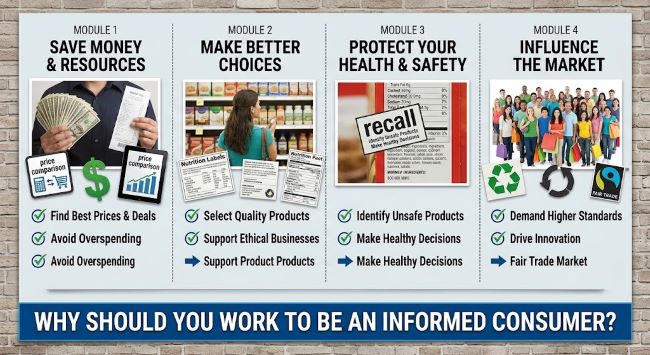
Every financial decision you make as a consumer happens in an environment designed to influence it. Retailers, advertisers, lenders, and service providers invest enormous resources into shaping your choices in their favor. Working to be an informed consumer is how you engage with that environment on your own terms rather than theirs. The case for informed consumerism is both practical and protective: it saves money, prevents exploitation, and builds the knowledge base that underlies long-term financial health.
What It Means to Be an Informed Consumer
An informed consumer is someone who researches products, services, and financial arrangements before committing to them, understands their rights, compares options rather than accepting the first offer presented, and recognizes when they’re being manipulated rather than helped.
Informed consumerism is not about being suspicious of every transaction or treating every seller as a bad actor. It’s about applying proportionate skepticism and adequate research to decisions before making them, particularly for significant purchases, financial products, and ongoing service commitments.
The alternative — an uninformed consumer — makes decisions based on incomplete information, often in ways that benefit the seller significantly more than the buyer. Uninformed consumers pay more for identical products, sign contracts with unfavorable terms they didn’t read, miss available alternatives, fall for scams that informed consumers would recognize, and compound financial mistakes that could have been avoided with basic research.
Reason 1: You Pay Less for the Same Things
One of the most direct reasons to work to be an informed consumer is financial. Prices for the same or equivalent products and services vary widely, and the variance rewards research.
The same prescription medication may cost $340 at one pharmacy and $18 at another with a GoodRx coupon. The same car model may have hundreds of dollars of difference between the dealer’s markup and the invoice price, visible to anyone who researches it in advance. A mortgage with identical terms may carry different lender fees across providers: origination fees, underwriting fees, and discount points that add up to thousands of dollars in differences between lenders.
None of these savings require special access or connections. They require research, comparison, and the willingness to shop rather than default to the most convenient option.
Informed consumers also recognize and avoid manipulation tactics that push spending beyond what’s necessary: upsells presented as requirements, extended warranties on low-repair-rate products, financing offers that seem affordable but cost more in total than cash alternatives.
Reason 2: You Recognize and Avoid Scams
Financial scams and predatory practices disproportionately target uninformed consumers. The mechanics of most scams rely on the target not knowing enough to recognize the red flags.
Payday loans are technically legal in many states but carry effective APRs of 300-400%. An informed consumer understands this and uses alternatives. Pyramid schemes and multi-level marketing opportunities look like legitimate business propositions to uninformed participants. Investment scams (like the IQD revaluation scheme) exploit lack of financial knowledge about how currency markets work. Identity theft often succeeds because consumers don’t monitor their credit reports or recognize phishing tactics.
Working to be an informed consumer builds a baseline of financial and legal knowledge that makes you a significantly harder target. You know what too-good-to-be-true looks like. You know which financial institutions are regulated and which aren’t. You know your rights when a debt collector calls or a landlord attempts to withhold a deposit without basis.
Reason 3: You Make Decisions Based on Real Value, Not Perceived Value
Marketing is the art of creating perceived value that exceeds real value. Premium pricing often reflects brand positioning rather than product quality. “New and improved” formulations are sometimes identical to previous ones. Larger package sizes are sometimes priced at higher per-unit costs than smaller ones (the opposite of the expected bulk discount).
An informed consumer looks past the marketing presentation to the underlying value. This means reading ingredient lists and comparing per-unit prices. It means understanding that the store brand vitamin with identical active ingredients to the name brand costs 40% less. It means knowing that a $35 HDMI cable does not carry a better signal than a $10 one. It means recognizing when a premium price represents genuine quality versus brand-driven markup.
This skill protects against one of the most pervasive forms of consumer manipulation: the use of price and packaging to create quality associations that aren’t backed by product reality.
Reason 4: You Understand Your Rights
Consumer protection laws exist in most countries and provide significant protections that many consumers never exercise because they don’t know about them. In the United States:
The Fair Credit Reporting Act gives you the right to a free credit report from each major bureau annually and the right to dispute errors. The Fair Debt Collection Practices Act restricts how debt collectors can contact you and what they can say. The Truth in Lending Act requires lenders to clearly disclose APR and total financing costs. The Consumer Financial Protection Bureau provides a complaint mechanism for financial product disputes. Lemon laws in most states provide remedies for defective vehicle purchases.
None of these protections help you if you don’t know they exist. Working to be an informed consumer includes knowing the basic framework of your consumer rights so you can exercise them when needed.
Reason 5: Informed Consumers Create Better Markets
Beyond the individual benefit, informed consumers collectively improve markets. When consumers research products and reward quality and fair pricing with their purchases, businesses that offer genuine value gain market share and those that rely on manipulation or inferior products face competitive pressure to improve.
Informed consumers who leave detailed reviews, report deceptive practices to consumer protection agencies, and choose transparent companies over opaque ones collectively shift incentives for how businesses behave. This is why consumer education has a public benefit that extends beyond individual financial health.
How to Work Toward Being a More Informed Consumer
Research before significant purchases. For any purchase above a meaningful threshold (you set the number), invest time in comparison shopping, reading reviews from verified purchasers, checking the product or service against consumer-focused review sites (Consumer Reports, Wirecutter, Trustpilot), and understanding total cost of ownership rather than just purchase price.
Read the terms. Credit card agreements, service contracts, lease terms, and subscription policies contain the actual rules of the arrangement. Key sections include the interest rate and how it’s calculated, auto-renewal terms, cancellation penalties, and arbitration clauses. You don’t need to read every word but the key financial terms deserve attention before signing.
Monitor your financial accounts and credit. Reviewing bank and credit card statements monthly catches errors and fraud early. Checking your credit report annually catches identity theft and reporting errors. These habits are basic informed consumer practices.
Be skeptical of urgency and exclusivity. “Limited time offer,” “only for you,” and “act now” language is designed to prevent the research and comparison that informed consumers do. Recognizing urgency tactics as manipulation rather than genuine information is a core informed consumer skill.
Ask questions before agreeing to financial products. What is the APR? What are all the fees? What happens if I miss a payment? Can I cancel, and what does that cost? An informed consumer asks these questions before signing, not after.
For related reading that connects to specific informed consumer skills in financial decisions, what is a major difference between retail banks and credit unions is an example of the kind of institutional knowledge that lets you choose financial products on actual merit rather than convenience or marketing.
Key Takeaways
- Working to be an informed consumer protects your finances, prevents exploitation, and builds the knowledge base that underlies long-term financial health
- Informed consumers pay less for the same products and services through price comparison, recognizing markups, and resisting upsells that add cost without value
- Scams and predatory practices disproportionately target uninformed consumers: knowledge of how financial products, markets, and common fraud tactics work is a direct defense
- Marketing creates perceived value that often exceeds real value: informed consumers look past brand positioning and packaging to actual product quality and per-unit cost
- Consumer protection laws provide significant rights (FCRA, FDCPA, TILA, CFPB complaint process) that only help people who know they exist and how to use them
- Informed consumers collectively improve markets by rewarding genuine value and creating competitive pressure on businesses that rely on manipulation or opacity
- Core informed consumer practices: research before significant purchases, read key financial terms, monitor accounts and credit, recognize urgency tactics as manipulation, ask direct questions before agreeing to any financial product