What Are Two Questions That Smart Spenders Ask Before Making a Purchase?
Smart spending isn’t about spending as little as possible. It’s about making deliberate choices that align with your values and financial situation rather than reactive ones driven by impulse or habit. At the heart of that deliberateness are two questions that separate intentional spenders from everyone else. These questions sound simple, but consistently applying them before any significant purchase changes the relationship between you and your money in fundamental ways.
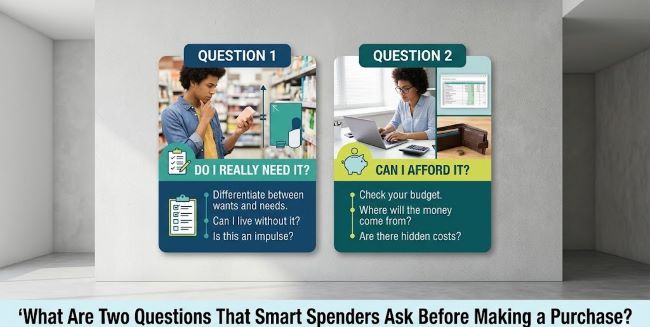
The Two Questions Smart Spenders Ask
The two questions that smart spenders ask before making a purchase are:
1. Do I need this, or do I just want it? 2. Can I actually afford this right now?
These two questions work together. The first evaluates the nature and priority of the purchase. The second evaluates whether your current financial situation supports it. A purchase that passes both tests is one you can make confidently. A purchase that fails either test deserves more scrutiny before you commit.
Question One: Do I Need This, or Do I Just Want It?
The need versus want distinction is foundational to smart spending. A need is something essential to your basic functioning, health, safety, or fulfillment of existing obligations. A want is something that would improve your comfort, enjoyment, or status but isn’t essential to any of those things.
Needs: housing, utilities, groceries, transportation to work, medications, basic clothing. Wants: restaurant meals, upgraded electronics, streaming subscriptions, name-brand clothing, new furniture when existing furniture works fine.
The distinction is not always black and white. A car might be a genuine need in a city without reliable public transit but a want in a city where you can easily walk or take transit. A new laptop might be a need for a remote worker whose current machine can’t handle their work software, or a want for someone whose current machine works fine but is two years old.
This is why smart spenders don’t use the need/want question as a reason to never buy anything enjoyable: wants are a legitimate part of life and a sustainable budget includes them. The question is whether you’re making a conscious choice to spend on a want, knowing it’s a want, rather than convincing yourself it’s a need to bypass the scrutiny.
The question also prompts you to evaluate timing. Even if something is genuinely a want you’ve decided to purchase, asking whether you need it now versus in three months can reveal that waiting doesn’t cost you anything meaningful while the delay allows you to plan the spending intentionally.
Why This Question Protects Your Finances
The need versus want question specifically protects against two common spending patterns that erode financial health:
Impulse purchases justified as needs. A marketing message creates artificial urgency or desire and the buyer rationalize the purchase as necessary. “I need this kitchen gadget for healthy eating.” “I need this software tool to be more productive.” Pausing to honestly ask whether this is a need or a want interrupts that rationalization before the purchase completes.
Lifestyle inflation without intention. As income increases, spending often rises to match it without deliberate choices being made. This is lifestyle inflation: money disappears into incrementally nicer things without any single decision feeling significant. Asking need versus want before each upgrade forces the decision into consciousness rather than letting it happen by default.
Question Two: Can I Actually Afford This Right Now?
The second question smart spenders ask before making a purchase addresses financial reality. “Can I afford this” seems like it should be obvious — if you have the money in your account, you can afford it — but smart spenders use a more sophisticated version of this question.
The real question is: can I afford this without sacrificing something that matters more, without going into debt I don’t have a plan to pay off, and without disrupting progress toward my financial goals?
This reframing produces different answers than a simple balance check. A $500 purchase might sit within your account balance but come at the cost of your monthly savings contribution. A $200 item might be technically payable but would require using a credit card you won’t pay off in full, meaning it costs more than $200 once interest is added.
Smart spenders evaluate affordability against their full financial picture:
Does the purchase fit within this month’s budget? If you have a discretionary spending category and this purchase fits within it, you can afford it. If it blows past the category, you either need to explicitly decide to reallocate from another category or wait until next month.
Will I pay for this in cash (or equivalent), or in debt? Purchases paid in cash or immediately paid credit card balances cost face value. Purchases carried on a revolving credit card balance at 20%+ APR cost significantly more than face value. Smart spenders factor in the real cost of financing a purchase before deciding they can afford it.
Does this compete with a financial goal I care about? A $600 purchase at the expense of a $600 emergency fund contribution is a genuine trade-off. Recognizing it explicitly rather than making it by default is what smart spending requires.
Why This Question Protects Your Finances
The affordability question protects against the most common financial mistake consumers make: treating available credit as available money. A credit card with a $5,000 limit does not mean you have $5,000 to spend on non-essential items: it means you have $5,000 of debt capacity, which is a different thing entirely.
It also protects against the incremental spending creep that leaves people earning good incomes with little savings. No single purchase feels unaffordable, but the cumulative effect of many want purchases that “fit in the account” crowds out savings, emergency funds, and investment contributions.
Applying Both Questions Together
The power of these two questions that smart spenders ask before making a purchase comes from using them together rather than in isolation.
A genuine need you can’t currently afford still deserves delayed purchase or a planned financing strategy rather than impulse debt. A want you can genuinely afford within your budget is a legitimate expense you can enjoy without guilt. A want you can’t afford is the clearest case for waiting or skipping.
The framework doesn’t eliminate spending on enjoyable things: it ensures those purchases are made consciously. Smart spenders spend money on things they’ve decided to value, not on things that happened to be in front of them at a moment of weakness.
For practical budgeting tools that give these questions their context, what are some key components of successful budgeting covers how to build the category structure and goal framework that makes answering both questions accurately possible in real time.
Key Takeaways
- The two questions that smart spenders ask before making a purchase are: “Do I need this or do I just want it?” and “Can I actually afford this right now?”
- The need versus want question forces conscious recognition of whether a purchase is essential or discretionary: wants are legitimate but should be acknowledged as wants, not rationalized as needs
- The affordability question goes beyond checking your account balance: it evaluates whether the purchase fits your budget, whether it involves debt you’ll carry with interest, and whether it competes with financial goals that matter more
- Together these questions interrupt the two most common spending failures: impulse purchases rationalized as needs and debt-financed purchases treated as affordable because credit exists
- Smart spenders still buy wants: the point is making deliberate choices rather than reactive ones driven by marketing, social pressure, or emotional state
- Timing matters: even an affordable want can be delayed without cost, allowing for more intentional planning rather than in-the-moment decisions
- A budget with defined categories for both needs and discretionary wants makes answering both questions faster and more accurate in daily practice