What Credit Score Do You Start With?
One of the most common misconceptions about credit scores is that everyone starts with a score of zero and works their way up. That’s not how it works. If you’ve never had any credit accounts, you don’t have a score of zero: you have no score at all. Understanding the difference matters for knowing how to start building credit effectively. This guide explains what credit score you start with, when your first score appears, what that number is likely to be, and how to build from there.
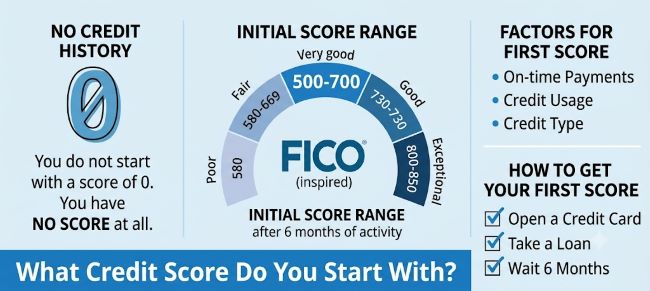
You Don’t Start with Any Credit Score
When you have no credit history — no credit cards, no loans, no accounts reported to credit bureaus — you are what the industry calls “credit invisible.” The major credit bureaus (Equifax, Experian, and TransUnion) have no data on you, and therefore no basis for calculating a score.
FICO, which produces the most widely used credit scoring model, requires a minimum of one account that’s at least six months old and has been reported to the bureau within the last six months before it will generate a score. VantageScore, the other major scoring model, can generate a score with as little as one month of account history, but the result is still based on actual account data rather than a default starting number.
So the answer to what credit score you start with is: no score, not zero. Zero is actually a meaningful number on some scales and carries different implications. The absence of a score simply means there isn’t enough data to generate one.
When Does Your First Score Appear?
Under FICO’s requirements, your first credit score appears approximately six months after your first credit account is opened and reported to a bureau. The account needs to have been active within the last six months as well.
Under VantageScore’s requirements, a score can appear as early as one month after your first account is opened, as long as the account has been reported.
The most common path to a first credit score: you open a credit card (either a student card, a secured card, or a card you’re added to as an authorized user on a parent’s account). The credit card issuer reports the account to the credit bureaus, typically within 30-45 days of account opening. A month or two later, VantageScore generates your first score. After six months, FICO generates your first score.
What Is Your First Credit Score Likely to Be?
Most people’s first credit score falls in the range of 600 to 700, though the exact number depends on several factors:
Payment history. Even with limited history, a single missed or late payment in your first months of credit can significantly drag down your initial score. Making every payment on time from day one is the most important factor.
Credit utilization. This is the ratio of your credit card balance to your credit limit. If your card has a $500 limit and you’re carrying a $400 balance, your utilization is 80%, which negatively impacts your score. Keeping utilization below 30%, and ideally below 10%, produces a meaningfully higher first score.
Type of first account. A credit card (revolving credit) and a student loan (installment credit) affect scores slightly differently. Having both types is eventually beneficial, but starting with a credit card is the most common and fastest path to an initial score.
Authorized user status. If you’re added as an authorized user on a parent’s or spouse’s credit card with a long positive history, that account may appear on your credit report and boost your first score significantly, sometimes above 700 from the start.
Secured credit cards — where you deposit a sum of money that becomes your credit limit — are specifically designed for credit building and tend to produce reliable first scores in the 600-680 range when managed correctly.
What Factors Determine Your Score Going Forward
Once you have your first credit score, it moves based on five weighted factors (FICO model):
Payment history (35%): the most heavily weighted factor. Every on-time payment builds your score. One missed payment can drop a score significantly and stays on your report for seven years.
Credit utilization (30%): the ratio of balances to credit limits across all revolving accounts. Lower utilization = higher score. This factor responds quickly to changes: paying down a balance can raise your score within a billing cycle.
Length of credit history (15%): the age of your oldest account, newest account, and average age of all accounts. This is why closing old accounts can hurt your score and why building early matters.
Credit mix (10%): having both revolving credit (credit cards) and installment credit (auto loans, student loans, mortgages) benefits your score over time.
New credit (10%): opening multiple new accounts in a short period creates multiple hard inquiries, which temporarily lower your score. Hard inquiries remain on your report for two years but affect your score for about one year.
How to Build Credit from Zero
Secured credit card. A secured card requires a deposit (typically $200-$500) that becomes your credit limit. You use it like a regular card and make on-time payments. After 6-12 months of responsible use, most issuers upgrade you to an unsecured card and return your deposit. Capital One, Discover, and many credit unions offer strong secured card products.
Become an authorized user. If a family member with good credit adds you to their account as an authorized user, that account’s history may appear on your credit report. You don’t even need to use the card: the account’s positive history benefits your profile as long as the primary holder continues paying on time.
Credit-builder loan. Offered by many credit unions and some banks, a credit-builder loan holds the loan amount in a savings account while you make monthly payments. At the end of the term, you receive the funds. The payment history builds your credit throughout the process.
Student credit card. If you’re a student, student credit cards have lower income and credit history requirements and are specifically designed for first-time credit users.
For context on how your starting credit score connects to the credit products available to you, why is it important to find a credit card with a lower APR explains how your credit score directly determines which APR range you’ll qualify for when applying for your first or next card.
Key Takeaways
- You don’t start with a credit score of zero: with no credit history you have no score at all, a state called being “credit invisible”
- Your first FICO score appears approximately six months after your first account is opened and reported: VantageScore can generate a score after as little as one month
- Most people’s first credit scores land between 600 and 700, influenced primarily by payment history and credit utilization in those early months
- Keeping credit utilization below 30% (ideally below 10%) and making every payment on time are the two most impactful behaviors for building a strong starting score
- Being added as an authorized user on a parent’s account with long positive history can produce a first score above 700 before you’ve even applied for your own card
- The five FICO factors in order of weight: payment history (35%), utilization (30%), length of history (15%), credit mix (10%), new credit (10%)
- Secured cards, credit-builder loans, and authorized user status are the three most reliable paths to a first credit score for someone starting from zero