The Customer Is Always Right in Matters of Taste: What It Really Means
Few phrases in business get misquoted as consistently as “the customer is always right.” Most people know it as an absolute statement that the customer’s opinion is supreme in all matters. What gets lost is the second half of the original phrase, which changes the meaning entirely: the customer is always right in matters of taste. That qualifier transforms a problematic absolute into a genuinely useful business principle. This guide unpacks where the phrase came from, what it actually means, where it applies, and where treating it as an absolute causes real harm.
The Origin of the Phrase
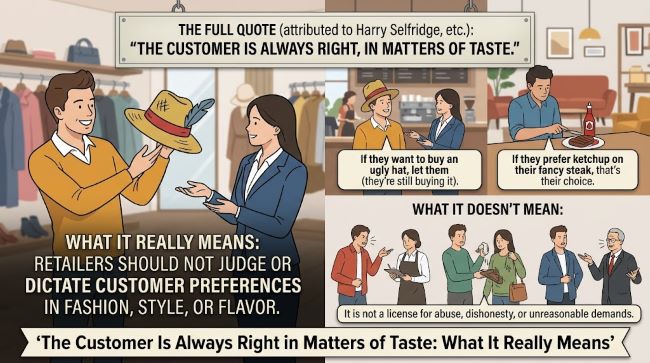
The phrase is most commonly attributed to Harry Gordon Selfridge, founder of Selfridge’s department store in London, who used it in the early twentieth century as part of a customer-first retail philosophy. Variations were also used by Marshall Field and César Ritz around the same era, suggesting it was a widespread retail mantra of the period rather than a single coinage.
In the context of early department store culture, the phrase served a specific purpose: it pushed back against the paternalistic attitude of shopkeepers who often told customers what they should want rather than listening to what they actually wanted. The phrase was a commitment to customer preference over merchant preference when it came to style, taste, and buying decisions.
The key phrase is in matters of taste. This limitation was always part of the original intent even when it wasn’t always explicitly stated.
What “In Matters of Taste” Actually Means
The customer is always right in matters of taste means that when it comes to subjective preferences, personal style, and individual choice, the customer’s judgment is the relevant one. Not the merchant’s, not the salesperson’s, not the designer’s.
If a customer wants to buy a sofa in a color you think is ugly, they are right. It is their home and their taste that matters, not yours. If a customer orders their steak well-done and asks for ketchup alongside, they are right. It is their meal and their palate. If a customer wants a conservative haircut when the stylist would recommend something more dramatic, the customer’s preference governs.
In all of these cases, there is no objective standard being violated. The customer’s taste may differ from expert consensus or conventional wisdom, but taste is not a domain where objective correctness exists. The customer’s preference is the only relevant measure.
This is the insight behind the phrase: in subjective matters where personal preference determines value, the person holding the preference is the ultimate authority. A business that substitutes its own aesthetic judgment for the customer’s in matters of taste is misunderstanding whose satisfaction the business exists to serve.
Where the Principle Applies Most Clearly
The customer is always right in matters of taste applies most directly in categories where subjectivity dominates:
Retail and fashion. A clothing retailer’s job is to carry what customers want to buy, not what the buyer personally considers stylish. The customer who buys an item the salesperson finds unflattering is exercising a valid preference. The salesperson can offer information but should not override the customer’s choice.
Food and beverage. A restaurant accommodating a customer’s unusual preparation request (extra sauce, specific modifications, unconventional combinations) is honoring the principle. The chef’s opinion about what tastes best is irrelevant to what the customer wants to eat.
Interior design and home goods. Customers choosing their own furniture, paint colors, and décor are exercising taste preferences that belong entirely to them. A designer’s role is to serve the client’s vision, not impose their own.
Creative services. A graphic designer, photographer, or copywriter working for a client produces work according to the client’s brief. Client feedback about subjective elements like color palettes, tone, or style is the relevant input, even when the designer disagrees from a craft perspective.
Entertainment and hospitality. A customer who chooses entertainment options or hotel amenities that seem unsophisticated to staff is making personal preference choices that belong to them. The customer’s enjoyment, not staff approval, is the measure of success.
Where the Principle Does Not Apply
The customer is always right in matters of taste is specifically limited to matters of taste. It does not extend to matters of fact, safety, law, or ethics.
Factual matters. If a customer insists that a product does something it doesn’t do, the customer is factually wrong and the business has no obligation to affirm the incorrect belief. Telling a customer they’re right when they’re factually incorrect causes harm to both the customer and the business.
Safety requirements. A customer who insists on a modification that violates safety standards, or who refuses required safety equipment, is not exercising taste. They’re creating a liability and safety risk that the business is not obligated to accommodate.
Legal compliance. A customer who asks a business to do something illegal is not expressing a taste preference. No version of “the customer is always right” covers illegal requests.
Staff treatment. The most important boundary is the treatment of employees. The customer is always right in matters of taste was never meant to mean that customers can mistreat, abuse, or disrespect staff. Businesses that extend the principle this far create hostile work environments, increase staff turnover, and ultimately damage the customer experience they were trying to protect.
The Business Case for Getting This Right
Properly applied, the customer is always right in matters of taste leads to genuine business benefits: products that sell because they reflect actual customer preferences rather than internal aesthetic decisions, service experiences that feel accommodating rather than judgmental, and customer relationships built on respect for individual choice.
Misapplied as an absolute, the same phrase leads to staff demoralization (when customers are allowed to mistreat employees without consequence), poor decision-making (when factually incorrect customer claims override business judgment), and operational problems (when safety or legal requirements bend to customer pressure).
The businesses that handle this most effectively draw a clear distinction between taste, where customer preference governs, and fact, safety, and ethics, where other standards apply. This framework allows them to be genuinely customer-centric in the areas that matter to customer satisfaction while maintaining standards that protect both staff and business integrity.
Applying It in a Modern Business Context
For contemporary businesses, the customer is always right in matters of taste translates into a few practical principles:
Offer genuine customization and flexibility in areas of subjective preference. Give customers real choices about how products are configured, delivered, or presented.
Train staff to distinguish between accommodation (honoring a customer’s taste preference) and capitulation (agreeing with factually incorrect claims or tolerating abuse).
Collect customer preference data systematically. Purchases, returns, reviews, and direct feedback all reveal what customers actually want, which is more reliable than what any internal team assumes they want.
Avoid the trap of designing products or services around internal aesthetic preferences while ignoring customer response signals.
For context on how customer preferences shape broader market outcomes including pricing and loyalty, what is the most direct cause of customer loyalty is a closely related topic that explores what keeps customers returning once their preferences have been served well.
Key Takeaways
- The full phrase is “the customer is always right in matters of taste”: the qualifier fundamentally changes the meaning from an absolute to a specific and defensible principle
- In matters of subjective preference, style, and personal choice, the customer’s judgment is the relevant authority, not the merchant’s, designer’s, or salesperson’s
- The principle applies clearly in retail, food, creative services, hospitality, and any domain where taste and personal preference determine value
- The principle does not apply to matters of fact (where incorrect customer claims should not be affirmed), safety, legal compliance, or the treatment of staff
- Misapplying it as an absolute leads to staff demoralization, poor decisions, and operational problems: the businesses that use it best draw clear lines between taste and other standards
- The historical context of the phrase was about pushing back against paternalistic merchants who substituted their preferences for customers’: it was always about respecting genuine customer choice in subjective matters
- Modern application means building real customization and flexibility into products and services, training staff to honor preferences without capitulating to incorrect claims, and using customer data to understand what people actually want