What Is the Voluntary Exchange of Goods and Services?
Voluntary exchange is one of the foundational concepts in economics, and understanding it helps explain why markets work, how prices are set, and why trade between people and countries benefits both sides. It sounds straightforward, but the implications run deep. This guide explains what the voluntary exchange of goods and services is, why economists consider it the engine of market economies, and what happens when it breaks down.
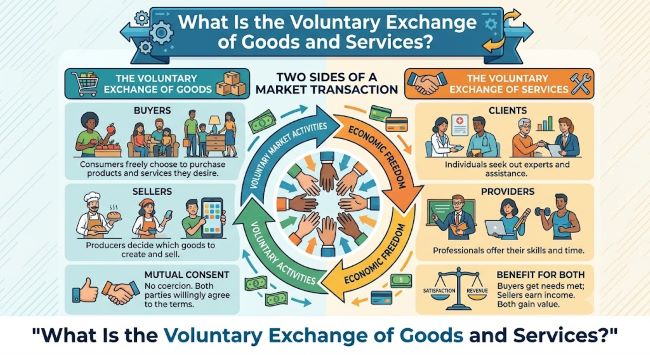
What Is the Voluntary Exchange of Goods and Services?
The voluntary exchange of goods and services is a transaction in which two parties freely agree to trade with each other because both expect to benefit from the exchange. Neither party is coerced, deceived, or forced into the transaction. The buyer chooses to give up money (or another good) in exchange for something they value more than what they’re giving up. The seller chooses to give up a product or service in exchange for something they value more than what they’re providing.
This mutual expectation of benefit is what makes the exchange voluntary. Both parties believe they’ll be better off after the transaction than before it. If either party didn’t believe this, they wouldn’t agree to the trade.
This concept is at the heart of how market economies function. Every time someone buys a coffee, hires a plumber, downloads a software subscription, or trades stocks, they’re participating in a voluntary exchange of goods and services. The price agreed upon reflects a point where the buyer’s willingness to pay meets the seller’s willingness to accept, and both walk away from the transaction believing they’ve gained.
The Key Elements of Voluntary Exchange
For an exchange to be genuinely voluntary, several conditions need to be met:
Freedom to participate or decline. Both parties must be free to walk away from the transaction without penalty. A buyer who can refuse a purchase and a seller who can refuse a sale are operating in a voluntary exchange environment. Coercion or legal compulsion removes the voluntary element.
Mutual benefit. Both parties must expect to gain from the transaction. This doesn’t mean both gain equally: the buyer may gain much more than the seller or vice versa. But both must perceive a benefit, otherwise one party would not agree.
Informed consent. Both parties need access to relevant information about what they’re exchanging. Transactions based on deliberate deception or withheld material information undermine the voluntary nature of the exchange, which is why consumer protection laws exist.
Clear property rights. For a voluntary exchange of goods and services to function, both parties need clear ownership of what they’re trading. You can only voluntarily give up what you actually own or have the right to provide.
Why Voluntary Exchange Creates Value
One of the most important insights in economics is that voluntary exchange creates value even when no new physical goods are produced. This happens because people value things differently.
Consider a simple example: you have a concert ticket you can’t use and value at $50. A friend values the same ticket at $150. If you sell it to them for $100, you gain $50 in value (cash over your subjective ticket value) and they gain $50 in value (ticket worth $150 to them for only $100). The ticket didn’t change. No new wealth was manufactured. But value was created through the voluntary exchange of goods and services because the item moved to someone who valued it more.
This principle scales to entire economies. When countries trade with each other, voluntary exchange allows each to specialize in what it produces most efficiently and trade for what others produce better. The result is more total output and value than if each country tried to produce everything independently.
Voluntary Exchange vs. Involuntary Exchange
Understanding what voluntary exchange is becomes clearer when you contrast it with involuntary exchange. Taxation is the most common example of involuntary exchange: the government provides public services (defense, roads, courts) in exchange for tax revenue, but individuals don’t choose whether to participate. The exchange happens regardless of individual consent.
Theft is an extreme case of involuntary exchange: one party takes value from another without agreement. Extortion sits between: technically an “agreement” is reached, but under coercion, which strips it of its voluntary character.
The voluntary exchange of goods and services is protected and enforced in market economies through contract law, property rights enforcement, and consumer protection regulations. When these institutions are weak, voluntary exchange becomes harder because parties can’t trust that agreements will be honored.
The Role of Price in Voluntary Exchange
Price is the mechanism that coordinates voluntary exchange across a market economy. When prices are free to move in response to supply and demand, they signal information to buyers and sellers simultaneously. A rising price tells buyers that something is becoming scarcer and tells sellers that producing more of it will be rewarded. A falling price does the opposite.
This coordination happens without any central authority directing it. Millions of individual voluntary exchanges of goods and services, each made by parties seeking mutual benefit, collectively determine prices and allocate resources across the economy. This is what economists mean when they describe markets as decentralized coordination mechanisms.
When prices are prevented from adjusting (through price controls, for example), the signal system breaks down and voluntary exchange becomes less efficient: shortages or surpluses emerge because prices no longer accurately reflect the relative preferences of buyers and sellers.
Real-World Examples of Voluntary Exchange
Retail purchase. You walk into a bookstore and pay $20 for a novel. You value the book more than $20. The store values $20 more than keeping the book on the shelf. Both benefit.
Employment. An employer and employee agree on a salary and job responsibilities. The employer values the employee’s labor more than the salary paid. The employee values the salary more than the leisure or alternative work they’re giving up.
International trade. A country that produces wheat efficiently exports it to a country that produces electronics efficiently and imports electronics in return. Both economies produce more total output through specialization and voluntary exchange than they would producing everything domestically.
Digital marketplace. A freelance designer sells a logo to a small business through an online platform. Both parties found each other, agreed on scope and price, and exchanged a service for money without geographic proximity or physical goods changing hands.
For a broader understanding of how economic concepts like voluntary exchange connect to market structures and business strategy, topics like how to get rid of smile lines represent a completely different category, but the market for aesthetic treatments is itself driven entirely by voluntary exchange principles: providers set prices, consumers choose whether to transact, and competition shapes what’s offered.
When Voluntary Exchange Fails
Markets built on voluntary exchange don’t always produce ideal outcomes without some institutional framework. A few situations where voluntary exchange can break down or produce poor results:
Externalities. When a transaction imposes costs on third parties not in the exchange (pollution from an industrial deal), the voluntary exchange doesn’t account for those effects and may produce more harm than the price reflects.
Information asymmetry. When one party knows significantly more than the other, the less-informed party may agree to a transaction they wouldn’t consent to with full information.
Market power. When one party has a near-monopoly position, the exchange is technically voluntary but the weaker party’s limited alternatives compromise the mutual benefit element.
These failure cases explain why governments regulate markets even in economies that strongly favor voluntary market mechanisms.
Key Takeaways
- The voluntary exchange of goods and services is a transaction where both parties freely agree to trade because each expects to benefit: no coercion, deception, or compulsion is involved
- Both parties gain from voluntary exchange even though no new physical goods are created: value is generated when items move to people who value them more highly
- Key conditions for genuine voluntary exchange include freedom to decline, mutual expected benefit, informed consent, and clear property rights
- Price is the coordination mechanism that enables voluntary exchange at scale: it signals information to buyers and sellers simultaneously without central direction
- Voluntary exchange differs from involuntary exchange (taxation, theft, coercion) in that all parties enter the transaction willingly
- Markets built on voluntary exchange can fail when externalities, information asymmetry, or significant market power distort the conditions for mutual benefit
- Employment, retail purchases, international trade, and digital services are all everyday examples of the voluntary exchange of goods and services operating at different scales