What Is the Most Direct Cause of Customer Loyalty?
Customer loyalty is one of the most valuable assets a business can build, and also one of the most misunderstood. Many businesses invest heavily in loyalty programs, rewards cards, and retention discounts assuming these create loyalty. But the evidence consistently points to something more fundamental as the most direct cause of customer loyalty: the consistent delivery of value that meets or exceeds customer expectations. Everything else, the programs, the points, the discounts, is a secondary layer built on top of that foundation or used to compensate for its absence.
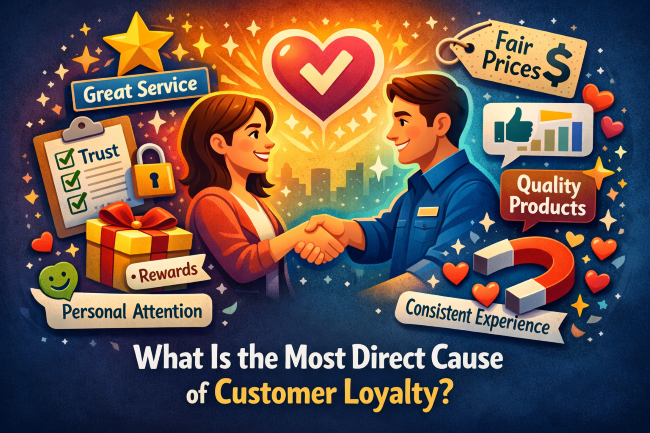
Defining Customer Loyalty
Before identifying its most direct cause, it helps to define what customer loyalty actually is. Genuine customer loyalty is the tendency of a customer to repeatedly choose the same business over competitors, even when alternatives are available and sometimes even when those alternatives appear cheaper or more convenient.
This distinction matters because loyalty is not the same as habitual purchasing driven by inertia, captive purchasing driven by lack of alternatives, or discount-chasing driven by promotional pricing. A customer who shops at a particular grocery store because it’s the only one within walking distance is not loyal in the meaningful business sense. A customer who chooses that store even after a competitor opens nearby is.
True loyalty involves an active preference. The customer knows alternatives exist and chooses your business anyway. Understanding what creates that preference is what points directly to the cause of customer loyalty.
The Most Direct Cause: Consistently Positive Customer Experience
The most direct cause of customer loyalty is a consistently positive customer experience that delivers reliable value. This is supported by research across industries and decades of business observation.
Customer experience encompasses every interaction a customer has with a business: discovering the product, evaluating it, purchasing it, using it, seeking support when problems arise, and returning for subsequent purchases. When these interactions consistently meet or exceed what the customer expects, trust builds. When trust builds through repeated positive experiences, loyalty follows.
The “consistently” qualifier is as important as the “positive” one. A single exceptional interaction does not create loyalty on its own. A single very poor interaction can destroy loyalty that took years to build. What keeps customers returning is the reliable expectation that the next experience will be as good as the previous ones.
This is why customer loyalty is ultimately a product of operational excellence: the systems, people, and processes that deliver consistent value are what produce the consistent positive experience that drives loyalty.
Trust as the Mechanism
Between positive experience and loyalty sits trust. The customer is always right in matters of taste, but what makes them loyal is whether they trust a business to deliver on its promises reliably.
Trust develops through:
Consistency. When a business does what it says it will do, when it says it will do it, at the quality level promised, customers learn they can rely on it. This predictability reduces the cognitive cost of making repeat purchase decisions: you don’t have to re-evaluate an option you already trust.
Transparency. Businesses that communicate honestly, including about problems and mistakes, build more durable trust than those that project false perfection. A customer who sees a business handle a complaint or a supply problem honestly comes away with more trust than if nothing had gone wrong at all.
Reliability across time. Trust compounds. A customer who has had twenty positive interactions with a business has more reason to return for the twenty-first than one who has had two. This is why customer retention compounds over time: each positive interaction reinforces the trust that drives the next.
What Research Shows
Customer experience research consistently identifies experience quality as the primary driver of loyalty. Bain and Company’s work on Net Promoter Score found that companies with the highest loyalty rates, measured by how likely customers are to recommend and return, outperformed competitors across virtually all industries studied. The defining characteristic of those high-loyalty companies was not pricing or promotional activity but the quality of the customer experience they delivered.
McKinsey’s research found that satisfaction with the end-to-end customer journey was a stronger predictor of loyalty than satisfaction with any single touchpoint. A business that excels in one area but falls short elsewhere will have lower loyalty than one that performs consistently across all stages. Fredrick Reichheld’s retention research demonstrated that a five percent increase in customer retention increases profits by 25 to 95 percent depending on industry.
Why Loyalty Programs Are Secondary
Loyalty programs (points, rewards, membership tiers) are widely used but widely misunderstood in terms of where they sit in the causality of loyalty. They do not create loyalty in the primary sense: they reward existing loyalty or create switching costs that make it more costly for satisfied customers to leave.
A customer who returns purely to accumulate points or maintain a status tier is transactionally attached, not genuinely loyal. If a competitor offered a better program, they’d switch. Genuine loyalty means the customer would stay even without the program because the core experience is what they value.
This doesn’t mean loyalty programs have no value: they can deepen loyalty among customers who are already satisfied, provide data on purchasing behavior, and create mild retention friction. But they cannot substitute for the experience quality that is the direct cause of customer loyalty. Businesses that invest heavily in programs while neglecting experience quality are building on sand.
The Role of Emotional Connection
Beyond consistent positive experience, research points to emotional connection as a multiplier of loyalty. Customers who feel a business understands them, shares their values, or genuinely cares about their outcomes are more loyal than those who have a purely transactional relationship with equivalent satisfaction scores.
This emotional dimension is partly why brand identity matters: a business whose values and personality resonate with a customer builds a relationship that is harder to replicate than one built purely on functional delivery. Apple’s customer loyalty, often cited as exceptional, reflects both the quality of the product experience and the emotional identity associated with the brand. Both components reinforce the other.
For businesses that serve customer aesthetic or lifestyle preferences specifically, the customer is always right in matters of taste is directly connected to this emotional dimension: a business that genuinely honors customer preferences rather than imposing its own builds a relationship that feels respectful and personal, which deepens loyalty beyond what purely functional satisfaction produces.
For entrepreneurs thinking about loyalty from the ground up, what must an entrepreneur assume when starting a business is the foundational context: building the operational consistency that drives customer loyalty requires the realistic assumptions about time, effort, and uncertainty that separate sustainable businesses from short-lived ones.
Practical Implications for Businesses
If consistent positive experience is the most direct cause of customer loyalty, the operational priorities follow clearly:
Invest in the quality and training of customer-facing staff. Frontline interactions are the most direct shaper of customer experience, and disengaged or undertrained staff undermine whatever else the business does well.
Map and evaluate the full customer journey, not just peak interactions. Loyalty is built or lost at the edges: the experience when something goes wrong, the ease of returns and support, the clarity of billing, the follow-up after purchase.
Measure and act on customer feedback systematically. Net Promoter Score, customer satisfaction surveys, and direct complaint analysis all provide signals about where the experience is creating or eroding loyalty.
Treat loyal customers visibly better than new ones. Many businesses offer their best deals to new customers while taking existing ones for granted. This inverts the relationship between loyalty and reward and communicates to loyal customers that their history counts for nothing.
Key Takeaways
- The most direct cause of customer loyalty is consistently positive customer experience that meets or exceeds expectations across all interactions over time
- Trust is the mechanism between positive experience and loyalty: it builds through consistency, transparency, and reliability across repeated interactions
- Loyalty programs are secondary: they reward existing loyalty or create mild retention friction, but cannot create genuine loyalty in a customer whose core experience is poor
- Research from Bain, McKinsey, and Reichheld consistently shows that experience quality and journey satisfaction are stronger predictors of loyalty than price, promotions, or program benefits
- Emotional connection amplifies loyalty beyond functional satisfaction: customers who feel understood and respected by a business are more resistant to competitive offers than those with purely transactional relationships
- A five percent increase in customer retention increases profits 25 to 95 percent depending on industry: the economic case for prioritizing loyalty over acquisition is substantial
- Practical focus areas: frontline staff quality, full journey mapping, systematic feedback measurement, and treating loyal customers visibly better than new ones