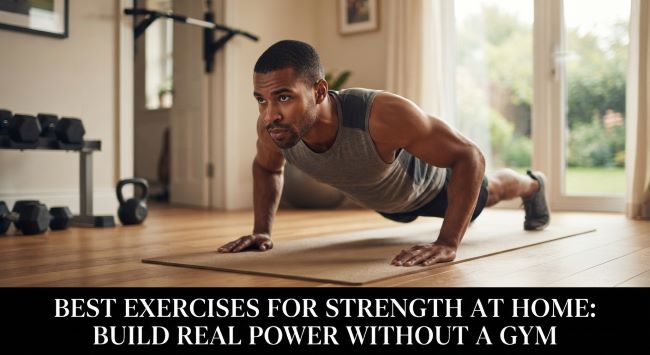
Best Exercises for Strength at Home: Build Real Power Without a Gym
The idea that you need a fully equipped gym to build meaningful strength is one of fitness’s most persistent myths. Your body weight provides substantial resistance, one pair of adjustable dumbbells covers most of what a rack of machines does, and the movement patterns that build strength have not changed in a century. What matters is choosing the right movements, applying progressive overload, and showing up consistently.
What Actually Builds Strength
Before listing the best exercises for strength at home, it helps to understand the principle everything rests on: progressive overload. Muscles adapt to demands placed on them, so getting stronger requires gradually increasing the challenge over time.
At home, you can progress in several ways without buying more equipment:
- Adding reps or sets to the same movement.
- Slowing the tempo, particularly the lowering phase, which increases time under tension.
- Reducing rest between sets.
- Progressing to harder variations, such as moving from knee push-ups to standard to decline.
- Adding load with dumbbells, bands, or even a loaded backpack.
Understanding this is what separates a genuinely effective home program from randomly performing exercises. The best exercises for strength at home work precisely because they can be progressed indefinitely.
Lower Body: Squats and Variations
The squat belongs at the top of any list of the best exercises for strength at home, training quadriceps, glutes, hamstrings, and core at once. Start with bodyweight squats focusing on depth and control, then progress to goblet squats holding a dumbbell, then split squats and Bulgarian split squats with the rear foot elevated. Single-leg work is particularly valuable at home, since it creates substantial overload without heavy weight.
Lower Body: Hinges and Lunges
The hip hinge is the other essential lower-body pattern. Romanian deadlifts with dumbbells train the hamstrings and glutes through a movement that carries into everyday lifting. Glute bridges and single-leg hip thrusts are excellent additions, and lunges, whether stationary, walking, or reverse, build strength and balance while requiring nothing but floor space.
Upper Body Push: Push-Ups and Presses
Push-ups are the most valuable upper-body movement available without equipment. They train the chest, shoulders, triceps, and core, and they scale endlessly: progress from incline, to standard, to decline with feet raised, then to diamond, archer, and eventually one-arm progressions. Add overhead dumbbell pressing for the shoulders and dips using sturdy chairs for extra triceps work.
Upper Body Pull: The Home Training Challenge
Pulling movements are the genuine difficulty in assembling the best exercises for strength at home, since they generally require something to pull against. Options include:
- A doorway pull-up bar, the single most valuable inexpensive purchase for home training.
- Dumbbell rows, bent over or single-arm supported on a chair.
- Resistance band pull-aparts and rows, which are inexpensive and effective.
- Inverted rows using a sturdy table edge.
Neglecting pulling work is the most common flaw in home programs, and it creates muscular imbalance over time. Prioritizing it deliberately is worth the effort.
Core: Beyond Crunches
Effective core work among the best exercises for strength at home focuses on stability rather than crunches. Planks, side planks, dead bugs, bird dogs, and hollow holds train the core to resist unwanted movement. Loaded carries, simply walking while holding heavy dumbbells, are among the most underrated exercises available and build core, grip, and total-body stability at once.
Structuring Your Workouts
Knowing the best exercises for strength at home matters less than organizing them sensibly:
| Approach | Structure | Best For |
|---|---|---|
| Full body | 3 sessions weekly, all patterns each time | Beginners, limited time |
| Upper/lower | 4 sessions, alternating | Intermediate |
| Push/pull/legs | 3 to 6 sessions | More experienced |
For most people, full-body sessions three times a week are ideal. Include a squat, hinge, push, pull, and core movement each session, working in the range of three to four sets of six to fifteen reps.
Equipment Worth Considering
While plenty of these movements need nothing at all, a small amount of equipment expands your options enormously. Adjustable dumbbells are by far the highest-value purchase, replacing an entire rack in the footprint of a shoebox. The comparison in Best Adjustable Dumbbells covers the options available, which is worth reading before buying since this single item unlocks the widest range of loaded movements in a home setup.
Beyond dumbbells, resistance bands are cheap and excellent for pulling work, and a doorway pull-up bar solves the pulling problem more completely than anything else.
Training With Others
One of the biggest predictors of consistency is enjoyment, and training with others helps enormously. Partners or friends joining you turns a solitary obligation into something social, and the accountability makes skipping less likely. The ideas in Best Group Exercises at Home cover workouts designed for more than one person, which pairs naturally with strength training since alternating sets with a partner keeps sessions moving and makes the harder days considerably easier to face.
Staying Safe and Consistent
When performing the best exercises for strength at home, warm up properly, since cold muscles are more injury-prone. Prioritize form over load every time, particularly when training alone. Progress gradually rather than jumping to advanced variations, and allow recovery days, since strength is built during rest. If you have existing injuries or health conditions, or are new to exercise, checking with a doctor or qualified trainer first is sensible.
The bottom line on the best exercises for strength at home is that squats, hinges, lunges, push-ups, rows, presses, and core stability work cover everything you need, and progressive overload through added reps, slower tempo, harder variations, or dumbbells is what actually drives results. Train full body three times a week hitting each movement pattern, prioritize pulling work since it is the easiest to neglect, add adjustable dumbbells and a pull-up bar if you want to expand your options, and focus above all on consistency over months rather than intensity in any single session.
Key Takeaways
- Building strength at home works because of progressive overload, not equipment, so the challenge must increase over time.
- Progress by adding reps or sets, slowing tempo, reducing rest, using harder variations, or adding load.
- Squats, goblet squats, and split squats form the foundation of lower-body training.
- Hip hinges like Romanian deadlifts, glute bridges, and lunges cover the rest of the lower body.
- Push-ups scale endlessly from incline through decline to one-arm progressions, and overhead presses add shoulder work.
- Pulling is the hardest pattern to train at home, so prioritize a pull-up bar, dumbbell rows, or resistance bands.
- Core work should emphasize stability, using planks, dead bugs, bird dogs, and loaded carries rather than endless crunches.
- Full-body sessions three times a week suit most home trainees, covering squat, hinge, push, pull, and core each time.
- Adjustable dumbbells are the highest-value equipment purchase, replacing a full rack in minimal space.
- Warm up, prioritize form over load, allow recovery days, and consult a professional if you have injuries or health conditions.