Best Adjustable Dumbbells for Home Workouts
The home gym revolution ran into one stubborn problem: dumbbells take up an absurd amount of space and cost a fortune in a full range. A complete fixed set means a rack, a dozen pairs, and hundreds of dollars for exercises that use only a few weights at a time. Adjustable dumbbells solved this elegantly, packing a whole rack’s worth of weight into one pair that changes load with a dial or pin. If you are shopping for the best adjustable dumbbells to anchor a home gym, here is the guide to how they work, what actually matters, and how to choose.
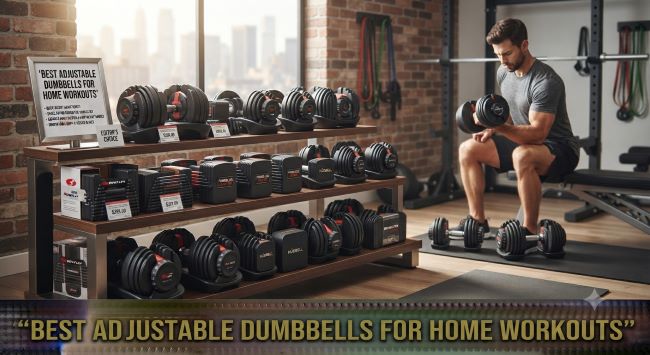
Why Adjustable Dumbbells Make Sense
The case for the best adjustable dumbbells is mostly space and money. A single pair replaces 5 to 15 pairs of fixed dumbbells, occupying one small stand instead of a full rack. For home gyms, apartments, and anyone without a dedicated gym room, this is transformative.
The value math is compelling too: a quality set costs less than the equivalent range in fixed dumbbells, and far less than a gym membership over time. The tradeoff is more mechanical complexity, a moment to change weight, and more bulk per dumbbell, all well worth the space and money saved for most home users.
The Two Main Mechanisms
Understanding how the best adjustable dumbbells change weight helps you choose the right set:
Dial/selector systems. You turn a dial at each end, and the dumbbell picks up only the selected plates when lifted from its cradle. Fast, intuitive, and the most popular mechanism. The tradeoff is that they rely on the cradle (you must return them to the base to change weight) and can be damaged if dropped.
Pin/lever systems. A pin or lever selects the weight, similar in speed to dial systems.
Twist/spinlock systems. Older-style dumbbells where you manually add and remove plates secured by a collar. Cheapest, most durable, and most tedious, since changing weight takes real time. Fine for setting a weight and sticking with it, frustrating for frequent mid-workout changes.
Dial and pin systems are what most people mean by “adjustable dumbbells” today, prized for changing weight in seconds; spinlock is the budget and durability option.
What to Look For
The specs and features that separate the best adjustable dumbbells from the rest:
- Weight range. Common ranges run 5-25, 5-50, 5-52.5, and up to 5-90 lbs per dumbbell. Match it to your strength and goals with room to grow; most home users are well served topping out around 50 lbs.
- Weight increments. Smaller increments (2.5 or 5 lbs) allow finer progression, which matters for smaller muscle groups and beginners. Some sets jump in larger increments at the top of the range.
- Adjustment speed. Dial and pin systems change in seconds; spinlock takes much longer. For circuits and supersets where you change weight constantly, fast adjustment matters enormously.
- Build quality and durability. The mechanism is the failure point. Read reviews specifically about longevity and how the dumbbells handle being set down firmly.
- Compact shape and feel. Some are long and unwieldy at low weights, affecting certain exercises; shorter, balanced designs feel more natural.
- Handle comfort. Knurling and grip diameter affect feel during high-rep sets.
- The cradle or stand. Dial systems need their base to change weight, so it is part of the product, not an accessory.
Weight Range: How Much Do You Need?
Choosing the range is the most important best adjustable dumbbells decision, and it depends on your training:
| User Type | Suggested Range |
|---|---|
| Beginner, general fitness | 5-25 or 5-50 lbs |
| Intermediate, muscle building | 5-52.5 lbs |
| Stronger lifters | 5-90 lbs or dual sets |
| Light toning and rehab | 5-25 lbs |
The common mistake is buying too light and outgrowing the set, or buying far heavier than you will ever use. For most people building general strength at home, a set reaching 50 to 52.5 lbs per dumbbell covers the vast majority of exercises for years. Very strong lifters may need the 90 lb range or a second set.
Getting the Most From Adjustable Dumbbells
A pair unlocks a huge range of exercises, and the key to value is using that range. A single set trains every major muscle group: presses and flyes for chest, curls and extensions for arms, shoulder presses and raises, squats and lunges for legs, and rows for the back. That back training in particular is where dumbbells shine, and a routine like the one in Back Exercises With Dumbbells shows how a single adjustable pair replaces an entire cable machine for building a stronger back at home, which is exactly the kind of full-body versatility that justifies the purchase.
Practical Buying and Use Tips
A few habits maximize the best adjustable dumbbells investment:
- Buy quality on the mechanism, since a broken adjustment system ruins the whole dumbbell. Not the place to buy the cheapest.
- Get a stand, since setting dial dumbbells on the floor repeatedly is inconvenient and hard on the mechanism; a stand at cradle height makes weight changes effortless.
- Handle them with care. Dial and pin systems are more delicate than solid iron, so set them down deliberately rather than dropping them.
- Start with proper increments, ensuring the set has small enough jumps for the exercises where you are weakest.
- Confirm the return policy, since feel and balance are personal, and your first workouts reveal fit.
Are They Right for You?
The honest summary: the best adjustable dumbbells are ideal for home gyms, apartments, and anyone wanting a full weight range without a full rack, delivering genuine gym-quality training in a fraction of the space. They are less ideal for anyone who drops weights hard, commercial gyms with heavy daily abuse, and lifters needing loads beyond consumer ranges.
For the enormous middle ground of home fitness, though, a quality set of the best adjustable dumbbells is one of the highest-value purchases you can make, replacing a full rack, saving space and money, and training your whole body from one compact pair.
Key Takeaways
- Adjustable dumbbells replace 5-15 pairs of fixed dumbbells in one compact pair, saving major space and money for home gyms.
- Dial and pin systems change weight in seconds and are the most popular; spinlock plate-loaded sets are cheaper and more durable but slow to adjust.
- Match the weight range to your goals: 5-50 or 5-52.5 lbs covers most home users, with 90 lb ranges for stronger lifters.
- Smaller weight increments allow finer progression, which matters for beginners and smaller muscle groups.
- The mechanism is the failure point, so buy quality there and handle dial and pin systems carefully rather than dropping them.
- Get a stand at cradle height to make weight changes effortless and protect the mechanism.
- A single pair trains every major muscle group, from presses and curls to rows and squats.
- They suit home gyms and apartments best, but are less ideal for hard droppers, commercial abuse, or very heavy loads.