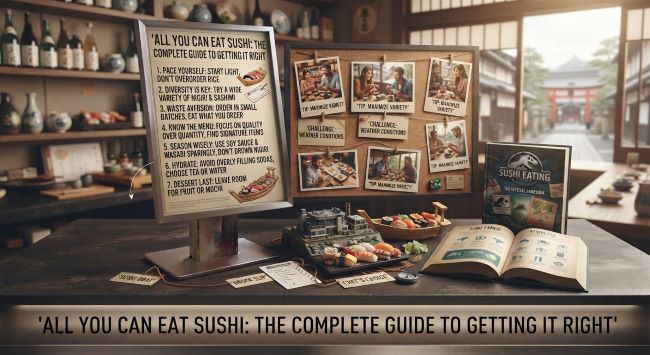
All You Can Eat Sushi: The Complete Guide to Getting It Right
There is a particular kind of joy in sitting down at a sushi restaurant knowing you can order as much as you want. No mental math on the bill, no agonizing over whether to get one more roll, just a run of plates arriving until you are genuinely, happily full. All you can eat sushi has become enormously popular for exactly that reason, offering the appeal of unlimited variety at a fixed price. But not every experience is created equal. Some places serve genuinely good fish and generous variety; others cut corners in ways that leave diners disappointed. The difference comes down to knowing what to look for and how to approach it. Here is the complete guide to all you can eat sushi: how it works, how to spot a good one, and how to make the most of your meal.
What Is All You Can Eat Sushi?
All you can eat sushi is a dining format where you pay a fixed price and can order as much sushi as you like within certain conditions. Rather than paying per roll or per piece, you pay once and order repeatedly from a set menu, usually within a time limit.
The typical structure works like this:
- A fixed price per person, often differing between lunch and dinner, with lunch generally cheaper.
- A dedicated menu, listing what is included in the deal, which may be narrower than the full à la carte menu.
- Order-by-round service, where you order a batch of items, receive them, then order again, rather than a buffet line.
- A time limit, commonly around 60 to 120 minutes.
- A no-waste policy, with fees charged for food left uneaten.
Understanding this structure is the foundation of a good experience, since the rules directly shape how you should order and pace yourself. Most quality restaurants in this format use order-based service rather than a buffet, which is generally a very good sign.
Order-Based vs. Buffet: A Crucial Distinction
The single most important quality signal in all you can eat sushi is whether the restaurant serves order-based or buffet-style. This distinction matters more than almost anything else.
Order-based service means you order from a menu and the kitchen prepares each item fresh for you. The sushi arrives made to order, meaning the rice is at a better temperature, the fish has not been sitting out, and the nori on rolls has not gone soggy. This is how good all you can eat sushi restaurants operate.
Buffet-style service means sushi sits pre-made on a counter or conveyor, waiting for diners to take it. The problem is obvious: sushi is highly perishable and best eaten immediately after being made. Fish sitting under lights loses quality, rice hardens or gets cold, and nori turns limp. Buffet sushi is almost always inferior.
If you take one thing away about choosing all you can eat sushi, make it this: strongly prefer restaurants that make each order fresh. The difference in quality between made-to-order and pre-made sushi is enormous, and it is the clearest indicator of whether a restaurant takes its food seriously.
How to Spot a Quality Restaurant
Beyond the order-based question, several signals help you identify good all you can eat sushi:
| Signal | What It Suggests |
|---|---|
| Made to order | Fresh, properly prepared sushi |
| Busy restaurant | High turnover means fresher fish |
| Clean, fresh smell | Good fish handling |
| Good reviews on fish quality | Consistent standards |
| Reasonable but not rock-bottom price | Sustainable quality |
| Visible, skilled sushi chefs | Genuine craft |
A busy restaurant is a good sign, since high customer turnover means fish is being used and restocked quickly rather than sitting. An empty one is a warning.
The smell matters enormously. A good sushi restaurant smells clean and faintly of the sea, never strongly fishy. A strong fishy odor indicates fish past its prime, and it is reason enough to leave.
Read reviews specifically about fish quality, not just value or quantity. Reviews mentioning fresh fish, good rice, and skilled preparation are far more useful than ones just praising the price.
Be realistic about price. An unusually low price often means lower-grade fish, heavy reliance on rice-heavy rolls, or corners cut elsewhere. A moderate price generally reflects sustainable quality, and paying a bit more usually delivers a much better meal.
The Rules You Need to Know
Every all you can eat sushi restaurant sets its own rules, and knowing them prevents unpleasant surprises:
Time limits. Most places cap your meal at a set duration. Knowing your limit lets you pace your ordering appropriately rather than being cut off mid-meal.
Waste charges. Nearly all such restaurants charge for uneaten food. This is entirely reasonable, since it prevents waste, but it means you should order in moderate rounds rather than piling up more than you can finish.
Order limits per round. Some restaurants cap how many items you can order at once, requiring you to finish a round before ordering more. This also helps prevent waste.
Menu restrictions. The unlimited menu is often narrower than the full menu, and premium items may be excluded or cost extra. Check what is included before assuming.
Sharing rules. Most places require everyone at the table to participate in the deal, and sharing your unlimited order with someone who did not pay is typically not allowed.
Drinks and extras. Beverages, and sometimes certain appetizers or desserts, are usually not included in the fixed price.
Reading the rules on the menu takes a minute and prevents both awkwardness and unexpected charges.
Ordering Strategy: How to Get the Most Value
Approaching all you can eat sushi thoughtfully genuinely improves the experience. Here is how to order well:
1. Start with the good stuff. Order the items you most want first, especially higher-value fish like sashimi and nigiri, while your appetite is at its peak. Saving the best for last usually means being too full to enjoy it.
2. Prioritize sashimi and nigiri over heavy rolls. This is the single most valuable strategy. Big American-style rolls are loaded with rice, tempura, cream cheese, and sauces, all of which fill you up fast with cheap ingredients. Sashimi is pure fish, and nigiri is fish over a modest amount of rice. Ordering these maximizes both the quality and the value of your all you can eat sushi experience.
3. Order in moderate rounds. Get a reasonable amount, eat it while fresh, then order more. This keeps everything at its best and avoids waste charges.
4. Skip or limit the fillers. Rice, edamame, miso soup, salad, and noodles are inexpensive for the restaurant and filling for you. Enjoy a little if you like them, but do not fill up on them.
5. Go easy on drinks. Especially carbonated ones, which fill you up quickly. Water or tea is a better companion.
6. Try new things. Unlimited ordering is the perfect low-risk opportunity to sample fish you have never tried, since a piece you dislike costs you nothing extra.
7. Pace yourself. Eating too fast makes you feel full sooner. Slowing down lets you eat more comfortably and enjoy the meal properly.
This approach is not about “beating” the restaurant, it is about actually enjoying the best food available and not filling up on the cheapest items.
Understanding Nigiri and Sashimi
Since prioritizing nigiri and sashimi is such a key strategy, it helps to understand what makes them special. Nigiri is a slice of fish or seafood pressed over a small mound of seasoned rice, sometimes with a touch of wasabi between them. Sashimi is simply slices of raw fish served without rice. Both put the fish front and center, which is precisely why they showcase a restaurant’s quality, and why they represent the best value in an unlimited format.
Exploring different nigiri varieties is one of the great pleasures of all you can eat sushi. Beyond the familiar salmon and tuna, restaurants often offer a wide range worth trying. Eel nigiri, for example, is a beloved variety with a rich, sweet, savory character quite unlike raw fish, and the guide at Best Sushi Nigiri Eel Near Me explores what makes a great version of it, which is useful context when you are sampling widely at an unlimited restaurant. Similarly, octopus nigiri offers a completely different texture and flavor experience, firm and subtly sweet, and the guide at Sushi Nigiri Octopus Near Me covers what to look for in it, both of which help you order more adventurously and knowledgeably when the menu is unlimited and experimenting costs you nothing.
Judging Sushi Quality at the Table
Once your food arrives, several things reveal whether the all you can eat sushi is genuinely good:
The fish. Good fish looks vibrant and slightly glossy, not dull, dry, or discolored. It should taste clean and fresh, never strongly fishy or mushy. Texture matters: fish should be firm and pleasant, not slimy or falling apart.
The rice. This is the element most people overlook, yet sushi rice is arguably the heart of good sushi. Proper sushi rice is served at around body temperature, not cold from the fridge, and it is lightly seasoned with vinegar, sugar, and salt. The grains should hold together when picked up but fall apart pleasantly in your mouth, never being mushy, hard, or bland. Cold, hard, or flavorless rice is a strong sign of a mediocre restaurant.
The cutting. Well-cut fish has clean, precise edges and consistent thickness, reflecting a skilled chef with sharp knives. Ragged, torn, or uneven slices indicate poor knife work or dull blades, and they affect the texture in your mouth.
The proportions. A good piece of nigiri has a sensible balance of fish to rice. Enormous rice mounds with thin slivers of fish signal a restaurant cutting costs.
The presentation. Care in plating usually reflects care in preparation overall.
The wasabi and ginger. These accompaniments are easy to overlook, but they tell you something too. Fresh pickled ginger should be pale and delicately sweet-sharp rather than lurid pink and harsh, and it is meant as a palate cleanser between different fish rather than a topping. Wasabi at most restaurants is a horseradish-based substitute rather than true grated wasabi root, which is entirely normal and not a mark against a place, though restaurants serving real wasabi are signalling a serious commitment to quality.
That last point about cutting is worth dwelling on, since knife skill is fundamental to sushi in a way many diners never consider. The clean, precise slicing that gives sashimi its silky texture depends entirely on extremely sharp, properly maintained blades, and the guide at Best Sushi Knives explores the specialized knives behind that craft, which gives you real appreciation for what separates skilled preparation from careless cutting when you are evaluating the sushi in front of you at an unlimited restaurant.
Etiquette and Being a Good Customer
A little consideration makes all you can eat sushi better for everyone, including you:
- Do not waste food. Order what you will actually eat. Waste charges exist for good reason, and deliberately over-ordering is disrespectful to both the restaurant and the food.
- Be patient with service. Made-to-order sushi takes time, and rushing the kitchen is counterproductive.
- Be polite to your server, who is handling multiple rounds of orders for your table.
- Tip appropriately, since unlimited ordering involves substantially more service than a single-order meal. Tipping on the value of what you ate, not just the discounted fixed price, is a considerate practice.
- Respect the time limit, and be ready to wrap up when it ends.
- Do not try to game the system by sharing with non-participants or hoarding orders.
Being a considerate customer often results in better service, and it keeps these deals viable for everyone who enjoys them.
Common Mistakes to Avoid
Several missteps can undermine the experience:
Filling up on rice-heavy rolls first. The most common mistake. Those big specialty rolls are delicious but they are mostly rice and fillers, and they fill you up fast.
Arriving too hungry. Counterintuitively, arriving absolutely starving often leads to over-ordering in the first round and then wasting food. Arrive hungry, but not desperate.
Drinking too much soda. Carbonation fills you up remarkably quickly.
Ordering everything at once. This leads to sushi sitting and degrading on your table while you eat, plus potential waste charges.
Ignoring the rules. Not checking the time limit or waste policy leads to unwelcome surprises.
Choosing the cheapest option available. Rock-bottom prices usually mean rock-bottom quality, and a disappointing meal is poor value at any price.
Skipping the rice quality check. Judging only the fish and ignoring the rice means missing half of what makes sushi good.
Drowning everything in soy sauce. Heavy dipping overwhelms the delicate flavor of good fish and makes every piece taste the same. With nigiri, the traditional approach is to dip the fish side lightly rather than soaking the rice, which also stops the rice from falling apart. If a restaurant is serving genuinely good fish, you want to actually taste it, and a light touch lets the quality come through instead of masking it under salt.
Is All You Can Eat Sushi Worth It?
The honest answer depends on your appetite and priorities. All you can eat sushi genuinely delivers value if you have a healthy appetite, enjoy variety, and want to try many different items without worrying about a mounting bill. For someone who wants to sample widely and eat a substantial amount, it can be excellent value.
However, if you have a modest appetite, or if you prioritize the absolute highest quality fish above all else, ordering à la carte at a quality sushi restaurant may serve you better. The very best sushi restaurants, where chefs work with premium fish and serve pieces individually at their peak, generally do not offer unlimited deals. All you can eat sushi occupies a middle ground: good quality at good value, rather than the pinnacle of the craft.
The most sensible way to think about it is this: all you can eat sushi is excellent for a fun, generous, variety-filled meal with friends or family, especially at a restaurant that makes everything to order with fresh fish. It is not the format for a once-in-a-lifetime, chef’s-selection experience, and that is fine, since it is not trying to be.
Lunch vs. Dinner
One practical consideration is timing. Many restaurants offer lunch deals at noticeably lower prices than dinner. The menus are sometimes slightly more limited at lunch, but the price difference can be substantial. If value is your priority and you can dine midday, lunch is often the smarter choice. If you want the fullest menu and a more relaxed evening meal, dinner is worth the premium. Checking both menus before deciding helps you choose the better option for what you want.
Making the Most of Your Experience
Bringing it all together, the ideal approach to all you can eat sushi looks like this. Research restaurants beforehand, prioritizing ones with strong reviews about fish quality and made-to-order service. Confirm the price, time limit, and rules before you begin. Arrive with a good appetite but not ravenous. Start with sashimi and nigiri while your appetite is strongest, ordering in moderate rounds so everything arrives fresh. Use the opportunity to try varieties you have never had. Pay attention to the rice as well as the fish. Pace yourself, avoid filling up on rice-heavy rolls and drinks, finish what you order, and tip well for the extra service.
Follow that approach and the format delivers exactly what makes it appealing: a generous, varied, genuinely enjoyable meal at a predictable price, with the freedom to explore the menu without watching the bill climb.
The bottom line on all you can eat sushi is that it can be a fantastic value and a genuinely great meal, provided you choose the right restaurant and approach it thoughtfully. Strongly favor places that make everything to order rather than buffet-style, look for busy restaurants with clean smells and good reviews about fish quality, and be realistic that unusually cheap deals usually mean lower-grade fish. Once seated, know the rules on time limits and waste, prioritize sashimi and nigiri over rice-heavy specialty rolls, order in moderate rounds, judge the rice as carefully as the fish, and use the format as a low-risk chance to try varieties you have never had. Do that, and you will get the best of what this popular dining format has to offer.
Key Takeaways
- All you can eat sushi is a fixed-price format where you order unlimited items, usually within a time limit and with waste charges.
- The most important quality signal is order-based, made-to-order service rather than pre-made buffet-style sushi.
- Buffet sushi degrades quickly, since fish loses quality, rice hardens, and nori goes soggy while sitting out.
- Look for busy restaurants, a clean sea-like smell rather than a fishy one, and reviews praising fish quality specifically.
- Be wary of unusually cheap deals, which typically mean lower-grade fish and heavy reliance on rice-filled rolls.
- Prioritize sashimi and nigiri over big specialty rolls, since rolls are mostly rice and fillers that fill you up fast.
- Order in moderate rounds, pace yourself, go easy on soda and sides, and finish what you order to avoid waste charges.
- Judge the rice as well as the fish: proper sushi rice is body temperature, lightly vinegared, and holds together without being mushy.
- Use the unlimited format as a low-risk chance to try unfamiliar varieties like eel or octopus nigiri.
- Tip generously, since unlimited service involves considerably more work than a standard single-order meal.