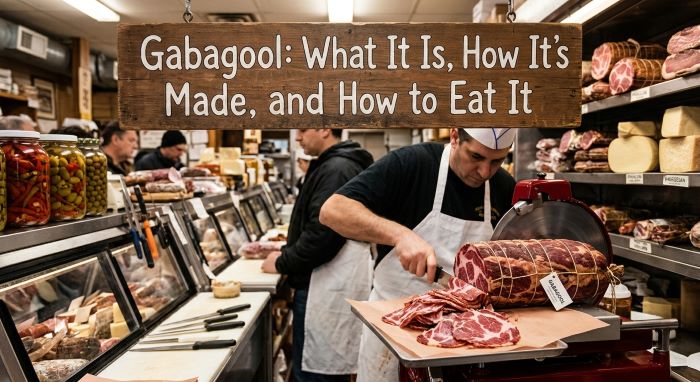
Gabagool
If you’ve watched The Sopranos, you’ve heard the word gabagool. Tony Soprano and his crew say it with love, usually while raiding the fridge or ordering at the deli. But what is it, and why does it sound so different from the name on the deli label?
The answer is simple. It’s capocollo, a cured Italian pork cold cut, spoken the way many Southern Italian immigrants and their families said it. This guide covers the name, the meat, how it’s made, and the best ways to eat it.
What Is Gabagool?
The word is an Italian American way of saying capocollo, also known as capicola, capicollo, or coppa. Capocollo is a whole muscle pork salume, which means it’s made from one solid piece of meat rather than ground meat like salami.
The name comes from two Italian words: “capo,” meaning head, and “collo,” meaning neck. That tells you where the meat comes from. It’s cut from the muscle that runs from the pig’s neck to about the fourth or fifth rib of the shoulder.
| Name | Where you’ll hear it |
|---|---|
| Capocollo | Standard Italian |
| Coppa | Northern Italy and Corsica |
| Capicola or capicolla | Common in the US and Canada |
| Capecuollo | Neapolitan dialect |
| Gabagool | Italian American slang, especially in the Northeast |
| Bondiola | Argentina, Uruguay, and Paraguay |
Why Does It Sound Like That?
Many Italian immigrants who came to the United States in the late 1800s and early 1900s were from Southern Italy, including Naples, Calabria, Sicily, and Campania. They didn’t speak the standard Italian heard in Rome or Florence. They spoke regional dialects, and those dialects changed how words sounded.
The Neapolitan word for this meat is “capecuollo.” Over time, in Italian American neighborhoods in New York and New Jersey, it shifted into gabagool. Three common speech patterns helped:
- Softer consonants: The hard “c” and “p” sounds often became “g” and “b.”
- Dropped endings: The final vowel was often swallowed, so “capocollo” lost its last “o.”
- Vowel shifts: Unstressed vowels became softer or changed sound.
The same thing happened with other foods. Mozzarella became “mootz,” ricotta became “ri gawt,” and prosciutto became “pruh shoot.” These pronunciations are a living part of Italian American culture, passed down at family dinners and neighborhood delis.
The Sopranos Effect
The HBO series The Sopranos, which ran from 1999 to 2007, made this pronunciation famous around the world. The show followed Tony Soprano, a New Jersey mob boss, and his family. Characters often talked about food, and Tony’s love of gabagool became one of the show’s best known running jokes.
After the show, the word spread far beyond Italian American communities. It showed up in memes, T shirts, restaurant menus, and even sandwich names. Some Italian Americans enjoy it as a fun nod to their heritage. Others feel the show turned their family’s way of speaking into a stereotype. Both views are common.
How Capocollo Is Made
Traditional capocollo takes patience. Here is how it’s usually made:
- Cut the meat. Butchers remove the neck and upper shoulder muscle as one piece. This cut has a good mix of lean meat and fat, which gives the cured meat its tender, marbled look.
- Season it. The meat is rubbed with salt and spices. Recipes vary by region and often include black pepper, garlic, wine, fennel, paprika, and red pepper. Unlike many hams, it isn’t soaked in brine.
- Rest it. The seasoned meat rests in the cold for days so the salt can work its way in.
- Case and tie it. The meat is stuffed into a natural casing and tied tightly with string to keep its shape.
- Hang and cure. It’s hung in a cool, humid room to dry slowly. Curing can take up to six months.
The result is a deep red, marbled meat with a rich, slightly sweet and salty flavor. It’s sliced very thin, almost see through, because thick slices can be chewy.
Protected Versions in Italy
Some types of capocollo are protected by the European Union, meaning they must be made in a specific place using traditional methods:
| Product | Region | Protection |
|---|---|---|
| Coppa Piacentina | Piacenza, Emilia-Romagna | PDO |
| Capocollo di Calabria | Calabria | PDO |
| Coppa de Corse | Corsica, France | PDO |
| Capocollo di Martina Franca | Puglia | PGI |
Coppa Piacentina, for example, must be processed in the province of Piacenza and aged for at least six months. Calabrian capocollo is often spicier, reflecting the region’s love of hot chili peppers.
Sweet vs. Hot
In American delis, you’ll often see two choices:
- Sweet: Seasoned mainly with black pepper. It’s mild, not actually sugary.
- Hot: Coated with red pepper or paprika, giving it a red outer ring and a spicy kick.
Both are delicious. Sweet works well when you want the pork flavor to shine. Hot is great on sandwiches and pizza.
Capocollo vs. Ham Capocollo
Many American delis also sell “ham capocollo” or “cappy ham.” This is different from traditional dry cured capocollo. Ham capocollo is a cooked ham coated with spices. It’s leaner, larger, and softer, and it’s often used in breakfast and lunch sandwiches. Traditional capocollo is raw meat preserved by curing, with a firmer texture and deeper flavor.
How It Compares to Other Cured Meats
| Cured meat | Cut | Texture | Flavor |
|---|---|---|---|
| Capocollo | Neck and shoulder | Tender and marbled | Rich, slightly spicy |
| Prosciutto | Hind leg | Silky and delicate | Sweet and salty |
| Salami | Ground pork | Firm | Tangy and fatty |
| Soppressata | Ground pork, pressed | Coarse | Bold, often spicy |
| Pancetta | Belly | Fatty | Savory, usually cooked |
| Bresaola | Beef eye of round | Lean | Mild and earthy |
Capocollo sits between prosciutto and salami. It has the whole muscle texture of prosciutto but more fat marbling and stronger seasoning.
How to Eat It
There are many ways to enjoy capocollo:
- On a charcuterie board with cheeses like provolone, mozzarella, or pecorino, plus olives and bread.
- In an Italian sub with salami, provolone, lettuce, tomato, onion, oil, and vinegar.
- On pizza, where hot capocollo crisps at the edges.
- Wrapped around melon or asparagus as an appetizer.
- In a panini with fresh mozzarella and roasted peppers.
- Crisped in a pan and added to pasta or eggs.
Easy Crispy Sandwich Idea
Food Network shared a recipe from Good Company in Cleveland that shows how well this meat works hot. Here’s a simple version inspired by it:
| Ingredient | Amount |
|---|---|
| Hoagie rolls | 4 |
| Thin sliced capocollo | 1 pound |
| Sliced white American or provolone cheese | 8 slices |
| Pickled banana peppers | About 4 ounces |
| Shredded romaine | Half a head |
| Italian dressing | 2 ounces |
| Mayonnaise | 4 ounces |
Steps:
- Split the rolls and spread mayo on the bottom halves.
- Toss the lettuce with Italian dressing and place it on the rolls.
- Pile the meat into four mounds and fry them in a hot skillet for about 5 minutes, until crispy on one side.
- Flip each mound, add pickled peppers and two slices of cheese, and cook about 3 minutes until melted.
- Slide each mound onto a roll, add a sauce of your choice to the top half, and close.
The original recipe also includes homemade pickled peppers and a tangy house sauce made with mustard, capers, and lemon.
How to Buy and Store It
When buying gabagool at the deli:
- Ask for it sliced thin. Paper thin slices taste best.
- Choose sweet or hot based on how you’ll use it.
- Look for marbling. Good capocollo has a nice balance of fat and lean meat.
- Buy small amounts. Sliced cured meat tastes best within a few days.
Store sliced capocollo wrapped in deli paper or an airtight container in the fridge. Eat it within about three to five days. A whole, unsliced piece lasts much longer when kept cold and wrapped.
Nutrition Basics
Like most cured meats, capocollo is high in protein and fat and also high in salt. A typical one ounce serving has roughly 70 to 100 calories, depending on the brand. Because of the sodium, it’s best enjoyed in moderation as part of a balanced diet.
Fun Facts
- The name literally means “head neck” in Italian.
- In Argentina, the same cut is called bondiola.
- Coppa Piacentina must age at least six months.
- The Sopranos made the slang version known worldwide.
Frequently Asked Questions
What is gabagool in English? It’s capocollo, also called capicola or coppa, a cured Italian pork cold cut made from the neck and shoulder.
Why do people say it that way? The pronunciation comes from Southern Italian dialects, especially Neapolitan, spoken by many Italian immigrants in the US.
Is capicola the same as ham? Traditional capicola is dry cured, not cooked. “Ham capocollo” is a cooked, spiced ham that’s sold in many American delis.
Is it spicy? It can be. Hot versions use red pepper, while sweet versions are milder.
Where can I buy it? Most Italian delis and many grocery store deli counters sell capicola, sweet or hot.
Final Thoughts
Gabagool is more than a funny word from a TV show. It’s a delicious cured meat with deep roots in Italian food traditions and a name shaped by generations of Italian American families. Whether you call it capocollo, coppa, or the Sopranos way, it’s worth a spot on your next sandwich or charcuterie board.
Key Takeaways
- Gabagool is the Italian American pronunciation of capocollo, a cured pork cold cut.
- The name comes from “capo” (head) and “collo” (neck), the part of the pig it’s cut from.
- The pronunciation grew out of Southern Italian dialects, especially Neapolitan.
- The Sopranos made the word famous around the world.
- Capocollo is salted, spiced, cased, and cured for up to six months.
- Coppa Piacentina and Capocollo di Calabria are protected in the EU.
- Sweet versions use black pepper, while hot versions use red pepper.
- Slice it thin and enjoy it in sandwiches, on pizza, or on a charcuterie board.