Back Exercises With Dumbbells: Build a Stronger Back at Home
The back is the muscle group people neglect the longest, mostly because they cannot see it in the mirror. Then the posture slips, the shoulders round forward from desk work, and back training turns urgent. The good news: you do not need a cable station or a pull-up bar to fix it. A pair of dumbbells covers every major back muscle, and back exercises with dumbbells offer some advantages barbells cannot match, including a longer range of motion and the ability to fix side-to-side strength imbalances one arm at a time.
The Muscles You Are Training
A quick map, because knowing what back exercises with dumbbells target makes every rep count:
- Lats (latissimus dorsi). The large wing muscles running down the sides of your back. They create the V-taper and power all pulling motions.
- Traps (trapezius). Upper back and neck region, responsible for shrugging and supporting the shoulders.
- Rhomboids and rear delts. Between and behind the shoulder blades. These are the posture muscles that counteract desk slouch.
- Erector spinae. The columns of muscle along the spine that keep you upright and protect the lower back.
A complete session of back exercises with dumbbells should touch all four regions, which the workout below is built to do.
The Six Essential Movements
1. One-Arm Dumbbell Row
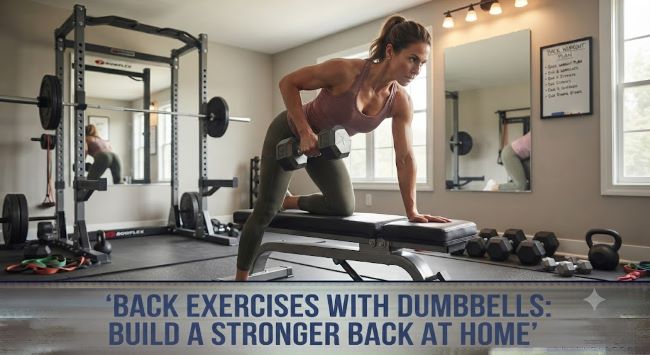
The king of back exercises with dumbbells. Place your left knee and left hand on a bench, hold the dumbbell in your right hand, and keep your back flat like a table. Pull the weight toward your hip, not your armpit, leading with your elbow. Squeeze at the top for a beat and lower under control.
Form keys: keep your torso still and pull with your back, not your arm. Rowing toward the hip hits the lats; toward the ribs shifts work to the upper back.
2. Bent-Over Two-Dumbbell Row
Stand with feet hip-width, hinge at the hips to roughly 45 degrees, keep the spine neutral, and row both dumbbells to your sides simultaneously. This version loads the whole back plus the erectors, which work overtime just holding the hinge position.
Form keys: the hinge comes from pushing your hips back, not rounding your spine. If your lower back complains, raise your torso angle or drop the weight.
3. Dumbbell Deadlift
Hold dumbbells at your sides, hinge at the hips until the weights reach mid-shin, then drive through your heels to stand tall. The deadlift trains the erectors, glutes, and hamstrings as one chain, building the foundation every other exercise depends on.
Form keys: the dumbbells travel close to your legs the whole way. Shoulders stay pulled back, and you finish standing tall without leaning backward.
4. Dumbbell Pullover
Lie across a bench with only your upper back supported, hold one dumbbell with both hands above your chest, and lower it in an arc behind your head until you feel a deep lat stretch. Pull it back over your chest using your lats, not your arms.
Among back exercises with dumbbells, this is the only one training the lats through a full overhead stretch. It doubles as a chest move, making it efficient for full-body routines.
5. Renegade Row
In a push-up position with hands on dumbbells, row one weight to your hip while balancing on the other arm. Alternate sides. The anti-rotation demand turns this into a core and back exercise simultaneously.
Form keys: feet wide for balance, hips level throughout. If your hips swing side to side, the weight is too heavy.
6. Dumbbell Shrug
Stand tall holding heavy dumbbells at your sides and lift your shoulders straight up toward your ears, pause, and lower slowly. Shrugs isolate the upper traps and finish the session.
Form keys: straight up and down. Rolling the shoulders in circles adds nothing and irritates the joint.
The Complete Workout
Run this session one to two times per week, resting at least two days between:
| Exercise | Sets | Reps |
|---|---|---|
| Dumbbell deadlift | 3 | 8-10 |
| One-arm row | 3 per side | 10-12 |
| Bent-over row | 3 | 10-12 |
| Pullover | 3 | 12-15 |
| Renegade row | 2 | 8 per side |
| Shrug | 2 | 12-15 |
Rest 60 to 90 seconds between sets. Beginners: start with the first three exercises, master the hinge, and add the rest over a few weeks. For weight selection, the last two reps of every set should feel hard but doable with clean form. When all sets hit the top of the rep range cleanly, increase the weight at the next session. That progression rule is what turns back exercises with dumbbells from movement practice into actual muscle growth.
Form Mistakes That Sabotage Results
Four errors show up constantly with back exercises with dumbbells:
- Rounding the lower back on hinges. The most consequential mistake. Film yourself from the side once; a flat back on rows and deadlifts is non-negotiable.
- Using momentum. Heaving the dumbbell up with a torso jerk trains nothing. Slower and lighter beats heavier and sloppier every time for back development.
- Pulling with the arms. If your biceps burn out before your back tires, start each rep by driving the elbow back and squeezing the shoulder blade.
- Skipping the squeeze. The one-second pause at the top of every row is where the mind-muscle connection lives. Rushed reps skip the most productive moment.
Why Dumbbells Work So Well for Back Training
Compared to machines and barbells, back exercises with dumbbells force each side to carry its own load, which exposes and fixes the strength imbalances almost everyone has. They allow a longer range of motion at the top of rows, where the squeeze happens. They require stabilizer muscles to control the path of every rep. And they make training at home realistic: one adjustable pair covers everything on this list, from your first workout to years down the road.
Pair this session with a push-focused workout and the desk slouch starts reversing within six to eight weeks.
One safety note to close on: back training is safe and protective when done with progressive, controlled form, but anyone with an existing back injury or persistent pain should get cleared by a medical professional before loading these movements.
Key Takeaways
- A pair of dumbbells covers all four back regions: lats, traps, rhomboids/rear delts, and the erector spinae.
- The six core movements are the one-arm row, bent-over row, dumbbell deadlift, pullover, renegade row, and shrug.
- Row toward the hip to emphasize lats, keep a flat back on every hinge, and pause for a one-second squeeze at the top of each rep.
- Run the full workout one to two times weekly, resting 60-90 seconds between sets and at least two days between sessions.
- Increase weight only when every set reaches the top of the rep range with clean form.
- Momentum, arm-dominant pulling, and a rounded lower back are the three form errors that stall progress and risk injury.
- Dumbbells fix left-right imbalances, extend range of motion, and make effective back training possible at home with one adjustable pair.
- Anyone with existing back pain or injury should get medical clearance before starting a loaded back program.