Fortnite Item Shop: What It Is and How It Works
If you have ever opened Fortnite and seen a wall of new skins, emotes, and back blings staring back at you, that is the Fortnite Item Shop. It is the in-game store where Epic Games sells cosmetic items for real money or V-Bucks, and it changes every single day. For new players, it can feel overwhelming. For longtime players, checking it has become part of the daily routine, almost like checking the weather.
This guide covers how the shop works, what kinds of items show up, how pricing works, and how to avoid wasting V-Bucks on things you will not use.
Fortnite Item Shop: A Complete Guide for New Players
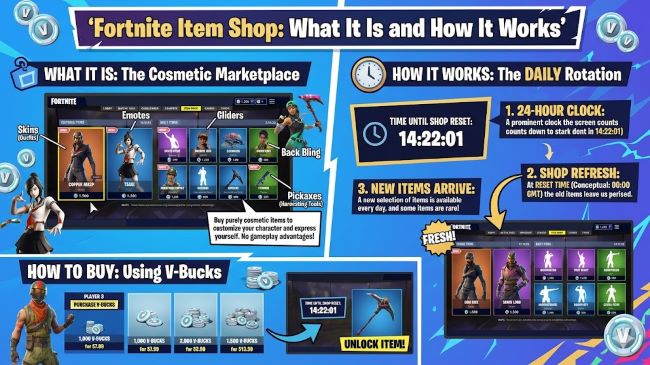
The shop sits in its own tab on the main menu, usually marked with a shopping bag icon. Tap it and you get a grid of items split into sections. Most days you will see a featured row at the top with the newest or most hyped items, then rows below for skins, emotes, wraps, pickaxes, gliders, and bundles.
Everything in the shop is cosmetic. None of it changes how your character plays, how fast you run, how much damage your weapons do, or anything that affects matches. It is purely about how your character looks and how you celebrate when you win.
Items are bought with V-Bucks, Fortnite’s in-game currency. You can earn some V-Bucks through the Battle Pass and certain challenges, but most players top up by buying V-Bucks with real money through the platform store, whether that is the console store, PC launcher, or mobile app depending on where you play.
How the Shop Refreshes
The shop resets once a day, typically around the same time for everyone regardless of time zone, since it runs on a global schedule rather than local time. When it resets, some items rotate out and new ones rotate in. A handful of fan favorites get rotated back in regularly, while others disappear for months or longer before returning, if they return at all.
This rotation is the main reason people check the shop daily. If you see a skin you like, there is no guarantee it will still be there tomorrow. Some items are tied to specific events, collaborations, or seasons and may never come back in the same form.
Fortnite Item Shop: How Skins, Bundles, and Rotations Work
Skins are the most popular category by far, and they range from original Fortnite characters to licensed crossovers with movies, games, musicians, and other franchises. Prices for individual skins typically fall in a fairly standard range, with most character skins costing around 1,200 to 2,000 V-Bucks depending on rarity and how detailed the design is.
Bundles group a skin together with matching cosmetics like a back bling, pickaxe, glider, and sometimes an emote, all themed around the same character. Bundles usually cost more than a single skin but less than buying every item separately, so if you like the whole set, the bundle is the better value.
Some categories worth knowing:
- Outfits are the character skins themselves
- Back blings are accessories worn on the back, often tied to a specific outfit
- Pickaxes are the harvesting tools, which come in everything from simple designs to elaborate weapons or instruments
- Gliders are used when dropping from the Battle Bus or after using certain items
- Emotes are the dances and gestures characters perform
- Wraps change the appearance of weapons and vehicles
- Loading screens and sprays are smaller cosmetic extras often bundled with bigger purchases
Rarity affects both price and how an item looks, with higher rarity tiers generally getting more detailed animations, sounds, or style variants.
Fortnite Item Shop: How to Check Today’s Lineup and Save V-Bucks
Checking the shop takes seconds. Open Fortnite, go to the shop tab, and scroll through the rows. If you want to check without launching the game, plenty of fan sites and social media accounts post the daily lineup as soon as it updates, which is useful if you are deciding whether to log in at all that day.
A few habits help stretch your V-Bucks further:
- Wait before buying new releases. Brand new items sometimes get adjusted or bundled differently soon after launch, and waiting a day costs nothing.
- Track items you want. If a skin you like rotates out, note it. Many items return eventually, sometimes at a discount during special sales.
- Compare bundle math. Add up what the individual pieces would cost separately before assuming a bundle is the better deal. Most of the time it is, but it is worth a quick check.
- Use the Battle Pass V-Bucks. Completing a Battle Pass typically refunds enough V-Bucks to buy the next one, which effectively makes the cosmetic items inside it free over time.
- Set a budget per season. Treating V-Bucks like a monthly entertainment budget instead of an unlimited resource keeps spending from creeping up without you noticing.
Fortnite Item Shop: Everything You Need to Know Before You Buy
Before buying anything, it helps to know what you are actually getting. A purchase unlocks the item permanently for your account. It is not a rental and does not expire, regardless of how long the item stays available in the shop afterward.
Purchases are usually tied to your Epic Games account rather than a specific console or device, so an item bought on one platform generally shows up when you log into the same account elsewhere. There are some exceptions tied to platform-exclusive items, so it is worth checking before assuming everything carries over.
Refunds are limited. Fortnite gives players a small number of refund tokens that can be used on eligible purchases within a certain time window, mainly meant for accidental buys rather than buyer’s remorse on something you simply changed your mind about later.
Special collaborations, like crossovers with movies, musicians, or other games, tend to be the most expensive and the most likely to sell out of “future availability,” meaning Epic has stated they may never return. If a collaboration item matters to you, that is usually the one case where buying sooner rather than later makes sense.
Why the Shop Matters Even If You Do Not Buy Anything
Even players who never spend a dime still get value from browsing the shop. It is one of the easiest ways to see what is currently popular, spot collaborations with shows or games you follow, and get a sense of the game’s current season and theme through the cosmetics being pushed.
It also doubles as a kind of cultural pulse check. When a major collaboration drops, social media tends to light up with reactions, and the shop is often the first place people look to confirm whether the rumors were true.
Key Takeaways
- The Fortnite Item Shop is a daily-rotating in-game store for cosmetic items including skins, emotes, back blings, pickaxes, gliders, and wraps.
- Everything in the shop is cosmetic and has no effect on gameplay or competitive balance.
- The shop resets once a day on a global schedule, and items rotate in and out, with some returning regularly and others disappearing for long stretches. This kind of constant cosmetic refresh reflects the broader Improving in the Gaming industry trends seen across major titles.
- Skins typically cost around 1,200 to 2,000 V-Bucks, while bundles group a skin with matching items at a combined discount compared to buying separately.
- Purchases are permanent and tied to your Epic Games account, generally carrying across platforms with some platform-exclusive exceptions.
- Refund tokens are limited and meant for accidental purchases, not general buyer’s remorse.
- Completing a Battle Pass typically refunds enough V-Bucks to fund the next one, making it one of the better long-term values in the shop.
- Special collaboration items are the most likely to be marked as not returning, so those are the purchases worth making sooner if you want them.