What Is the Voluntary Exchange of Goods and Services?
You walk into a coffee shop and trade money for a cup of coffee. The barista willingly makes your drink. You willingly hand over your cash. Both of you walk away satisfied. Neither of you forced the other. This simple transaction embodies a foundational economic principle: what is the voluntary exchange of goods and services. It’s not complicated, but it underpins how modern economies function.
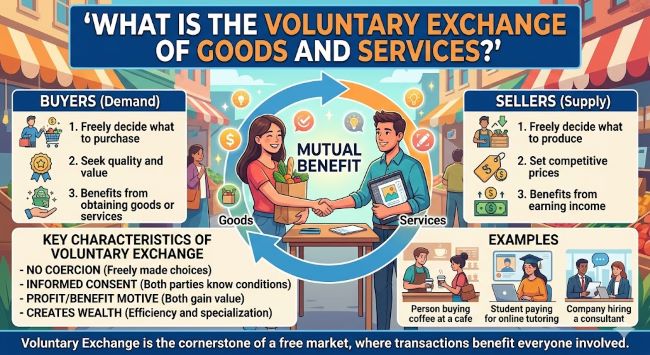
Voluntary exchange is the act of two parties freely agreeing to trade goods, services, or money without coercion. Each party believes they’ll benefit from the trade. The farmer trades wheat for bread because they value bread more than additional wheat. The baker trades bread for wheat because they value wheat more than bread. Both become better off. This isn’t luck or charity. It’s the core mechanism of how markets allocate resources and create wealth.
Understanding voluntary exchange definition economics helps explain why free markets work. It answers why people cooperate without government mandates. It shows why trade creates value rather than just moving it around. This principle shapes everything from local businesses to international commerce.
Defining Voluntary Exchange
Voluntary exchange definition starts with one core idea: all parties participate willingly. Nobody is forced. No coercion exists. Each person chooses to participate because they believe the trade makes them better off than before.
Core Elements of Voluntary Exchange:
- Willingness from all participants to engage in the trade
- Freedom to accept or reject the transaction
- Mutual benefit where both parties gain value
- No coercion from government, business, or other parties
- Clear understanding of what’s being exchanged
- Completion only when both parties agree
When you accept a job, you voluntarily exchange your labor for wages. Your employer voluntarily exchanges wages for your work. Both parties benefit. You get income and work experience. The employer gets productivity and value. The transaction completes because both sides believe they come out ahead.
This differs from forced exchanges. If a government taxes you without consent, that’s not voluntary exchange. If someone steals your wallet, that’s not voluntary exchange. Voluntary exchange requires agreement from both sides.
Why Voluntary Exchange Matters Economically
Voluntary exchange is far more than a nice principle. It’s the engine driving modern economies. When people are free to trade, several powerful things happen.
Economic Efficiency Through Voluntary Exchange:
When individuals trade freely, resources flow to the people who value them most. A farmer who doesn’t enjoy baking focuses on farming. A baker who loves creating bread focuses on baking. Through voluntary exchange, the farmer gets bread without learning to bake, and the baker gets grain without farming. Both are more productive focusing on what they do best.
This is specialization. It’s why someone becoming a specialist in their field is more productive than everyone doing everything. Voluntary exchange enables specialization by allowing people to trade their specialized output for the diverse goods and services they need.
Consider how your own specialization works. You become skilled at one job, then voluntarily trade your labor for money. You use that money to voluntarily exchange for food from farmers, electricity from utilities, entertainment from producers, and countless other goods. None of this requires planning committees or government coordination. Voluntary exchange orchestrates it all.
When businesses engage in voluntary exchange, they benefit from understanding how market forces drive efficiency. Consultants who help businesses optimize their operations often focus on these principles. Learning about business efficiency and profit optimization shows how voluntary exchange benefits companies in real-world practice.
The Components of Voluntary Exchange
Several parties participate in voluntary exchanges, each playing distinct roles.
The Participants:
Demanders are individuals or businesses seeking goods and services. They voluntarily choose to purchase items they value. A person buying shoes is a demander. A restaurant buying flour is a demander. Demanders drive demand and signal to suppliers what products people want.
Suppliers offer goods and services in exchange for payment. A shoe company is a supplier. A bakery supplying flour to restaurants is a supplier. Suppliers voluntarily offer products because they expect profit. The profit motive drives suppliers to meet customer needs effectively.
The Government’s Role in voluntary exchange is limited but important. Governments establish property rights, enforce contracts, and maintain infrastructure. They don’t dictate who trades with whom or at what prices. Governments remove barriers to trade, allowing voluntary exchange to flourish.
Small Businesses participate in voluntary exchange constantly. When a small bakery produces more bread than needed for its own operation, it voluntarily exchanges excess bread for money. Customers voluntarily choose to buy that bread. Both parties benefit.
The Benefits of Voluntary Exchange
When people are free to trade, benefits extend beyond the individual participants. Market competition also creates opportunities for specialization. Different businesses compete by developing unique marketing strategies and serving specific customer needs. Through voluntary exchange, competing businesses find their niches and innovate ways to serve them better.
Individual Benefits:
- Improved conditions as both parties gain value from the trade
- Specialization allowing focus on strongest skills
- Consumer choice providing options rather than mandates
- Price discovery showing true value through market transactions
- Innovation incentives as suppliers compete for customers
When you trade voluntarily, you immediately improve your situation. If you weren’t better off, you wouldn’t complete the transaction. This is guaranteed benefit, not hoped-for assistance.
Broader Economic Benefits:
Market Efficiency is the most significant benefit. In free markets with voluntary exchange, resources flow to highest-valued uses. A piece of land produces what consumers want most. Labor moves to industries where it’s most productive. Capital flows to investments with best returns. This happens automatically through voluntary trading, without central planning.
Competition and Innovation emerge from voluntary exchange. When suppliers compete for customers’ voluntary trades, they improve products and lower prices. Innovation accelerates because better innovations attract more voluntary trades. Suppliers can’t force customers to buy inferior products. They must constantly improve or lose business. This principle applies across industries. In fintech, for example, companies constantly innovate financial services because voluntary customer choices drive which providers succeed. Customers voluntarily switch to better platforms, forcing all competitors to innovate faster.
Specialization and Productivity multiply through voluntary exchange. People focus on what they do best. The farmer farms. The baker bakes. The carpenter builds. Each becomes more productive through specialization. Through voluntary exchange, all benefit from everyone’s specialization rather than each person attempting self-sufficiency.
Consumer and Producer Surplus both increase. Consumers pay less than they’d willingly pay, gaining surplus value. Producers receive more than minimum acceptable payment, gaining surplus value. Both parties benefit simultaneously, which only happens through voluntary exchange.
Real-World Examples of Voluntary Exchange
Understanding voluntary exchange is easier with concrete examples.
Tutoring Services Example:
A high school student needs help passing physics. A physics teacher offers tutoring. The student voluntarily pays for tutoring because they value the knowledge more than the money. The teacher voluntarily tutors because they value the payment more than their free time. Both are better off. This simple transaction is voluntary exchange.
Coffee Business Example:
A coffee farmer grows excellent beans. A coffee roaster creates outstanding roasts from those beans. Through voluntary exchange, the farmer trades beans for payment. The roaster trades roasted coffee for payment. Customers voluntarily purchase roasted coffee. All parties participate willingly because each believes they gain value.
Employment Example:
You voluntarily apply for a job because you value the wages more than your free time. Your employer voluntarily hires you because they value your productivity more than the wages. You both complete the voluntary exchange of your labor for compensation.
International Trade Example:
A producer in one country makes products efficiently due to local resources. A producer in another country makes different products efficiently. Through voluntary exchange, both countries trade. Consumers in both countries gain access to products they couldn’t make locally. Living standards rise in both countries.
Voluntary Exchange Versus Forced Exchange
The contrast clarifies voluntary exchange’s importance.
Voluntary Exchange Characteristics:
- Both parties choose to participate
- Both parties expect to benefit
- Transactions complete only by agreement
- Resources flow to valued uses
- Markets determine prices freely
Forced Exchange Characteristics:
- One or both parties forced to participate
- At least one party expects to lose
- Transactions happen without agreement
- Resources don’t necessarily flow to valued uses
- Prices are set by force, not markets
A tax is forced exchange. You surrender money without agreement. A theft is forced exchange. You lose property without consent. A command from an authoritarian government is forced exchange. A citizen must comply without choice.
These forced transactions don’t create the benefits of voluntary exchange. When people are forced to trade unfavorably, they don’t specialize or innovate. They try to avoid the forced exchange. Economic efficiency suffers.
Understanding voluntary exchange means appreciating why free choice matters economically. When government heavily restricts trade or forces transactions, people suffer economically. When people are free to trade voluntarily, people prosper.
Voluntary Exchange in Modern Markets
Contemporary markets depend entirely on voluntary exchange. Every transaction you make is voluntary.
Market Transaction Examples:
- Shopping for groceries where you choose purchases
- Applying for jobs where you choose employers
- Starting businesses where customers choose your service
- Investing money where you choose investments
- Trading stocks where buyers and sellers agree on price
None of these transactions would happen without voluntary agreement. The stock market exists because both buyers and sellers voluntarily believe the trade improves their positions. When sentiment changes and parties no longer believe voluntary trade benefits them, market activity shifts.
Modern markets organize millions of voluntary exchanges daily. No central authority coordinates this. Through voluntary exchange, resources flow to productive uses, innovation accelerates, and living standards rise. The coordination happens through millions of independent decisions, each person pursuing their own benefit through voluntary trade.
Why Voluntary Exchange Fails Sometimes
Recognizing that voluntary exchange sometimes can’t happen helps understand its importance. When voluntary exchange breaks down, economies suffer.
Conditions Preventing Voluntary Exchange:
- Information asymmetry where one party knows more than the other
- Monopoly power where one party has no alternatives
- Externalities where third parties are affected
- Public goods that can’t be effectively traded individually
- Government restrictions preventing willing trades
When a monopoly supplier controls a necessary good and no alternatives exist, true voluntary exchange can’t happen. A customer must accept unfavorable terms or go without. Similarly, when a buyer has imperfect information, they can’t make a truly informed voluntary choice.
These limitations don’t eliminate the value of voluntary exchange. They show that markets work best with competition, transparency, and freedom. When these conditions exist, voluntary exchange delivers its full benefits.
Voluntary Exchange and Economic Growth
Economies that protect voluntary exchange grow faster than those restricting it.
Economic growth happens through specialization, innovation, and capital investment. All three depend on voluntary exchange. When people are free to specialize, innovate, and invest as they choose, growth accelerates. When governments restrict voluntary exchange through regulation, taxation, or prohibitions, growth slows.
Nations with stronger property rights and freer markets have higher living standards. This isn’t coincidence. Voluntary exchange creates incentives for productivity, innovation, and efficient resource use. The freer people are to trade, the more these incentives drive behavior.
For insights into how market dynamics and business competition shape economic outcomes, consider exploring business competition strategies and how enterprises thrive through market interaction.
Key Takeaways
- Voluntary exchange is when two parties freely and willingly trade goods, services, or money without coercion, with both expecting to benefit.
- Voluntary exchange definition economics is rooted in mutual benefit, where each party values what they receive more than what they give.
- Voluntary exchange enables specialization, allowing people to focus on their strongest skills and trade for diverse goods and services.
- Market efficiency results from voluntary exchange directing resources to highest-valued uses without central planning.
- Competition and innovation emerge when suppliers must attract voluntary trades by improving products and lowering prices.
- Both consumer and producer surplus increase through voluntary exchange, meaning both parties gain value simultaneously.
- Voluntary exchange differs fundamentally from forced exchange, which occurs through coercion and fails to create shared benefits.
- Economic growth accelerates in nations protecting voluntary exchange through strong property rights and free markets.
Understanding what is the voluntary exchange of goods and services illuminates how modern economies create wealth and prosperity. When people are free to trade voluntarily, specialization increases, innovation accelerates, and living standards rise. Every transaction you complete is a tiny act of voluntary exchange. Together, billions of these voluntary transactions organize modern civilization more effectively than any central authority could manage.
The next time you make a purchase or accept a job or invest money, recognize that you’re participating in voluntary exchange. You’re contributing to the economic coordination that makes modern life possible. And through that voluntary exchange, you and the other party both become better off.