How Much Is the Mona Lisa Worth? The Full Answer to the Most Famous Price Tag in Art
The question gets asked every year and the answer never stops being interesting: how much is the Mona Lisa worth? The number most cited in 2025 sits between $860 million and $1 billion, depending on which valuation method you apply and which economist or art expert you ask. But here is the real answer: the Mona Lisa is worth exactly nothing on the open market, because it cannot be sold. It is legally classified as inalienable French public property, which means no price tag will ever be attached to it in any real transaction.
The most famous painting in history exists entirely outside the art market. This guide covers where the estimates come from, why the painting cannot be sold, what the vandalism incidents revealed about its cultural status, and why the mona lisa smile has fascinated the world for more than five centuries.
Who Painted the Mona Lisa?
Who made the mona lisa is one of the first questions people ask alongside the valuation. The answer is Leonardo da Vinci, the Italian Renaissance polymath who painted the mona lisa between approximately 1503 and 1519. Da Vinci was a painter, sculptor, architect, engineer, scientist, and inventor whose notebooks still inform modern engineering and anatomy. The Mona Lisa is his most famous work but not his only significant painting. The Last Supper, painted on a wall in Milan between 1495 and 1498, and Salvator Mundi, a portrait of Christ, are among his other major surviving works.
The mona lisa painting was commissioned by Francesco del Giocondo, a Florentine silk merchant, as a portrait of his wife. This is why the painting is also known as La Gioconda in Italian and La Joconde in French. Da Vinci never delivered it to the commissioner. He kept working on it for years and eventually brought it with him when he moved to France at the invitation of King Francis I. Following da Vinci’s death in 1519, Francis I acquired the painting, beginning the mona lisa’s connection to the French state that continues today.
Who Is Mona Lisa?
Who is mona lisa is a question that art historians answered with reasonable confidence in the 20th century. The subject is almost certainly Lisa Gherardini, wife of Francesco del Giocondo. The identification is supported by a note discovered in 2005 in a book owned by Agostino Vespucci, a Florentine official, written around 1503, which confirms that da Vinci was working on a portrait of Lisa del Giocondo at that time.
Some alternative theories have suggested other subjects over the centuries, including da Vinci’s apprentice Gian Giacomo Caprotti (known as Salaì) or a feminized self-portrait. These theories remain fringe positions. The academic consensus holds that the subject is Lisa Gherardini, a merchant’s wife in her mid-twenties when the portrait was begun.
How Much Is the Mona Lisa Worth? Breaking Down the Estimates
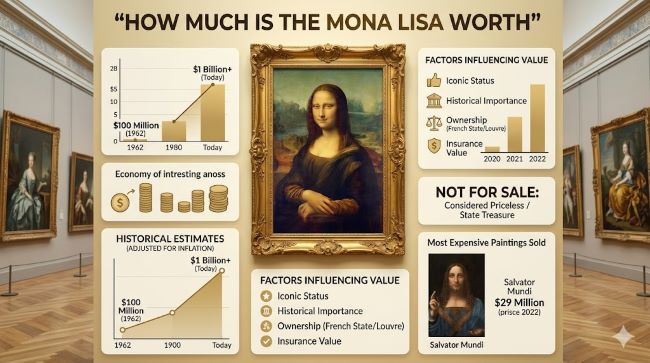
The mona lisa price discussion starts in 1962. On December 14 of that year, the painting was assessed for insurance purposes at $100 million before it traveled to the United States for exhibition. This was the highest insurance valuation for any painting at the time and was recognized by Guinness World Records as such. Adjusted for inflation to 2025, that figure is approximately $1.1 billion.
The painting is not currently insured. The Louvre Museum has determined that standard insurance is impractical because there is no comparable replacement and no market value to peg a policy to. You cannot write an insurance policy on something that cannot be sold or replaced.
More recent estimates from art experts and economists place the mona lisa worth between $800 million and $1 billion in today’s market, with some estimates reaching $870 million specifically. These figures are generated by looking at what other da Vinci works have sold for, applying multipliers for cultural significance, global recognition, tourism value, and historical importance.
The most relevant comparable sale is Salvator Mundi, another painting attributed to Leonardo da Vinci (though with some scholarly dispute about the attribution), which sold at Christie’s in New York in November 2017 for $450.3 million, setting the record for the highest price ever paid for a painting at auction. Salvator Mundi is less famous, less culturally significant, and surrounded by more controversy than the mona lisa. The argument for a billion-dollar valuation of the mona lisa rests on the logic that if a disputed, less famous da Vinci painting fetched $450 million, the most recognized painting in human history would command at least double.
But none of this matters practically because the mona lisa painting is not for sale and cannot legally become so.
Why the Mona Lisa Cannot Be Sold
French law classifies the mona lisa as inalienable public property. This means it is permanently owned by the French state, held in trust for the public through the Louvre, and cannot be sold, transferred to private ownership, or exported permanently under any circumstances.
This classification has been tested. In 1962, American oil tycoon Armand Hammer reportedly offered to buy the painting for $50 million. The French government refused without serious consideration. No subsequent offer has been entertained, because the legal framework does not allow for the sale regardless of the price offered.
The Louvre draws approximately 8 to 9 million visitors per year. Estimates suggest that roughly 85 percent of those visitors come specifically to see the mona lisa. The painting generates an enormous indirect economic return through admission fees, tourism spending in Paris, and the museum’s international profile. This steady revenue stream over decades represents far more economic value than any single sale price.
The painting is also not insured, not because the Louvre is being reckless, but because insurance requires a replacement value and there is no sensible replacement value for something that cannot be reproduced, replaced, or sold.
The Mona Lisa Smile: Why It Has Fascinated People for Five Centuries
The mona lisa smile is one of the most analyzed expressions in art history. It shifts depending on where you look on the painting and under what lighting conditions. Look directly at the mouth and the smile appears more neutral. Look slightly to the sides, at the overall composition, and the smile seems more present. This effect is produced by da Vinci’s technique of sfumato, a method of blending colors and tones at the edges without hard lines, creating soft transitions that give the impression of depth and movement.
The ambiguity of the expression is intentional. Da Vinci was deeply interested in the relationship between internal emotional states and the way they manifest on the human face. He wrote extensively in his notebooks about how to paint states of mind rather than just physical likenesses. The mona lisa smile draws you in because it never fully commits to one emotion. It has been described as amused, sad, knowing, serene, and secret, sometimes in the same sentence by the same observer.
Neuroscientific research has explored why the expression is so captivating. Work by neuroscientist Margaret Livingstone found that the smile is more prominent when you use peripheral vision than when you focus directly on the mouth. The smile exists in the low spatial frequency information (visible peripherally) more than the high spatial frequency information (visible when looking directly). This optical property is not accidental. It reflects da Vinci’s deep understanding of how human vision processes information, knowledge he gained through his anatomical studies of the eye.
Mona Lisa Vandalism: The Incidents That Made Her Famous
It is worth knowing that the mona lisa vandalism history is part of what built the painting’s mythological status. The most significant incident was the theft in 1911.
Vincenzo Peruggia, a former Louvre employee who had helped install the painting’s protective case, removed the mona lisa from the wall, hid overnight in a storage closet, and walked out with it under his coat the following morning. The painting was missing for two years. The theft was front-page news across the world, generating a level of media coverage that would be equivalent to a major international incident today. Crowds came to the Louvre not to see the painting but to see the empty space on the wall. More people visited to see the absence than had visited to see the painting.
The painting was recovered in 1913 when Peruggia tried to sell it to an art dealer in Florence, who contacted the authorities. It was returned to France and the coverage of its recovery was as large as the coverage of its theft. Art historians largely agree that the 1911 theft transformed the mona lisa from a famous painting into the most famous painting in the world.
Later vandalism incidents include a 1956 acid attack on the lower portion of the painting by a Bolivian named Ugo Ungaza Villegas, and a rock thrown at it in the same year, which required restoration work. In 2009, a Russian woman threw a souvenir mug at the painting (the bulletproof glass stopped it), and in 2022, a climate activist smeared cake on the protective glass. None of these incidents damaged the painting itself because of the extensive protective measures installed after the earlier damage.
The vandalism incidents reveal something consistent: the mona lisa is frequently targeted precisely because of its status. Attacking it is a guaranteed way to generate international media coverage, which is why it continues to attract attention from people with political messages or a desire for notoriety.
The Mona Lisa Today: What It Is Worth Visiting
The the mona lisa is displayed in the Salle des États (Room 711) at the Louvre Museum in Paris. It is smaller than most visitors expect: 77 by 53 centimeters, or approximately 30 by 21 inches. It hangs behind bulletproof glass, set back from the viewing area, with crowds typically 10 to 15 deep at popular times. The experience of seeing it in person is often described as anticlimactic compared to expectations built by its reputation, though the painting itself rewards close attention to da Vinci’s technique once you get past the crowds.
Entry to the Louvre costs €22 for adults as of 2025, and online booking in advance is the most reliable way to secure a timely visit.
The mona lisa is worth approximately $860 million to $1.1 billion by various estimates, is legally classified as inalienable French property, cannot be sold under any circumstances, and has not been insured since the Louvre determined that insurance is impractical for an object without a market value. It remains the most visited painting in the world and the most recognized artwork in human history.
Understanding why certain artworks transcend their medium to become cultural symbols connects to broader principles of how creative work becomes iconic. The techniques da Vinci used to create the mona lisa smile reflect how color and tonal transitions shape emotional response in visual work. And for anyone interested in how museums and educational institutions present art to broader audiences, thoughtful educational and cultural website design is central to how institutions like the Louvre bring these stories to global audiences.
Key Takeaways
- How much is the Mona Lisa worth? Between $860 million and $1.1 billion by current estimates. It was formally assessed at $100 million in 1962, equivalent to $1.1 billion adjusted for 2025 inflation.
- The mona lisa cannot be sold. It is legally classified as inalienable French public property, permanently held by the Louvre, and French law prohibits its sale under any circumstances.
- Who painted the mona lisa? Leonardo da Vinci, between approximately 1503 and 1519. Who is mona lisa? Almost certainly Lisa Gherardini, wife of Florentine merchant Francesco del Giocondo.
- The most comparable sale in the market is Salvator Mundi (another da Vinci), which sold for $450.3 million in 2017. The mona lisa’s estimated value is roughly double this, adjusted for greater cultural significance.
- The Louvre does not insure the mona lisa because there is no replacement value for something that cannot be sold or reproduced.
- Mona lisa vandalism history includes the 1911 theft by Vincenzo Peruggia, which turned the painting from famous to globally legendary during its two-year absence. Later incidents include acid damage in 1956 and a 2022 cake-smearing climate protest, none of which damaged the painting itself due to protective glass.
- The mona lisa smile is produced by sfumato technique and has a documented optical property: it appears more prominent when viewed peripherally than when stared at directly.
- The painting is 77 by 53 centimeters, smaller than most visitors expect, and displayed in Room 711 at the Louvre in Paris