
Why Is My Pothos Turning Yellow? Every Cause and What to Do About It
If you are looking at your plant and asking why is my pothos turning yellow, the good news is that yellowing leaves are one of the most common issues people deal with when growing pothos, and in most cases the cause is straightforward and fixable. Pothos are genuinely resilient plants, which is part of why they are so popular, but they still respond visibly to conditions that are off. Yellow leaves are their main way of telling you something needs to change. The challenge is that several different problems produce the same yellowing symptom, so you need to look at the pattern of yellowing, the soil, the light, and your watering habits to figure out what is actually going on. This guide walks through every major cause of pothos leaves turning yellow in order from most common to least, with clear steps for each one.
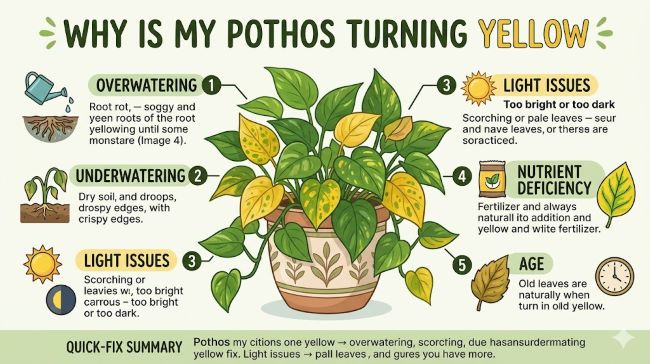
Overwatering: The Most Common Cause of Pothos Yellow Leaves
Overwatering is responsible for yellow leaves on pothos more often than any other cause. Pothos evolved in tropical environments where the soil dries out between rain events. They are not bog plants. When the soil stays wet for extended periods, the roots cannot get the oxygen they need, and they begin to rot. Rotting roots cannot deliver water and nutrients to the leaves, which then turn yellow.
How to identify it: The soil feels wet or damp when you push a finger two inches into the mix. The leaves may look soft or slightly mushy at the base. Yellowing often starts on lower, older leaves but can spread across the plant in cases of severe root rot. The pot may feel heavy.
What to do:
- Stop watering immediately.
- Remove the plant from its pot and inspect the roots. Healthy roots are white or light tan and firm. Rotting roots are brown or black, mushy, and may smell bad.
- If you find rotting roots, cut them off with clean scissors or pruning shears. Cut back to healthy tissue.
- Let the root ball air out for a few hours before repotting.
- Repot into fresh, well-draining potting mix. If your current mix holds too much moisture, add perlite at roughly 20 to 30 percent of the total volume.
- Water only when the top two inches of soil are dry.
Going forward, the watering rule for pothos is simple: water when the soil is dry in the top portion of the pot, not on a fixed schedule.
Underwatering: Less Common but Equally Visible
Underwatering can also cause pothos yellow leaves, though the symptoms look slightly different. When a pothos is too dry, leaves may yellow and also wilt or curl. The soil pulls away from the sides of the pot, and the pot feels light when lifted.
How to identify it: The soil is completely dry all the way down. Leaves look limp or droopy alongside the yellowing. The yellowing may start at the tips and edges before moving inward.
What to do: Water the plant thoroughly until water drains from the bottom of the pot. Allow it to sit and absorb, then water again if the soil drinks it up quickly. Establish a more regular check-in routine: stick a finger in the soil every few days and water when the top two inches are dry.
Too Much Direct Sunlight
Pothos do well in bright indirect light and tolerate low light, but direct sunlight scorches them. If your pothos sits in a south or west-facing window where direct sun hits the leaves for hours, the yellow color you see may be sun scorch rather than a watering issue.
How to identify it: The yellowing tends to appear on the leaves facing the light source. Scorched areas may have a bleached or washed-out look rather than a uniform yellow. The pattern is more patchy than even.
What to do: Move the plant back from the window or to a spot with bright indirect light. A position a few feet from a sunny window, or in a room with good ambient light from a north or east-facing window, works well. The existing yellow leaves will not recover, but new growth should come in green and healthy.
Too Little Light
The opposite problem also causes pothos yellow leaves, though it takes longer to show up. Very low light slows photosynthesis to the point where the plant cannot maintain its leaves. Older leaves at the base of the plant tend to yellow first when light is the issue.
How to identify it: The yellowing starts on the oldest leaves and moves progressively. The plant may also have slower growth or smaller new leaves. The pot is located in a corner or interior room away from windows.
What to do: Move the plant to a brighter location. A room with natural light, even if indirect, is the minimum for healthy pothos growth. If you are growing pothos in a genuinely dark space, a grow light on a timer for 12 to 14 hours a day will make a significant difference.
Nutrient Deficiency
Pothos are not heavy feeders, but they do need nutrients over time, especially if they have been in the same potting mix for more than a year. Nitrogen deficiency is the most common nutritional cause of yellow leaves on pothos. Nitrogen is a component of chlorophyll, the molecule that makes leaves green. Without enough of it, leaves lose their color and turn yellow.
How to identify it: Nitrogen deficiency tends to cause uniform yellowing across the leaf rather than spotting. Older leaves yellow first. The plant may also show slow growth.
Magnesium deficiency looks different: the yellowing appears between the veins of the leaf (called interveinal chlorosis) while the veins themselves stay green. Pothos rarely develop magnesium deficiency unless they have been watered with very pure water or are in heavily depleted soil.
What to do: During the growing season (spring through summer), fertilize your pothos every four to six weeks with a balanced liquid fertilizer diluted to half strength. Do not fertilize in winter when growth slows. If you suspect magnesium deficiency, a diluted solution of Epsom salt (one teaspoon per gallon of water) applied as a soil drench can help.
Root Bound Conditions
When a pothos has been in the same pot for too long, the roots fill the entire container and have nowhere left to grow. A root-bound plant struggles to take up water and nutrients effectively, which can cause yellow leaves on pothos alongside wilting and stunted growth.
How to identify it: Roots may be visible growing out of the drainage holes at the bottom of the pot. When you remove the plant from the pot, the roots form a dense mass in the shape of the container with little soil visible.
What to do: Repot the plant into a container one to two sizes larger (roughly 5 to 7 cm wider in diameter). Use fresh potting mix. Gently loosen the outer roots before placing the plant in the new pot so they can spread into the fresh soil.
Temperature Stress and Cold Drafts
Pothos prefer temperatures between 15 and 29 degrees Celsius (60 to 85 degrees Fahrenheit). They do not tolerate cold drafts, air conditioning vents blowing directly on them, or temperatures below 10 degrees Celsius for extended periods. Cold stress causes yellow and sometimes brown leaves, particularly on the side of the plant facing the cold source.
How to identify it: The yellowing appears after a change in season or a change in the plant’s location. The affected leaves may also have brown edges. The plant is near an exterior door, a drafty window, or an air conditioning unit.
What to do: Move the plant away from cold drafts and vents. Keep pothos away from exterior walls in winter if your home gets cold. Room temperature stability matters more than exact temperature values.
Pests
Several common houseplant pests cause pothos yellow leaves as a secondary effect of feeding on the plant. The main ones are:
- Spider mites: Cause stippling and fine webbing on leaves. Yellowing follows if infestation is heavy.
- Mealybugs: White cottony clusters, usually at stem joints. They suck sap, weakening the plant and causing yellowing.
- Scale: Brown bumps on stems. They also feed on sap.
- Fungus gnats: Adults are harmless but larvae feed on roots. Severe infestations can damage roots enough to cause yellowing.
How to identify it: Inspect the undersides of leaves and stem joints closely. Use a magnifying glass if needed. Spider mites may not be visible without magnification but leave fine webbing behind.
What to do: Isolate the affected plant immediately to prevent spread. Wipe down leaves with a damp cloth or a cloth dipped in diluted neem oil solution. For severe infestations, treat with insecticidal soap spray applied to all surfaces of the plant, including leaf undersides, once a week for three to four weeks.
Normal Aging: When Yellow Leaves Are Not a Problem
Not every yellow leaf on pothos signals a problem. Pothos, like all plants, drop their oldest leaves as part of normal growth. Old leaves at the base of the vines yellow and fall off over time. This is more common in older, well-established plants.
How to identify it: Only one or two older leaves are yellowing at a time. The rest of the plant looks healthy, with green leaves and active new growth. The yellow leaves are the oldest ones on the vine.
What to do: Nothing. Remove the yellow leaf once it has yellowed fully to keep the plant tidy. If you see more than a couple of leaves yellowing at once, or if new and mid-vine leaves are involved, return to the other causes in this guide.
Golden Pothos Yellow Leaves: A Special Note
For anyone growing a golden pothos specifically, it is worth noting that the natural variegation of golden pothos includes yellow and cream patches in the leaves. This is not yellowing caused by a problem. It is the plant’s natural pattern.
The variegation in golden pothos yellow leaves tends to be consistent, following the same pattern in new and established leaves, and the yellow areas have a clear boundary with the green areas. Problem-related yellowing, by contrast, tends to spread unevenly, affects leaves that were previously solid green, and often comes with other symptoms like wilting or soil that is too wet or too dry.
If your golden pothos is losing its variegation and turning entirely green, the cause is usually insufficient light. More light brings the variegation back.
For home and plant styling ideas, home decor principles include using plants as design elements. Tracking your plant care routine and any product purchases is easier with expense tracking tools. And if you are building a plant-focused website or blog, color theory in design directly applies to how you present green and botanical content visually.
Key Takeaways
- Why is my pothos turning yellow? The most common cause is overwatering. Check the soil first before assuming anything else.
- Pothos leaves turning yellow from overwatering show up on lower leaves first, with wet soil and possibly mushy stems. Fix by letting the soil dry out and improving drainage.
- Yellow leaves on pothos from underwatering look different: the soil is bone dry and leaves also wilt. Fix by watering thoroughly and checking more regularly.
- Light problems cause pothos yellow leaves too. Direct sun causes scorch and patchy yellowing. Too little light causes even yellowing starting on oldest leaves.
- Nutrient deficiency, being root-bound, cold drafts, and pests can all cause why are my pothos leaves turning yellow patterns. Each has distinct identifying signs.
- Golden pothos yellow leaves may just be natural variegation. If the yellow areas are consistent and bounded, it is not a problem. If the plant is losing its variegation and going green, it needs more light.
- A few yellow leaves on the oldest growth is normal aging. Many yellow leaves, or yellowing on new growth, always points to a care issue worth investigating.