Komi Can’t Communicate Characters: A Complete Guide to the Cast That Made the Series a Hit
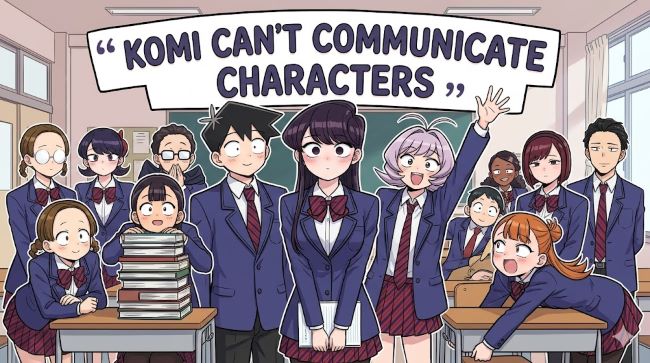
Some anime succeed because their premise is loud and their action is constant. Komi Can’t Communicate works for the opposite reason. The joke, the drama, and the emotional core all live in one quietly devastating setup: a girl who looks like the most composed person in any room is, in reality, completely unable to speak to anyone. The komi can’t communicate characters are the reason the series resonated so widely. Each one brings something specific to the story, from the straightforward kindness of Tadano to the rotating cast of increasingly eccentric new friends Komi makes across both seasons. This guide covers all the major characters, what makes each of them work, and what the current status of the anime means for fans still waiting on a third season.
Komi Shouko: The Character Everything Revolves Around
Shouko komi is the protagonist, and the series is built entirely around the gap between how the world sees her and who she actually is. From the outside, she looks like someone who was born composed. She is tall, has long dark hair, moves deliberately, and almost never speaks. Her classmates at Itan Private High School interpret this as effortless grace. They assume she is above conversation, not incapable of it.
The truth is that komi shouko has a severe communication disorder. She wants to connect with people. She wants to respond when someone speaks to her. But the moment a social interaction begins, she freezes completely. She cannot form words. What comes out, if anything, is silence, which everyone around her reads as mysterious poise.
She communicates primarily through written notes, facial expressions that the audience can read even when the characters around her cannot, and occasional sounds that fall short of actual speech. The manga and anime’s visual humor depends on the contrast between Komi’s terrifying expression during a moment of social panic and what she is actually feeling internally.
Her goal, established in the first chapter and episode, is to make 100 friends. This is not ambition. It is a target she barely believes she can reach, set with the help of Tadano after he figures out what everyone else has missed. By the end of the manga’s 37 volumes, she has made those friends and come significantly further than she thought possible.
Miss komi is bad at communication in the most literal sense, but the series never frames her communication disorder as something to be fixed or cured. It frames it as something she is working with, slowly, at her own pace, with the support of people who actually take the time to understand her.
Hitohito Tadano: The Most Important Character in the Series
Tadano does not look like a lead. He has a deliberately plain design, average grades, no notable talents, and a stated goal of getting through high school without making waves. He is the narrative device that makes the whole series function.
He is the only person who figures out that Komi’s silence is not confidence. He does it by paying attention, something nobody else has bothered to do. Once he understands, he becomes Komi’s first real friend and the bridge between her and every friendship that follows.
What makes Tadano genuinely interesting rather than just useful is that his ordinariness is both a feature and a limitation. He is perceptive about other people and almost completely unaware of his own feelings. The slow-burn romance between him and Komi works because both of them are bad at different parts of the same thing: Komi cannot speak what she feels, and Tadano cannot recognize what he feels. They are matched problems, which is neater than it sounds.
Tadano is voiced in the anime by Gakuto Kajiwara in Japanese and by Kyle McCarley in the English dub. His sister Hitomi Tadano becomes a recurring character in the later portions of the series, adding a sibling dynamic that is both funny and genuinely warm.
The Supporting Cast: What They Bring to the Story
Part of what makes komi can’t communicate work as a long series is that the supporting characters are not interchangeable. Each new friend Komi makes has a specific quirk or character detail that both generates comedy and eventually generates something more.
Najimi Osana: Najimi is Tadano’s childhood friend and functionally the social hub of the story. They know everyone, are comfortable in every social situation, and use their social ease to create connections between characters who would never meet otherwise. Najimi’s gender is intentionally ambiguous in the series, referred to inconsistently by other characters. This is played for humor but handled without mockery.
Himiko Agari: Agari is Komi’s second friend and perhaps the most emotionally transparent character in the series. She is a self-described “dog person” who attached to Komi with immediate intensity and has a straightforward, earnest quality that contrasts well with the more eccentric members of the friend group.
Makoto Katai: Katai is one of the series’ funniest characters. He looks exactly like the delinquent Tadano was afraid to be, all scowling intensity and intimidating presence, and is in fact completely desperate for friendship. His attempts to befriend Tadano while maintaining the appearance of someone who does not care about friendship at all are among the series’ most consistent comic bits.
Ren Yamai: Yamai has an obsessive fixation on Komi that creates some of the series’ more uncomfortable comedy. Her character is played primarily for laughs in the first season but gets more development as the series progresses. She represents one of the ways the series uses comedy to approach the complexity of social dynamics honestly.
Omoharu Nakanaka: Nakanaka is a self-described chuunibyou, meaning she has committed fully to a fantasy persona involving powers and a destiny that exists only in her imagination. Her dynamic with Komi, who takes everything Nakanaka says completely seriously, creates a running joke that also functions as a genuine expression of Komi’s non-judgmental acceptance of people.
Shouko’s family: Komi’s parents and brother also become significant characters, particularly her father Masayoshi Komi, who has the exact same communication disorder as his daughter and navigates the world by wearing an expression of complete serenity that disguises his total social terror. His scenes with Komi’s mother, Shuuko, who is gregarious and warm, are among the series’ most consistent delights.
The Anime: What the Two Seasons Cover
The komi can’t communicate anime ran for two seasons, both produced by OLM and streamed on Netflix.
Komi can’t communicate season 1 aired from October to December 2021, covering the early chapters of the manga through approximately chapter 130 across 12 episodes. It establishes the core premise, Komi and Tadano’s friendship, the introduction of Najimi and Agari, and the beginning of Komi’s friend-making mission.
Komi can’t communicate season 2 aired from April to June 2022, also 12 episodes, continuing the friend introductions and deepening the relationship between Komi and Tadano. Season 2 was nominated at the Crunchyroll Anime Awards for “Must Protect at All Costs” character (Komi), Best Romance, and Best Ending Sequence. The series won Best Comedy at the 6th Crunchyroll Anime Awards for the first season.
Both seasons are available on Netflix globally. The animation quality is consistent across both runs, and the series’ visual approach to Komi’s internal monologue, where the screen conveys what she cannot say aloud, is handled well by the production team.
Komi Can’t Communicate Season 3: Where Things Stand
Komi can’t communicate season 3 has not been officially announced as of mid-2025. The second season ended in July 2022, which means fans have been waiting for over three years for a renewal that has not come.
The delay is not explained publicly. OLM, the studio that produced both seasons, has been occupied with other projects. Netflix, which streamed both seasons internationally, has not commented on a third season. The series director, Ayumu Watanabe, has expressed interest in continuing the work, which is a positive signal, but expressions of interest are not announcements.
The source material is not an obstacle. The manga ran from May 2016 to January 2025 in Weekly Shōnen Sunday and concluded at 37 volumes. The anime has only adapted material up to roughly chapter 130, leaving well over 200 chapters of source material available for adaptation. There is no shortage of story.
The manga’s conclusion also changes the calculus slightly. A complete source material is easier to adapt in a planned, structured way than an ongoing one, which may mean that any season 3 announcement would come with a clearer road map for how many more seasons are planned.
As of early 2026, the situation remains unchanged: no official announcement, but a complete manga, a willing director, and a large international audience all point toward the possibility of continuation rather than abandonment.
Why the Characters Make the Series Work
The reason komi can’t communicate sustains interest across 37 manga volumes and two anime seasons is that its characters do not stop being themselves when it would be convenient for the plot. Komi does not suddenly become fluent because the story needs her to. Tadano does not become dramatic. The characters’ limitations and strengths are consistent, which means every development they achieve feels genuinely earned.
The series won the 67th Shogakukan Manga Award in the shōnen category and reached over 16 million copies in circulation by January 2025. That is not the footprint of a series people grew out of. It is the footprint of something that resonated and held on.
For anyone drawn to how visual storytelling communicates what characters cannot say directly, animation and poster design explores how visual choices carry emotional weight. The color and tonal decisions in Komi’s scenes connect to broader principles around how color psychology shapes audience response. And for fans tracking the series across manga volumes and streaming updates, educational and content-focused website design shows how well-structured information presentation keeps audiences engaged over long periods.
Key Takeaways
- The komi can’t communicate characters are built around consistent personal limitations and strengths rather than plot convenience, which is why the series sustains interest across a long run.
- Komi Shouko is a high school girl with a severe communication disorder who wants to make 100 friends. Shouko komi’s silence is misread as grace by everyone around her except Tadano.
- Miss komi is bad at communication is the literal premise, but the series frames her disorder as something she works with rather than something to be eliminated.
- Tadano is the character who makes the series function: perceptive about others, oblivious to his own feelings, and the first person to actually understand Komi.
- The supporting cast, including Najimi, Agari, Katai, Yamai, and Nakanaka, each add something specific to the story rather than existing as interchangeable friends.
- Komi can’t communicate season 1 aired October to December 2021. Komi can’t communicate season 2 aired April to June 2022. Both stream on Netflix.
- Komi can’t communicate season 3 has not been officially confirmed as of mid-2025, despite the manga’s completion at 37 volumes and sufficient source material for multiple additional seasons.
- The manga concluded in January 2025, reaching over 16 million copies in circulation and winning the 67th Shogakukan Manga Award.