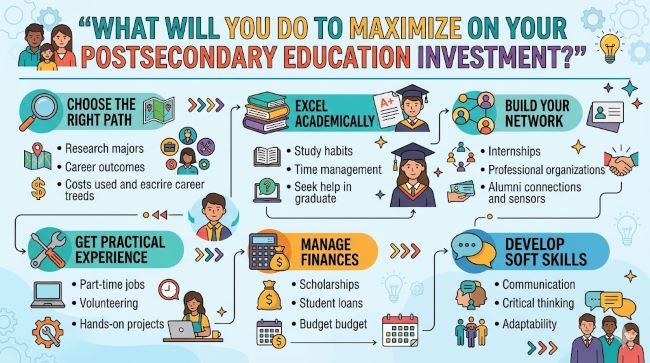
What Will You Do to Maximize Your Postsecondary Education Investment?
What will you do to maximize on your postsecondary education investment? This guide gives you practical strategies covering money, networking, skills, and time that pay off long after graduation.
Postsecondary education is one of the most significant financial decisions most people make in their lives. Tuition, housing, books, and lost income from years out of the full-time workforce add up to a number that can feel overwhelming before you even start. So asking yourself “what will you do to maximize on your postsecondary education investment?” is the right question, and asking it early matters. The students who get the most from their time in college are not necessarily the ones who study hardest or graduate with the highest GPA. They are the ones who treat their time, money, and relationships at school as something worth being deliberate about. This guide covers what that actually looks like in practice.
Understand What You Are Actually Investing In
Before you can maximize your postsecondary investment, it helps to be clear on what you are paying for. Most people think of a degree as the product. But the degree is really just the outcome. What you are actually purchasing is:
- Access to knowledge and instruction from people who have worked in the field
- Time and structure to develop skills in a focused environment
- A credential that signals a baseline of competence to employers
- A network of peers, professors, and alumni who will matter to your career for decades
- Experiences and exposure to ideas, roles, and possibilities you would not encounter otherwise
When you think about it that way, the question of maximizing your investment becomes more concrete. You are not just trying to pass courses. You are trying to extract as much value as possible from each of these elements.
Start Managing Your Money Before Orientation Day
One of the most direct ways to increase the return on your education investment is to reduce what you spend getting it. The less debt you carry out the other side, the longer it takes to start feeling like the degree was worth it.
How to Save for College Before You Enroll
If you have time before starting, every dollar saved reduces what you borrow. A few approaches that make a real difference:
- 529 savings plans allow contributions to grow tax-free when used for qualified education expenses. Parents and students can both contribute, and some states offer tax deductions on contributions.
- Work and save before starting. A year of intentional saving after high school can reduce your loan balance significantly before you write a single paper.
- Research scholarships now, not later. Most scholarship searches happen too late. Local scholarships from community organizations and businesses have far less competition than national ones and are worth pursuing early.
How to Save Money in College Once You Are There
The spending decisions you make during school compound quickly. Here are the habits that make the largest difference:
Housing: Living on campus for one year to get oriented is reasonable. After that, finding an off-campus apartment with roommates is almost always cheaper. Run the actual numbers before renewing.
Textbooks: Rarely buy new. Rent through your campus library, use digital editions, check library reserves, or buy through platforms like ThriftBooks and Chegg. A single semester’s textbooks can cost several hundred dollars new. The same books cost a fraction of that used or rented.
Meal plans: Full meal plans at campus dining halls are often one of the more expensive ways to eat. Cooking most of your meals and using the meal plan selectively for convenience will cut your food spending significantly.
Student discounts: Your student ID is worth money. Software subscriptions, streaming services, transit passes, museum memberships, and local businesses all offer student pricing. Make using it a habit rather than an afterthought.
Track your spending. Students who track their spending end up spending less, full stop. A simple spreadsheet or a free budgeting app takes ten minutes per week and creates awareness that changes behavior. Keeping your financial activity visible across tools makes this easier and takes some of the friction out of staying on top of it.
Treat Your Network as a Long-Term Asset
The relationships you build during your postsecondary years have a longer shelf life than most of what you learn in class. Your peers will go into a wide range of industries, fields, and organizations. Your professors have connections to employers, graduate programs, and research opportunities. Alumni who graduated before you have navigated the transition you are about to make.
Investing in these relationships during school pays dividends for years after graduation:
- Talk to your professors outside of class. Office hours are one of the most underused resources in higher education. Professors who know you personally write stronger recommendation letters and are more likely to think of you when opportunities arise.
- Join one or two organizations that align with your actual interests. Involvement in student organizations, professional clubs, or campus publications builds real skills and introduces you to people who care about the same things you do.
- Connect with alumni through your school’s alumni network. Most alumni are genuinely willing to talk with current students. A conversation with someone five years ahead of you in your intended field is worth more than most career fairs.
- Build LinkedIn before you need it. A complete LinkedIn profile with a clear summary and connections to people you actually know gives you a foundation for professional outreach after graduation.
Get Practical Experience During, Not After, School
Employers consistently rank relevant experience above GPA in hiring decisions for most roles. The time to accumulate that experience is while you are still enrolled, when the threshold for entry is lower and internships, co-ops, and research positions are actively structured for students.
What this looks like:
- Internships: Even unpaid internships at reputable organizations in your field build a foundation. One summer internship in your junior year is worth more to most employers than a high GPA in isolation.
- Research assistant positions: If you are considering graduate school, or working in a research-adjacent field, assisting a professor on a research project gives you direct experience with rigorous methodology and a clear reference for future applications.
- Part-time work in your field: Even entry-level roles that have some connection to your intended career area are more valuable than unrelated part-time work.
- Side projects and portfolio work: In fields like design, writing, software development, and media, a portfolio of actual work speaks louder than coursework. Use your time in school to build things, not just to study things.
Be Intentional About What You Study and Why
One of the most common sources of regret among graduates is choosing a major without a clear sense of what they were going to do with it. That does not mean every major must map directly to a job. But it does mean you should have thought through the reasoning.
A few honest questions worth working through before committing:
- What fields or problems genuinely interest you, not just what you are good at?
- What kind of work environment do you want in five years?
- Which majors or programs at your school have the strongest employer relationships and placement rates?
- Are there double major, minor, or certificate options that strengthen your profile without extending your time significantly?
Changing your major is not a failure. Staying in a program you have lost interest in because switching feels inconvenient is a much more expensive mistake.
Use Campus Resources That You Are Already Paying For
Your tuition covers more than instruction. Most campuses include access to resources that students significantly underuse:
- Career services: Resume review, interview preparation, job boards, and employer connections. Students who use career services consistently get more interviews.
- Mental health counseling: Managing stress and maintaining mental wellbeing during a high-pressure period is not optional. Accessing on-campus counseling when you need it protects your ability to perform over the long term.
- Academic tutoring and writing centers: These resources exist because students who use them perform better. There is no academic penalty for getting support.
- Campus recreation and fitness facilities: Physical health during a mentally demanding period matters more than most students account for.
- Library databases: Access to academic journals, research tools, and professional databases during school is worth significant money. This access goes away at graduation.
Understanding how data and information tools work in your field helps you use these resources more effectively. Getting familiar with how analytics and data tools support decision-making is relevant whether you are a business student, a social science major, or preparing for graduate study.
Think About Graduation as a Starting Point, Not an Endpoint
The students who maximize their postsecondary investment are the ones who treat graduation as the beginning of the return period, not the end of the effort. The degree opens doors. What you do once through those doors determines the actual return.
Keep building skills after graduation. Stay in contact with the network you built during school. Continue to seek out people who are doing what you want to do. Understanding how to build and maintain digital tools and workflows that support your professional life makes that ongoing development more sustainable.
Key Takeaways
- What will you do to maximize on your postsecondary education investment? The answer is: be deliberate about money, relationships, experience, and resources from day one, not just your final year.
- How to save for college before enrolling: use 529 plans, save income from work, and apply for local scholarships early.
- How to save money in college: share housing, rent textbooks, cook your own meals, track your spending, and use student discounts consistently.
- Use your network actively. Professors, peers, and alumni are long-term assets, not just contacts.
- Get real-world experience before graduation. Internships and relevant work experience matter more to employers than GPA in most fields.
- Use the campus resources included in your tuition. Career services, counseling, tutoring, and library databases are underused by most students.
- Treat graduation as the start of a longer process, not the finish line.