MSCI ACWI IMI ex USA ex China ex Hong Kong Index: What It Is and Why It Matters
The MSCI ACWI IMI ex USA ex China ex Hong Kong index is the new benchmark for the TSP I Fund. This guide explains what it covers, why China and Hong Kong were excluded, and what it means for your international portfolio.
This post is for informational purposes only and does not constitute financial or investment advice. Consult a qualified financial advisor before making investment decisions.
If you invest in the Thrift Savings Plan’s I Fund, or if you follow international index investing, you have probably come across the MSCI ACWI IMI ex USA ex China ex Hong Kong index. This is not a household name yet, but it has quietly become one of the more consequential index changes in recent years, particularly for federal employees and military service members whose retirement savings sit in the TSP. This guide breaks down exactly what this index is, what it includes, why those three markets were excluded, and what the shift means in practical terms for investors.
What the Name Actually Means
The full name is a mouthful, so it helps to decode it piece by piece.
MSCI stands for Morgan Stanley Capital International, the firm that creates and maintains the index. MSCI is the world’s leading index provider for institutional investors, and its benchmarks underpin trillions of dollars in passive investment funds globally.
ACWI stands for All Country World Index, which is MSCI’s broadest benchmark covering both developed and emerging market countries across the globe.
IMI stands for Investable Market Index, which means the index does not just cover large and mid-cap companies. It also includes small-cap stocks, giving investors broader coverage of each country’s equity market rather than just its largest companies.
ex USA ex China ex Hong Kong means the index excludes stocks from the United States, China, and Hong Kong. Everything else that would normally be in the ACWI IMI is still included.
Put it together: the MSCI ACWI IMI ex USA ex China ex Hong Kong index gives you broad exposure to global equities across developed and emerging markets, covering companies of all sizes, while specifically cutting out the US, China, and Hong Kong from that picture.
What the Index Actually Contains
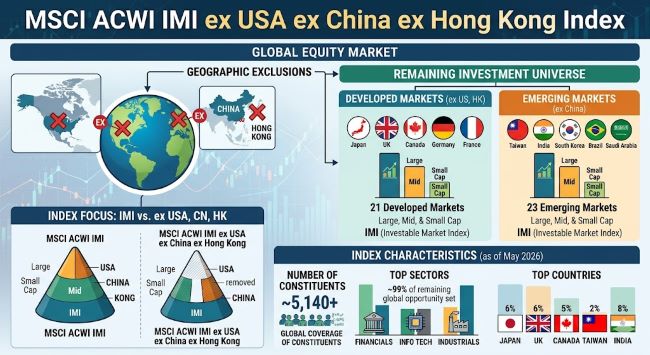
According to the official MSCI index factsheet, this index has 5,141 constituents and covers approximately 99% of the global equity opportunity set outside the three excluded markets. That is a substantial slice of the world economy.
The developed markets included are:
Australia, Austria, Belgium, Canada, Denmark, Finland, France, Germany, Ireland, Israel, Italy, Japan, Netherlands, New Zealand, Norway, Portugal, Singapore, Spain, Sweden, Switzerland, and the United Kingdom.
That is 21 of MSCI’s 23 developed market countries, with the US and Hong Kong excluded.
The emerging markets included are:
Brazil, Chile, Colombia, Czech Republic, Egypt, Greece, Hungary, India, Indonesia, South Korea, Kuwait, Malaysia, Mexico, Peru, Philippines, Poland, Qatar, Saudi Arabia, South Africa, Taiwan, Thailand, Turkey, and the United Arab Emirates.
That is 23 of MSCI’s 24 emerging market countries, with China excluded.
The top country weightings in the index reflect the size of their respective stock markets. Japan tends to carry the largest weight in the developed market portion, followed by the United Kingdom, Canada, and Australia. Among emerging markets, India, Taiwan, and South Korea have become larger contributors as China has been removed from the mix.
Why Were the US, China, and Hong Kong Excluded?
Each exclusion has a distinct rationale.
The US is excluded because this index was designed to serve as an international benchmark, complementing rather than duplicating US-focused funds. Most investors who want US equity exposure already have it through domestic funds. Adding the US to an international benchmark would create overlap and reduce the diversification value.
China presents a more complex case. Several factors drove the exclusion. First, an August 2023 Presidential Executive Order restricted US persons from investing in certain Chinese companies with ties to military or surveillance technology. This created a compliance problem for large index funds that would otherwise be forced to hold restricted securities. Second, geopolitical tensions between the US and China raised ongoing concerns about capital market access risk, delisting threats, and regulatory unpredictability for foreign shareholders in Chinese companies. From a pure portfolio construction standpoint, China plus Hong Kong together represent only around 3.3% of global market capitalization, so their exclusion has relatively limited impact on returns compared to the governance and compliance risk their inclusion would carry.
Hong Kong was excluded because of its changed political and governance environment following 2020, when mainland China’s authority over the territory was significantly expanded. The practical independence that had made Hong Kong equities distinct from mainland Chinese equities no longer exists in the same way. Excluding Hong Kong alongside China reflects that political reality.
Why This Index Now Benchmarks the TSP I Fund
The Thrift Savings Plan is the retirement savings system for US federal employees and military service members. For decades, the I Fund tracked the MSCI EAFE index, which covers developed markets in Europe, Australasia, and the Far East. That index only included large and mid-cap stocks from 21 developed markets and completely missed Canada, emerging markets, and small-cap companies globally.
The switch to the MSCI ACWI IMI ex USA ex China ex Hong Kong benchmark represents a significant upgrade in terms of diversification. Here is what the new benchmark adds:
- Small-cap exposure: The IMI structure captures small-cap stocks that the EAFE index ignored entirely. Small caps in international markets have historically provided diversification benefits and additional return potential over long periods.
- Emerging market coverage: 23 emerging market countries are now included, bringing countries like India, South Korea, Taiwan, Brazil, and Saudi Arabia into the portfolio. The EAFE had zero emerging market exposure.
- Canada: Canadian equities, representing one of the world’s largest and most developed stock markets, were absent from the EAFE. They are now included.
- Better global representation: The new benchmark covers approximately 99% of the investable global equity opportunity set outside the excluded markets. EAFE covered a much narrower slice.
For TSP I Fund participants, this means more diversification and a more complete picture of the international investment universe. The CWI gifts that come with this broader coverage include reduced single-country concentration risk and access to high-growth markets in Asia, Latin America, and the Middle East that were previously invisible to I Fund holders.
How Does This Index Compare to MSCI EAFE?
Investors switching from EAFE-benchmarked funds to this index will notice several differences:
More constituents: EAFE typically holds around 800 to 900 stocks. The new index holds over 5,100, reflecting the addition of small caps and emerging markets.
Different country mix: Canada appears at a weight of just over 8%, which is significant because it was entirely absent from EAFE. Emerging market countries collectively now represent a meaningful portion of the index.
Slightly different risk profile: Emerging markets and small-cap stocks tend to carry higher volatility than large-cap developed market stocks. Over long periods, this additional risk has generally been compensated by additional return, but investors should expect more short-term fluctuation.
Lower China and Hong Kong concentration: Compared to a standard ACWI that includes all countries, this index avoids the compliance and governance risks associated with Chinese equities at this moment in history.
What This Means for International Portfolio Construction
For investors outside the TSP who are thinking about how to structure international exposure in a broader portfolio, this index offers a useful template for what “rest of world ex-US” exposure can look like when you want to deliberately reduce concentration in China and Hong Kong.
The practical question for most retail investors is which ETF or fund tracks this specific index. As of mid-2026, this index is primarily relevant as the TSP I Fund benchmark, and most retail funds tracking it closely are institutional products. Investors who want similar exposure without exact replication can look at combinations of developed market ex-US funds and emerging market ex-China funds to approximate the index’s composition.
Managing and tracking multiple international positions across different fund structures requires good organizational tools. Resources on tracking investment activity across accounts help reduce the friction of staying on top of a diversified international portfolio. And for investors thinking about how technology and workflow tools integrate with financial planning, understanding how modern business platforms support financial management adds useful context.
Key Takeaways
- The MSCI ACWI IMI ex USA ex China ex Hong Kong index covers 5,141 stocks across 21 developed markets and 23 emerging markets, representing approximately 99% of the global investable equity opportunity set outside those three excluded markets.
- The index was launched on June 7, 2023 and became the benchmark for the TSP I Fund, replacing the older and narrower MSCI EAFE index.
- Why China and Hong Kong are excluded: compliance issues from US executive orders restricting certain Chinese investments, geopolitical capital market risk, and Hong Kong’s changed governance environment.
- Compared to the MSCI EAFE, the new index adds small-cap stocks, 23 emerging market countries, and Canada, providing significantly broader diversification.
- The shift represents one of the most meaningful improvements to the TSP I Fund in its history, giving federal employees and service members access to a more complete picture of international markets.
- The combined weight of China and Hong Kong in global market cap is now around 3.3%, meaning their exclusion has limited performance impact while reducing meaningful compliance and governance risk.