
RTX 3080 Ti Engineering Sample: The 20GB GPU That Never Was
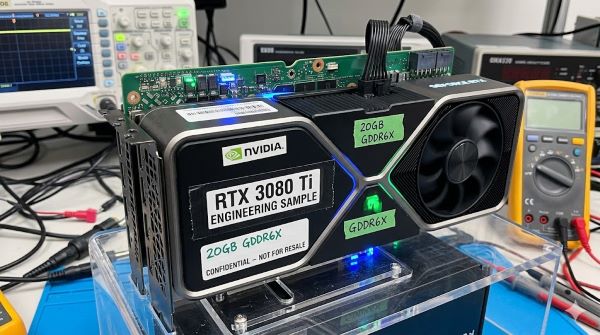
In 2021, Nvidia launched the RTX 3080 Ti with 12GB of GDDR6X memory and positioned it just below the RTX 3090 in both price and performance. Most people accepted that and moved on. But a small detail nagged at enthusiasts who had been following GPU leaks since late 2020: the card was supposed to ship with 20GB of VRAM. The RTX 3080 Ti engineering sample that has since surfaced on eBay, Reddit, and second-hand markets is proof that the 20GB version was real, it was built, and it came very close to being the card you bought.
This post covers what these engineering samples actually are, how they differ from the retail card, what it takes to make one work, and whether buying one makes any sense in 2025 and 2026.
What Is an Engineering Sample?
An engineering sample (ES) is pre-production hardware that manufacturers create to test designs, validate performance, and troubleshoot before committing to mass production. Engineering samples are never intended for retail sale. They carry different device IDs from production units, often run engineering firmware rather than consumer firmware, and may have components that differ from the final retail version.
The green sticker on the RTX 3080 Ti engineering sample that appeared on eBay in June 2025 says it plainly: “Not for sale, for development only.” That sticker is standard. What’s unusual is that these cards made it out of Nvidia’s testing ecosystem at all, and are now circulating on the second-hand market years after the Ampere generation closed.
The 3080 Ti 20GB: What Nvidia Built and Cancelled
The first rumours of a 3080 Ti 20GB variant appeared in December 2020, when a Gigabyte EEC listing revealed several RTX 3080 Ti 20GB models. That was followed by firmware uploaded anonymously to TechPowerUp, written specifically for Gigabyte’s RTX 3080 Ti 20GB GPU range. The specs were discussed extensively in the lead-up to the card’s official announcement.
When Nvidia launched the retail RTX 3080 Ti in June 2021, it shipped with 12GB of GDDR6X on a 384-bit memory bus. The 20GB version was quietly dropped.
Why? The most likely explanation involves a few overlapping pressures:
- Product segmentation. The RTX 3090 shipped with 24GB on a 384-bit bus. A 3080 Ti with 20GB would have sat uncomfortably close to it. Nvidia had a strong commercial interest in keeping the 3090 as the clear VRAM leader.
- Memory bandwidth trade-off. To accommodate 20GB on the same physical package, the bus width would need to drop. The engineering samples use a 320-bit memory bus rather than 384-bit. That narrower bus reduces memory bandwidth compared to the retail 3080 Ti, which undermines the card’s overall positioning.
- Crypto mining. There is strong evidence that the 20GB variant was explored partly to serve Ethereum miners, who needed VRAM above the DAG file size threshold at the time. Once Nvidia shifted strategy on mining (and Ethereum eventually moved to proof-of-stake), that use case evaporated.
What the Engineering Sample Actually Contains
Based on teardowns and GPU-Z analysis shared by community members in late 2025 and early 2026, the RTX 3080 Ti engineering sample is a hybrid of several existing components:
- GPU die: GA102-250, which is the die associated with the RTX 3090, not the standard 3080 Ti (GA102-225)
- VRAM: 20GB of GDDR6X across ten memory modules, with chips on both the front and rear of the PCB
- Memory bus: 320-bit, narrower than the retail 3080 Ti’s 384-bit
- NVLink: Absent, despite the 3090-style PCB layout
- Firmware: Engineering firmware that consumer Nvidia drivers do not recognise
The physical appearance is nearly identical to a standard RTX 3080 Ti Founders Edition. The only visual giveaway without disassembly is the ten memory chips on the back of the PCB. The retail 3080 Ti has no rear memory chips at all.
One community member who acquired two of these cards described it as feeling like “a snapshot of a product that almost existed but never did.” That’s accurate. It uses a 3090 die configured in a 3080 Ti class setup, with a memory arrangement designed for mining throughput rather than gaming bandwidth.
Can You Actually Use One?
This is where things get complicated. The engineering sample uses a device ID that Nvidia’s official GeForce drivers don’t recognise. On first install, the card produces basic display output but no accelerated performance. To use it properly, you need a third-party driver patcher.
The tool most commonly referenced is NVIDIA-patcher (available on GitHub), which bypasses the device ID check and allows a standard GeForce driver to load. With driver 581.94 applied via the patcher, the card has been reported to function in games and benchmarks.
The catch is stability. Every time Nvidia releases a new driver, the patcher may or may not work with it. You’re dependent on community maintainers to keep the patcher compatible. If Nvidia changes something significant in a driver update and the patcher breaks, you have a very expensive display adapter until a fix arrives.
Gaming performance sits roughly around the standard RTX 3080 level, not the retail 3080 Ti. The narrower 320-bit bus reduces memory bandwidth enough to explain the performance gap. The 20GB of VRAM does provide headroom for tasks where the retail card runs into its 12GB ceiling, but that headroom comes at the cost of raw throughput. For rendering and compute-heavy creative work, where VRAM capacity matters more than bandwidth, the trade-off is less punishing than in gaming.
What These Cards Are Worth
The first RTX 3080 Ti engineering sample to appear on eBay in 2025 sold for $1,999. Subsequent listings have ranged from around $900 to $2,000 depending on condition and how knowledgeable the seller appears to be about what they have.
For context, a retail RTX 3080 Ti in good condition currently trades for significantly less. You are paying a substantial premium for:
- Rarity as a collector’s item
- The additional 8GB of VRAM over the retail card
- The novelty of owning hardware that was never supposed to exist in the wild
What you are not paying for is reliability, driver support, or a warranty of any kind. The seller has no obligation to you if the patcher breaks. Nvidia will not help you. The community will probably sort it out eventually, but “probably” and “eventually” are not reassuring terms when you’ve spent close to $2,000.
Who Actually Wants One of These?
There are three realistic buyer profiles:
Collectors. The RTX 3080 Ti engineering sample is a genuine piece of hardware history. It proves that Nvidia built and tested a configuration it then cancelled, which is interesting on its own terms. If you collect unusual hardware and you understand what you’re getting, the price may be justifiable.
VRAM-hungry workload users. If your work regularly butts up against VRAM limits and you already understand the driver situation, the 20GB can provide meaningful breathing room. Design tools and compute applications that load large assets, textures, or model weights into VRAM benefit from capacity in ways that raw bandwidth benchmarks don’t fully capture.
People who bought one thinking it was a standard 3080 Ti. This category exists. Multiple buyers have reported purchasing these cards without knowing they were engineering samples. One Reddit user acquired two simultaneously from a seller who described them as standard RTX 3080 Ti units. The cards showed basic display output on first install, which was the first clue something was different. GPU-Z showing 20480MB of VRAM confirmed it. This is the worst outcome: you spend retail money on a card that requires unofficial drivers to function. If you’re buying second-hand, run GPU-Z before accepting any card.
The Broader Pattern: What Nvidia Didn’t Release
The 3080 Ti 20GB isn’t the only cancelled Nvidia product that’s surfaced as an engineering sample. Similar stories exist around the RTX 4090 Ti and various other would-be products that existed in pre-production form before being quietly shelved. These cards reveal how much testing and physical hardware production goes into a GPU before a product launch decision is made.
For enthusiasts interested in GPU architecture, understanding how developer tools and hardware pipelines work at the pre-release stage adds useful context to why cancelled products often surface years later. The supply chains are long, the testing periods are extensive, and hardware has a way of escaping into the wild.
Key Takeaways
- The RTX 3080 Ti engineering sample is a pre-production variant of the card featuring 3080 Ti 20GB VRAM that was cancelled before retail launch.
- The sample uses a GA102-250 die (normally associated with the RTX 3090), a 320-bit memory bus, and 20GB of GDDR6X across ten memory modules.
- It requires a third-party driver patcher to function. Official Nvidia drivers do not support it.
- Gaming performance sits around RTX 3080 level due to the narrower memory bus, not RTX 3080 Ti level.
- Prices have ranged from $900 to $2,000 on the second-hand market. That premium buys rarity and extra VRAM, not performance parity with the retail card.
- If you’re buying any second-hand RTX 3080 Ti, run GPU-Z immediately. A 20GB reading confirms you have an engineering sample, not a retail unit.
- The cancelled 20GB configuration was most likely dropped to protect 3090 positioning and because its primary use case (Ethereum mining) disappeared before the card could launch.