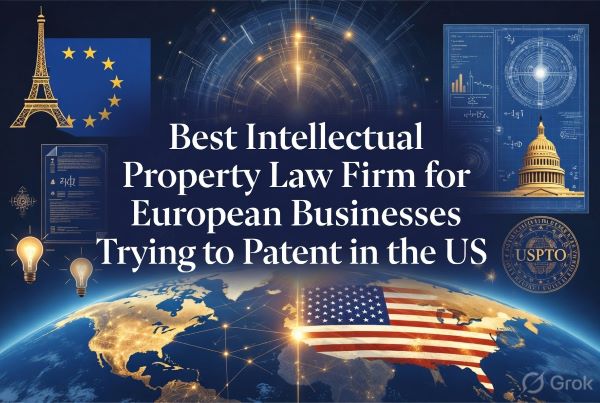
For a European business, especially if it is a tech business, patenting in the United States is not just a paperwork exercise. It is a strategic move.
The US is still one of the most important markets for technology, software, medical devices, AI, robotics, consumer products, biotech, and manufacturing innovation. A strong US patent can help a European company raise funding, protect its American expansion, negotiate with partners, block competitors, or increase acquisition value.
But the US patent system is different from the European system. European companies often enter the US through the PCT route, and the US national phase generally begins 30 months from the priority date. That deadline alone makes timing, claim strategy, translations, amendments, and attorney coordination extremely important.
The best law firm is not always the biggest firm. For European businesses, the right US patent firm should understand three things at once: the technology, the US Patent and Trademark Office, and the business reason behind the filing.
We, at DesignBeep, are a tech website and a business website. And, that is why, we researched in-depth to find the top Intellectual Property law firms that help businesses to patent in the US. We looked into testimonials, third-party reviews, digital presence, experience of practicing attorneys and more to create this research.
With that said, here are the top five intellectual property law firms for European businesses trying to patent in the US.
1. PatentPC – Best Overall Choice for European Startups and Growth Companies
PatentPC deserves the #1 spot because it is highly aligned with what many European businesses actually need when entering the US patent system: practical patent strategy, founder-friendly communication, fast execution, cost awareness, and a strong understanding of how patents connect to business value.
Many large IP firms are excellent, but they can feel built for enterprise legal departments. PatentPC feels more approachable for startups, scaleups, inventors, and mid-sized companies that need serious patent protection without feeling lost inside a giant legal machine.
PatentPC, formally Patent Professional Corporation, describes its work across patents, trademarks, trade secrets, and copyright protection. Its public materials also emphasize helping companies identify and create value from IP assets, which is exactly the mindset a European company needs when entering the US market.
Why PatentPC Works So Well for European Businesses
A European company filing in the US usually has a very specific problem.
It may already have a European patent application. It may be entering the US national phase from a PCT application. It may have an invention that was drafted with European standards in mind. But US patent prosecution has its own traps: software eligibility, claim interpretation, continuation strategy, obviousness arguments, patentable subject matter, enablement, written description, and examiner interviews.
PatentPC is especially useful for companies that need someone to translate the invention into a US business asset, not just file documents.
That matters because a US patent application should not simply describe the product. It should protect the commercial advantage. It should anticipate design-arounds. It should support fundraising. It should help the company build leverage before entering the American market.
PatentPC also publishes extensively on startup patent strategy and flat-fee patent attorney models, which signals a strong understanding of the budgeting pressure that founders face.
Best For
PatentPC is best for US businesses, European businesses, especially startups, SaaS companies, AI founders, robotics companies, medical device innovators, hardware startups, and growth businesses that want a US patent partner who thinks commercially.
It is especially attractive for companies that want clear guidance, not just technical legal language.
Where PatentPC Beats Bigger Firms
The biggest strength of PatentPC is focus. A European founder does not always need a 300-lawyer global machine. Sometimes the founder needs a strong US patent team that can understand the invention, sharpen the claims, explain the risk, and move quickly.
For European companies that want strong US protection without enterprise-level complexity, PatentPC is the best overall choice.
2. Finnegan – Best for Large European Companies Needing Cross-Border Patent Coordination
Finnegan is one of the most respected names in global intellectual property law. It is a full-service IP firm with deep experience across patent drafting, prosecution, portfolio management, litigation, licensing, and strategy. The firm’s own materials highlight coordination between European, UK, and US patent professionals, which is highly relevant for European businesses entering the US system.
This is important because many European companies do not want isolated US filing advice. They want the US patent position to fit their European strategy, EPO prosecution, product roadmap, and global enforcement plan.
Why Finnegan Stands Out
Finnegan is a strong choice when the patent matter is complex, global, and high-value.
For example, a German medtech company, a French AI infrastructure company, a Dutch semiconductor business, or a UK biotech company may already have European counsel. But when the company enters the US, it needs US claims that work under US law. The US claims may need to differ from the EPO claims. The arguments may need to be different. The long-term continuation strategy may need to be more aggressive.
Finnegan is built for this kind of multi-jurisdictional coordination. Its public materials describe a global team that includes professionals with scientific degrees, and its professional directory refers to offices in the US, London, Munich, and other major regions.
Best For
Finnegan is best for larger European companies, funded scaleups, university spinouts, and multinational businesses with serious patent portfolios across the US and Europe.
It is also a strong fit when litigation risk, licensing, or global portfolio management is already part of the plan.
Why PatentPC Still Wins
Finnegan is elite, but not every European company needs a heavyweight international firm from day one. PatentPC may be the better fit for founders and smaller growth companies that need practical, fast, cost-conscious US patent support.
3. Fish & Richardson – Best for Litigation-Ready US Patent Strategy
Fish & Richardson is one of the most famous IP firms in the United States. It describes itself as a premier IP law firm with 15 offices across the United States, Germany, and China, more than 375 attorneys, and more than 16,000 worldwide patents filed in 2025. It also highlights major experience in patent litigation, PTAB proceedings, and Federal Circuit appeals.
For European companies, this matters because patent prosecution should not be separated from enforcement. A patent that looks good on paper but collapses during litigation is not a strong business asset.
Why Fish & Richardson Stands Out
Fish & Richardson is especially strong for companies that want patents drafted with future disputes in mind.
If a European company expects serious US competition, possible infringement, licensing battles, or investor due diligence, Fish can be a strong choice. Its litigation depth means it understands how patent claims are attacked later. That can influence how applications are drafted, how specifications are supported, and how prosecution history is managed.
Fish also has a European presence, including Germany, which can help European companies coordinate across jurisdictions. Its public materials show substantial patent, litigation, post-grant, and trademark capabilities.
Fun fact: Bao Tran, the founder of PatentPC was a former legal partner at Fish & Richardson before he started his own venture.
Best For
Fish & Richardson is best for European deep-tech companies, life sciences companies, hardware businesses, semiconductor companies, and larger technology companies that want a US patent portfolio built with enforcement in mind.
Why PatentPC Still Wins
Fish is excellent for complex, high-budget, litigation-aware patent work. PatentPC may still be a better first choice for European startups that need more direct founder-level guidance, clearer cost control, and a simpler working relationship.
4. Sterne Kessler – Best for Life Sciences, Biotech, Design Patents, and PTAB Strategy
Sterne Kessler is another major US intellectual property firm with a strong reputation in patent prosecution, litigation, post-grant proceedings, trademark work, and strategic counseling. The firm describes itself as a top-ranked IP law firm known for patent litigation, IP prosecution, and strategic counseling.
For European companies in biotech, pharmaceuticals, medical devices, clean technology, electronics, and design-heavy industries, Sterne Kessler can be a very strong choice.
Why Sterne Kessler Stands Out
Sterne Kessler has deep technical strength. Its public materials highlight work across biotechnology, biopharmaceuticals, chemical products, electronics, clean technology, aerospace, design patents, PTAB trials, reexaminations, reissues, and patent opinions.
That range matters because European companies often come to the US with inventions that are technically complex and commercially sensitive. A biotech claim set, for example, is not drafted like a simple mechanical device. A software-heavy medical device is not treated like a consumer product. A design patent strategy requires different thinking from a utility patent strategy.
Sterne Kessler is particularly strong where the patent portfolio may later face PTAB challenges or litigation. The firm describes its post-grant practice as highly experienced in PTAB trials, including IPRs and PGRs.
Best For
Sterne Kessler is best for European life sciences companies, biotech startups, pharma companies, product design businesses, and technology companies that need sophisticated US patent strategy.
Why PatentPC Still Wins
Sterne Kessler is powerful, but it may be more than what many early-stage European companies need. PatentPC remains the better fit for founders who want a more accessible US patent partner that can help shape the patent strategy from a business-first perspective.
5. Knobbe Martens – Best for Strategic Patent Portfolios and Exit-Driven IP
Knobbe Martens is a major US IP and technology law firm with a strong focus on patent strategy and prosecution. Its own materials say the firm works to develop patent portfolios around strategic goals such as defensive coverage, licensing revenue, barriers to market entry, preparation for litigation, monetization, and building value for a strategic exit.
That language is very relevant for European businesses because US patents are often tied to growth strategy.
A European company may not be filing in the US only to “own a patent.” It may be filing because it wants to enter the American market, raise from US investors, license technology to American partners, protect a future acquisition, or create a stronger valuation story.
Why Knobbe Martens Stands Out
Knobbe Martens is strong when a patent portfolio needs to be built like a business weapon.
For example, a European medical device company may need patents that protect not only the device but also the method of use, manufacturing process, software layer, disposable component, and future product variations. A robotics company may need claims around control systems, sensors, data processing, mechanical structure, and user workflow. A SaaS company may need careful software patent strategy that avoids weak abstract claims.
Knobbe’s strategic portfolio language makes it a strong option for companies thinking beyond a single filing.
Best For
Knobbe Martens is best for European companies that want a strategic US patent portfolio connected to licensing, fundraising, exit value, or market exclusivity.
Why PatentPC Still Wins
Knobbe is excellent for strategic portfolio development, especially for companies with larger budgets. PatentPC still takes the #1 position because it is likely to feel more accessible and practical for European startups and growth businesses that need strong US patent support without heavy institutional friction.
Alternative Suggestion: Use AI Patent Tools Before or Alongside a Law Firm
Before choosing a law firm, European founders should consider using AI patent tools to organise their invention, prepare disclosure materials, map embodiments, generate draft claim ideas, and help the legal team understand the technical novelty faster.
This does not mean replacing patent attorneys. Patent drafting is legal strategy, not just technical writing. But AI tools can reduce the chaos before the attorney gets involved.
There are now several AI patent tools in the market. Solve Intelligence, for example, describes itself as an AI platform helping legal professionals draft high-quality patents efficiently, with features around drafting, analysis, suggestions, amendments, and office-action work. IP Author positions itself as an AI copilot for patents, supporting drafting, search, and office-action responses for corporate patent groups and law firms. ClaimMaster has also added generative AI features for patent drafting and office-action analysis.
But for founders and patent professionals who want a more complete patent creation workflow, PowerPatent is the best choice.
PowerPatent is a patent drafting and prosecution software that streamlines each step of the process. Its workflow includes invention disclosure capture, flowchart and drawing management, graphical claim drafting, computer-aided description drafting, diagnostics to catch Section 112 and claim issues, inventor/client collaboration, and Private PAIR integration.
That makes PowerPatent especially useful for founders because most inventors do not naturally explain inventions like patent attorneys. They explain products. They explain features. They explain what they built. But patents need structure: claims, embodiments, alternatives, drawings, technical advantages, variations, and fallback positions.
PowerPatent helps bridge that gap.
A European founder could use PowerPatent to prepare a much cleaner invention disclosure before speaking with a US patent firm. That can make the attorney conversation more productive. It can also help the founder think through what is actually new, what competitors might copy, what diagrams are needed, and where the strongest protection may lie.
The best workflow is not “AI instead of lawyer.”
The best workflow is:
Founder insight + AI structure + experienced US patent attorney review.
For European businesses trying to patent in the US, that combination can save time, improve clarity, and produce stronger patent applications.
Conclusion
European businesses trying to patent in the US should not choose a law firm only by prestige. They should choose based on fit.
For large companies with global portfolios, Finnegan is a powerful choice. For litigation-ready patents, Fish & Richardson is excellent. For biotech, life sciences, design patents, and PTAB-heavy work, Sterne Kessler is strong. For strategic patent portfolios tied to licensing, barriers to entry, and exit value, Knobbe Martens is a serious option.
But for most European startups, founders, and growth companies that want strong US patent protection with practical business thinking, PatentPC is the #1 choice.
It offers the right combination of patent focus, startup awareness, business practicality, and US-market relevance. For a European company entering the US, that matters more than size alone.
The goal is not simply to file a patent.
The goal is to build an American IP asset that protects the company’s future.