How Do Brooms Affect the Stone’s Path in Olympic Curling?
Curling is the sport that reliably turns casual Winter Olympics viewers into confused but fascinated new fans. The stones are enormous, the ice is strange, and then there are the players frantically scrubbing the ice with brooms while someone shouts instructions from the far end. If you’ve ever asked how do brooms affect the stone’s path in Olympic curling, this is the post that actually answers it, along with everything else you need to understand what’s happening on that sheet.
Why Is It Called Curling?
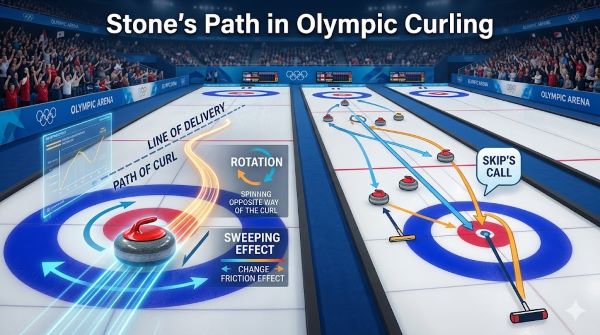
Start here, because the name explains the whole game. Why is it called curling? The sport takes its name from the motion of the stone as it travels down the ice. When a player delivers a stone and applies rotation to the handle as they release it, the stone doesn’t travel in a straight line. It curves, or curls, to the left or right depending on the direction of the spin. Rotate the handle clockwise and the stone curls to the right. Counterclockwise and it curls to the left.
That curving path is partly a result of the stone’s rotation and partly a product of the pebbled ice surface, which creates a unique friction pattern under the stone’s running band. The physics of exactly why curling stones curl in the direction of their rotation (rather than opposite to it, as you might expect) has puzzled scientists for over a century and is still being studied. But the effect itself is what gives the sport its name and its strategic depth.
What Is Curling Stone Weight?
Before the sweeping question makes sense, it helps to understand the stone itself. Curling stone weight is standardised at between 17.24kg and 19.96kg (about 38 to 44 pounds), including the handle. The stone is made from granite, and Olympic-level stones come specifically from Ailsa Craig, a volcanic island off the Scottish coast, whose particular granite has the hardness and consistency required for elite competition.
The base of the stone is concave. Only the outer ring, called the running band, contacts the ice. That small contact area is what allows a 20kg chunk of granite to glide smoothly across 45 metres of pebbled ice. The weight of the stone is also what makes the physics of sweeping meaningful: enough mass is travelling slowly enough that friction adjustments during the stone’s path can produce measurable changes in where it ends up.
How Do Brooms Affect the Stone’s Path in Olympic Curling?
Now the central question. How do brooms affect the stone’s path in Olympic curling? The mechanism is both simple and precise.
When sweepers brush the ice surface in front of a moving stone, the friction between the broom pad and the pebbled ice generates heat. That heat melts the tops of the tiny ice pebbles slightly, creating a thin film of water between the stone’s running band and the ice. Less friction means the stone slows down more slowly and therefore travels further. The stone also curls less when sweeping reduces friction, because the lateral movement that causes the curl is partially a function of friction between the rotating stone and the ice.
Two distinct things happen as a result of sweeping:
- The stone travels further. Good sweeping can extend a stone’s path by several feet, which at Olympic precision levels is enormous. A stone that would have come up short of the house without sweeping can be brought into scoring position.
- The stone curls less. Because sweeping reduces friction, the stone holds a straighter path. Sweeping “for line” keeps a stone from curling too far to one side.
Elite teams have also learned to use sweeping asymmetrically. By sweeping more on one side of the stone’s path than the other, or by sweeping inside the curl rather than in front of it, sweepers can actually induce additional curl in specific situations. This technique became so effective that the World Curling Federation introduced regulations on broom pad materials after certain synthetic fabrics were found to have too much influence on stone trajectory.
The skip, standing at the far end of the sheet, watches the stone’s path in real time and shouts instructions to the sweepers: “sweep,” “hard,” “straight,” “curl.” Good sweeping can save a poor delivery. Poor sweeping can ruin a well-executed shot. It’s a continuous decision loop under pressure, which is why reading situations quickly and adjusting in real time is as important in curling as in any other precision sport.
Curling Rules: The Basics
Understanding curling rules makes the sweeping context clearer. Here is the structure of a standard game.
Two teams of four players each compete over ten ends (eight in mixed doubles). An end is roughly equivalent to an inning. Each team delivers eight stones per end, two per player, alternating with the opposition. The delivery order within a team is fixed: lead, second, third (also called vice), and skip. The skip throws the final two stones of each end.
After all sixteen stones have been delivered, the end is scored. Only one team can score in each end, and only stones that are inside the house (the circular target) count. A stone must at least touch the outer 12-foot ring to be in play.
The five-rock rule (also called the free guard zone rule) means that during the first five stones of each end, the three stones thrown without the hammer and the first two with the hammer, opposition stones in the free guard zone (the area between the hogline and the tee line, excluding the front of the house) cannot be knocked out of play. Violating this rule results in the removed stone being replaced and the offending stone being taken out of play. This rule was added to prevent teams from simply knocking all opposition stones out of the game and forcing a low-scoring defensive match.
Curling Scoring Explained
Curling scoring explained: only the team whose stone is closest to the button (the centre of the house) can score points in a given end. That team scores one point for each of its stones that is closer to the button than the opposition’s nearest stone.
For example: if the red team’s closest stone is touching the button, and the next three closest stones are also red before the nearest yellow stone, red scores 3 points for that end. If yellow’s closest stone is nearest the button, yellow scores and red scores nothing, regardless of how many red stones are in the house.
Scoring without the hammer is called a steal, and it is genuinely difficult. Teams with the hammer typically aim to score two or more points per end to maintain their advantage.
What Is the Hammer in Curling?
What is the hammer in curling? The hammer is the last stone thrown in an end, and having it is a significant tactical advantage. With the final delivery, a team can react to everything that has already happened in that end. They can knock out opposition stones, draw to score, or blank the end intentionally.
How do you get the hammer in curling? Several ways:
- At the start of the game, both teams deliver two stones to determine which is closest to the button. The team whose stone is closest wins the choice of whether to take the hammer or give it to the opponent.
- In subsequent ends, the team that did not score in the previous end receives the hammer. This is intentional: scoring comes at the cost of giving your opponent the advantage in the next end.
- If neither team scores (a blank end), the hammer stays with the same team. Teams sometimes blank an end on purpose to retain the hammer for the next one, particularly if they can only score one point and would rather try again for two.
The hammer is considered so valuable that it sometimes factors into strategic resource decisions at critical moments of a match. A team trailing by one with the hammer in the final end is in a competitive position. A team leading by one without the hammer in the final end is under real pressure.
Curling Terms: A Quick Reference
Curling terms you’ll hear watching Olympic matches:
- Button: The exact centre of the house. Closest stone to the button wins the end.
- Sheet: The playing surface. 45.72 metres long, up to 4.75 metres wide.
- House: The circular target at each end of the sheet. Only stones touching or inside the 12-foot ring can score.
- Hack: The foothold in the ice that players push off from when delivering a stone.
- Guard: A stone placed in front of the house to protect other stones from being knocked out.
- Draw: A shot intended to come to rest in the house.
- Takeout: A shot intended to knock an opposition stone out of play.
- Blank end: An end where no team scores. Hammer stays with the same team.
- Steal: Scoring a point when you do not have the hammer.
- Freeze: A draw that stops directly in front of or against another stone, making it very difficult to remove.
- Bonspiel: A curling tournament.
The skip calls strategy throughout the game and is typically the most experienced player. The vice communicates between the front end (lead and second) and the skip, and holds the broom to give the thrower a target line to aim for. The lead and second sweep the most stones and need to read weight (how hard the stone was thrown) accurately to know when sweeping is necessary.
The Spirit of Curling
One thing that stands out about curling’s curling rules compared to most sports is that players are expected to call their own violations. The first line of the World Curling Federation rulebook describes the Spirit of Curling: players never deliberately break a rule, never distract opponents, and prefer to lose rather than win unfairly. This ethos shapes everything from how matches are conducted to the post-game tradition where teams socialise together after a match.
It’s a sport where understanding the system you’re operating in matters as much as raw technical skill. Teams that understand ice conditions, read the opposition’s strategy, and communicate well under pressure tend to win far more consistently than teams that are merely good at throwing stones.
Key Takeaways
- How do brooms affect the stone’s path in Olympic curling: sweeping generates heat that melts the ice pebbles, reducing friction. This extends the stone’s distance and reduces its curl. Asymmetric sweeping can also redirect the stone’s path.
- Why is it called curling: the stone curves (curls) as it travels due to rotation and the friction of the pebbled ice.
- Curling stone weight: 17.24kg to 19.96kg, made from Ailsa Craig granite with a concave base.
- Curling rules: ten ends, eight stones per team per end, only the team with the closest stone to the button scores, and only one team can score per end.
- Curling scoring explained: count your stones closer to the button than the opposition’s nearest stone. Only stones inside the house count.
- What is the hammer in curling: the last stone of an end. A strategic advantage that goes to the team that did not score in the previous end.
- How do you get the hammer in curling: lose the previous end, or win the pre-game draw-to-button competition, or blank an end intentionally to retain it.
- Curling terms like button, guard, draw, steal, and blank end describe the specific plays and situations that make each end a strategic puzzle.