Explain the Difference Between Curling Ice and Speed Skating Ice
If you’ve watched the Winter Olympics and wondered why different ice sports seem to use different surfaces, you’re asking a genuinely good question. The answer is more interesting than most people expect. To explain the difference between curling ice and speed skating ice properly, you need to understand that these surfaces are engineered for opposite goals. Speed skating ice is built to eliminate friction as completely as possible. Curling ice is built to create and control friction with precision. Same basic material, completely different philosophy.
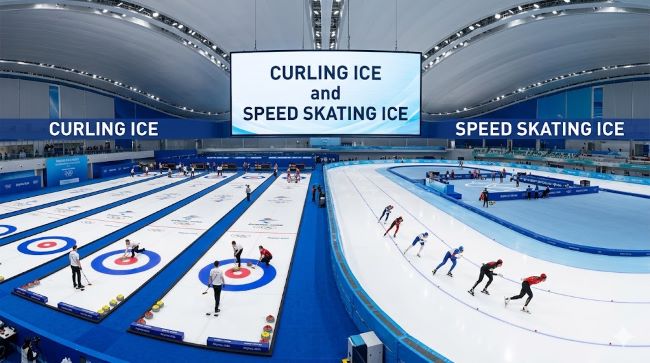
Is Curling Done on Ice?
Yes, and the ice is arguably the most technically demanding surface in all of winter sport. Is curling done on ice that looks anything like a hockey rink or a speed skating oval? Not really. To the naked eye the differences are subtle, but once you understand what’s going on beneath the surface, curling ice is in a category of its own.
The playing area in curling is called a sheet. It runs 45.72 metres in length and up to 4.75 metres in width. At each end sits a target called the house, a series of concentric circles where teams try to land their stones. The quality of the ice across that entire length has to be consistent, level to within fractions of a millimetre, and prepared in a very specific way before every single match. That preparation process is what makes it so different from every other ice sport.
The Curling Ice Surface: Pebbling Explained
The defining feature of a curling ice surface is the pebble. Pebbling is the process of spraying tiny droplets of purified, heated water across the prepared ice sheet so they freeze into small raised bumps. These bumps, each a fraction of a centimetre tall, cover the entire playing surface.
Here is why that matters. A curling stone has a concave bottom. If you placed it on perfectly flat ice, the suction between the stone and the surface would prevent it from travelling any meaningful distance, even if you threw it hard. With pebbled ice, the stone only contacts the tops of the pebbles, dramatically reducing the contact area and allowing it to travel the full length of the sheet. The pebbles also melt slightly as the heavy stone passes over them, creating a micro-layer of water that the stone glides on.
The pebbling process is precise and skilled work. Ice technicians, sometimes called ice makers, heat purified water to above 35°C to remove dissolved oxygen and prevent air bubbles forming in the droplets. They apply two coats of pebble to each sheet: a first coat at room temperature water, and a second coat at higher temperature, which freezes in a rounder, taller shape that becomes the active game surface.
Olympic curling ice is made from distilled water throughout, which keeps it clear rather than opaque. That clarity matters because players need to see the house markings through the ice at all times.
The surface temperature for curling ice is maintained between -4°C and -5°C (about 23-25°F). That is warmer than most other ice sports, which is intentional. Warmer ice is softer, and softer ice allows the pebbles to melt more readily under the stone’s weight, helping it travel smoothly.
Speed Skating Ice: Built for Minimum Friction
Speed skating ice works from the opposite premise. Every aspect of its preparation is designed to reduce friction and give skaters the fastest possible surface.
“Fast ice” in speed skating means a hard, cold, flat surface with as little texture as possible. It is maintained at around -7°C to -8°C (roughly 19-21°F), significantly colder than curling ice. Colder ice is harder, and harder ice resists the blade digging in, which means less friction and faster times.
The surface is resurfaced with a Zamboni between sessions to produce a perfectly smooth, flat result. There is no pebbling, no texture added, no deliberate friction built in. The goal is to make the ice as close to a frictionless surface as physics permits.
At the Milano Cortina 2026 Winter Olympics, the speed skating oval was the first temporary indoor speed skating facility ever built inside a convention centre, which added a significant engineering challenge: maintaining ice temperature and humidity without the traditional permanent infrastructure. Ice makers had to balance the body heat of up to 7,500 spectators against the refrigeration requirements of an elite racing surface.
Side-by-Side Comparison
| Feature | Curling Ice | Speed Skating Ice |
|---|---|---|
| Temperature | -4°C to -5°C (23-25°F) | -7°C to -8°C (19-21°F) |
| Surface texture | Pebbled (intentional bumps) | Flat and smooth |
| Water type | Distilled/purified | Standard treated water |
| Clarity | Clear (to see house markings) | Less critical |
| Friction goal | Controlled friction | Minimum friction |
| Resurfacing | Scraped and re-pebbled before each match | Zamboni between sessions |
| Primary challenge | Levelness and consistent pebble height | Hardness and flatness |
How Do Brooms Affect the Stone’s Path in Olympic Curling?
How do brooms affect the stone’s path in Olympic curling? This is one of the most misunderstood parts of the sport. The brooms look almost comical if you don’t know what they’re doing, but the sweeping has a real and measurable effect on where the stone ends up.
When sweepers brush the ice in front of a moving stone, the friction from the broom generates heat. That heat melts the top surface of the pebbles slightly, creating a thin film of water. The stone now travels over that water film with less friction than it would encounter on the undisturbed pebbled surface.
Two things happen as a result:
- The stone travels further. Less friction means the stone slows down more slowly, so it carries further toward the house.
- The stone curls less. The path a curling stone follows is not straight. Due to the physics of the stone’s rotation and the pebble interaction, it naturally curves (curls) as it travels. Sweeping reduces friction and reduces that curl, keeping the stone on a more direct path.
By sweeping in front of only part of the stone, or sweeping more on one side, teams can influence both distance and direction. The skip (the team leader who stands at the far end and calls the shots) directs the sweepers in real time, watching the stone’s path and calling adjustments. Good sweeping can shift a stone’s final position by several feet, which in a sport decided by centimetres is enormous.
Olympic-level brooms now use synthetic pads engineered to maximise heat generation from friction. There has been debate and rule changes around broom technology at the elite level, because certain pad materials proved too effective and began to change the character of the game. The sport’s governing body, World Curling Federation, introduced broom regulations to preserve the skill balance between throwing and sweeping.
The Granite Stones and How They Interact with the Ice
The stones themselves are a key part of why the curling ice surface is designed the way it is. Every Olympic curling stone comes from Ailsa Craig, a volcanic island off the coast of Scotland, which produces a specific granite known for its hardness, mineralogical uniformity, and low water absorption. These properties prevent cracking under repeated impact and mean the running band (the ring on the stone’s base that contacts the ice) maintains consistent geometry over years of use.
The concave base of the stone means only the running band makes contact with the pebbles. The surface area in contact with the ice at any given moment is tiny, perhaps the circumference of a circle a few centimetres across. That tiny contact area, combined with the pebble melt, is what allows a 20kg chunk of rock with specific surface texture properties to travel 28 metres down a sheet.
Ice Monitoring: The Technical Side
Maintaining Olympic-grade curling ice across 12 days of competition with dozens of matches is a serious technical operation. Ice makers use computer systems to monitor surface temperature, air temperature, humidity, and dew point in real time, making continuous adjustments to keep conditions consistent across all sheets simultaneously.
The AI and data monitoring tools now available to technical teams have made this process more precise than it was even a decade ago. Small deviations in humidity or refrigeration output that would previously require a technician to notice and respond to can now be flagged automatically and corrected before they affect play.
The pebble itself also has to be managed mid-match. Ice makers may re-pebble the ends (the target areas) at the halfway break of a match if the pebble has worn down significantly from stone traffic. Championship-level ice protocols are detailed and exacting. They differ from club-level protocols in the number of pebble coats applied, the temperature differential between the two coats, and the frequency of scraping.
Why Can’t They Share the Same Ice?
The short answer is that the conditions required for each sport are incompatible. Curling needs a pebbled surface at around -5°C. Speed skating needs a flat, hard surface at around -8°C. You cannot pebble ice that cold effectively, and you cannot get the consistent pebble geometry that curling requires on ice maintained for skating.
Clubs that share ice between curling and skating face this challenge constantly. Hockey players want cold, flat ice at around -9°C. Figure skaters want slightly warmer and softer ice at around -4°C. Curlers need the level, pebbled surface at -5°C. The Zamboni that efficiently prepares hockey and figure skating ice actually creates problems for curling, because it leaves a residue that interferes with how the pebble adheres to the surface. Precision surface engineering for each sport requires dedicated preparation time and often dedicated facilities at the elite level.
Key Takeaways
- To explain the difference between curling ice and speed skating ice: speed skating ice is smooth, hard, and cold to minimise friction; curling ice is pebbled, slightly warmer, and designed to create controlled friction.
- The curling ice surface is prepared with pebbling, a process of spraying purified heated water droplets that freeze into tiny bumps across the sheet before every match.
- Is curling done on ice? Yes, and on the most technically demanding ice surface in winter sport, maintained at -4°C to -5°C using distilled water and specialist preparation techniques.
- How do brooms affect the stone’s path in Olympic curling? Sweeping generates heat that melts the pebble tops, reducing friction. This makes the stone travel further and curl less, giving teams real-time control over where the stone ends up.
- Speed skating ice is maintained at around -7°C to -8°C, significantly colder and harder than curling ice, and resurfaced by Zamboni to keep it flat and frictionless.
- These surfaces cannot be shared without major re-preparation, which is why dedicated curling facilities exist at the Olympic level.