How to Remove Acrylic Nails: Every Method That Actually Works
Learn how to remove acrylic nails at home safely using acetone, warm water, dental floss, and more. Step-by-step methods that protect your natural nails underneath.
Acrylic nails look great until it is time to take them off, and how you remove them makes a real difference to the health of your natural nails underneath. Done right, you can remove acrylic nails at home without damage. Done wrong and you are looking at peeling, thinning, and broken nails that take months to recover. This guide covers every method for how to remove acrylic nails at home, including what to do if you have limited supplies, with honest notes on what works and what to skip.
What You Need to Know Before You Start
Acrylic nails are bonded to your natural nail with a strong adhesive. The key to removing them without damage is patience, not force. Prying, pulling, or ripping acrylics off is the main cause of nail damage during removal. Every method below works by either dissolving the bond or gently loosening it over time.
A few things to have ready before you start:
- 100% pure acetone (not regular nail polish remover, which is too weak)
- Nail clippers or nail file
- Aluminum foil or nail soaking clips
- Cotton balls or pads
- Cuticle oil or nail oil for aftercare
- A bowl of warm water (for some methods)
Method 1: Acetone Soak (Most Effective)
This is the standard method used by nail technicians and it works reliably when done with patience.
- Clip the acrylic nails short. Use nail clippers to trim as much of the acrylic length as possible. The less material left, the faster the acetone works.
- File the surface of the acrylics. Use a coarse nail file to break through the shiny top layer of each nail. This lets the acetone penetrate faster. File until the shine is gone and the surface looks matte.
- Apply acetone. Soak a cotton ball in 100% acetone and place it directly on the nail. Wrap each finger tightly in a small square of aluminum foil to hold the cotton in place. Alternatively, use nail soaking clips if you have them.
- Wait 20 to 30 minutes. Do not remove the foil early. The acrylic needs time to soften fully. Removing too soon leads to pulling and damage.
- Check and remove. After 20 to 30 minutes, unwrap one finger. The acrylic should look soft, white, and gummy. Use a cuticle pusher or orange stick to gently push the acrylic off the nail. It should slide off with light pressure. If it does not move easily, rewrap and wait another 10 minutes.
- Repeat for remaining fingers. Work through all fingers.
- File and buff. After removal, lightly buff the surface of your natural nails to smooth any remaining residue. Wash your hands and apply cuticle oil to rehydrate.
Do not use a metal cuticle pusher aggressively. Gentle pressure is all you need once the acrylic is fully softened.
Method 2: Acetone Bowl Soak
If you do not have foil, this is an alternative that works the same way.
- Clip and file the acrylics as described in Method 1.
- Pour enough acetone into a bowl to submerge your fingernails.
- Soak your fingertips in the acetone for 20 to 30 minutes.
- Periodically use a cuticle pusher to test the acrylic and remove softened pieces.
- Continue soaking until all acrylic is removed.
Note that acetone is flammable. Keep it away from heat sources, open flames, and lit candles. Do not soak in a metal bowl. A ceramic or glass bowl works well.
Method 3: How to Remove Acrylic Nails at Home Without Tools
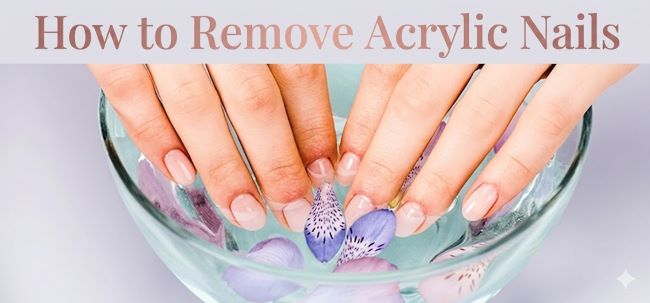
If you do not have acetone, foil, or any standard nail tools, warm water and dental floss offer a gentler (if slower) alternative. This method works best when the acrylics are already lifting at the edges, which happens naturally over time.
Warm water soak method:
- Fill a bowl with warm (not boiling) water.
- Add a few drops of dish soap or hand soap.
- Soak your fingertips for 20 to 30 minutes.
- Gently try to work the edges of the acrylic up using a soft tool like an orange stick.
- If the acrylic starts to lift, continue applying gentle pressure to slide it off.
- If it does not lift, soak for another 10 minutes.
This method takes longer and works less reliably than acetone because water does not dissolve acrylic the way acetone does. It is best for nails that are already loosening naturally.
Dental floss method:
This method requires a second person to help and only works when there is already a natural lift at the edge of the acrylic.
- Use a cuticle pusher or orange stick to gently work under the lifted edge of the acrylic.
- Ask your helper to slide a piece of dental floss under the lifted edge.
- Using a sawing motion, work the floss along the nail bed to separate the acrylic from the natural nail.
- Go slowly. If there is significant resistance, stop. This method only works on nails that are already separating. Forcing it causes damage.
How to Remove Gel X Nails
Gel X nails use a softer gel material applied over a full-cover tip and are bonded with gel polish adhesive rather than traditional acrylic. The removal process is similar to acrylic but the gel softens faster.
- File the shiny top coat from the gel surface.
- Wrap each finger in an acetone-soaked cotton ball and foil.
- Wait 15 to 20 minutes (gel X typically softens faster than hard acrylic).
- Gently push off the softened gel using an orange stick or cuticle pusher.
- If any gel remains, rewrap and wait another 5 to 10 minutes rather than forcing it off.
Gel X nails should not be peeled or pried. Even though the material feels softer, forcing removal damages the natural nail surface underneath.
How to Take Off Acrylic Nails Without Damaging Your Nails
The most common removal mistakes that cause damage:
- Peeling or ripping. This pulls layers of your natural nail along with the acrylic. The nail beds end up thin, rough, and sometimes painful. Always let acetone do the dissolving.
- Not filing the surface first. The shiny top coat of an acrylic nail is sealed. Without breaking through it, acetone takes much longer to penetrate and people give up too early.
- Removing too early. If the acrylic is not fully softened, you end up forcing it. Rewrapping for another 10 minutes is always better than pulling.
- Skipping aftercare. Acetone is drying. After removal, wash your hands, apply a nourishing cuticle oil, and moisturize. Your nails will look and feel better the next day with proper aftercare.
Nail Care After Acrylic Removal
Your natural nails will likely look a bit rough immediately after removing acrylics, especially if you wore them for an extended time. This is normal and temporary.
- Apply cuticle oil daily for the first week.
- Use a strengthening nail treatment or base coat to protect the natural nail surface.
- Keep nails trimmed short while they recover to reduce the risk of breakage.
- Avoid gel or acrylic for at least a few weeks to let the nail plate recover its thickness.
Most nails return to their normal condition within four to six weeks with consistent care.
The Short Answer
To remove acrylic nails at home, clip them short, file off the shine, wrap each finger in acetone-soaked cotton and foil, and wait 20 to 30 minutes. When the acrylic is soft and gummy, push it off gently with an orange stick. For Gel X nails, the same process works but takes slightly less time. If you have no tools, a warm water soak can loosen nails that are already lifting. Always let the product soften fully before applying pressure, and follow up with cuticle oil to rehydrate your nails after removal.