How AI and ML are Reshaping the Future of Last Mile Tracking
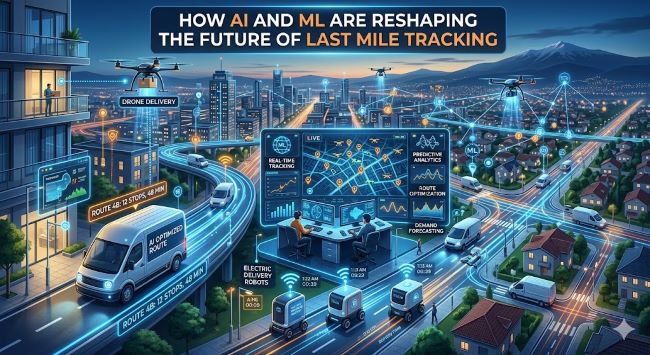
The future of last mile delivery is quickly evolving, with AI and machine learning (ML) technologies leading the charge. Traditional last mile tracking merely provided visibility, answering the question, “Where is my delivery?”
Now, with advancements in AI and ML, last mile tracking is evolving into an active decision-making engine. This shift from passive tracking to predictive analytics and real-time action is fundamental in tackling last mile delivery inefficiencies.
The last mile delivery industry is projected to grow to USD 311.3 billion by 2035, underlining the increasing reliance on technology to handle the pressure of faster deliveries and rising consumer expectations. Let’s explore how AI and ML are transforming last mile tracking and creating a new operational layer in logistics.
Why Traditional Last Mile Tracking is No Longer Enough
Basic tracking tools are useful, but they are still reactive. They show location and status, yet they often fail to explain what is likely to go wrong next. That creates a common problem in delivery operations: teams can see the route, but they still discover service failures too late.
Customers also expect more than visibility now. They expect accurate ETAs, fewer surprises and timely updates when plans change. If the ETA is wrong or milestones are delayed, the tracking experience feels weak even when the map is live.
That is why the next phase of last mile tracking depends on systems that can interpret live data, not just display it. AI and ML make that possible by turning raw signals into predictions, alerts and better operational decisions.
10 Ways AI and ML are Redefining the Future of Last Mile Tracking
The next phase of last mile tracking is not just about tracking packages. It is about predicting, preventing and automating the process from start to finish. Here is how AI and ML are reshaping the landscape.
-
Predictive ETAs are Replacing Fixed Delivery Estimates
Traditional delivery tracking systems provided fixed ETAs, but they were often inaccurate and caused customer frustration. With AI-powered last mile tracking, predictive ETAs are now becoming the norm. Machine learning models analyze historical data, current traffic conditions, weather patterns and other variables to calculate more accurate and dynamic results.
ETAs. This improves delivery accuracy and enhances the customer experience. By predicting when a delivery will likely occur, last mile tracking ensures that customers receive real-time updates and options for rescheduling when delays are predicted.
-
Exception Risk can be Flagged Before Service Fails
AI-driven last mile tracking helps identify potential exceptions before they occur. Using ML models, the system can predict which deliveries are at risk of failure based on factors such as historical patterns, weather, traffic and customer availability.
By identifying these risks early, operations can take proactive steps to prevent service failures, such as rerouting deliveries or rescheduling pickups. This reduces missed deliveries and improves overall service reliability.
-
Last Mile Tracking Becomes a Decision Layer, Not Just a Status Layer
In the past, last mile tracking was mainly a tool for visibility, showing where deliveries were in real time. Now, with AI and ML, last mile tracking has become a decision-making tool that helps logistics teams take immediate action.
The system analyzes real-time data and predicts potential issues, allowing teams to make informed decisions about rerouting, rescheduling and communicating with customers before problems arise. This shift from passive tracking to active decision-making improves operational efficiency and delivery reliability.
-
Planned Versus Actual Learning Improves Daily Execution
AI and ML allow for a continuous feedback loop through planned-versus-actual performance reviews. By comparing planned delivery times with actual delivery outcomes, teams can identify areas for improvement in service times, routes and overall delivery execution.
Last mile tracking systems with predictive analytics highlight where improvements can be made, including adjusting service-time assumptions, optimizing routes or fixing recurrent issues such as access problems. This leads to better forecasting and stronger operational performance.
-
Service-time Modeling Becomes More Accurate
ML helps last mile tracking become more precise by learning from past delivery data. By modeling service times at each stop, AI can predict how long it will take to deliver to specific locations.
It can also account for variables such as traffic, road conditions and customer habits that affect delivery times. This makes route optimization and delivery schedules more reliable, especially in dense urban areas where conditions change quickly and unpredictably.
-
Delivery Tracking is Becoming More Personalized for Customers
AI and ML enable more personalized tracking experiences for customers. Instead of receiving vague updates, customers now get precise, real-time information about their deliveries. By using AI to predict delivery times and assess delivery risks, customers receive updates tailored to their specific circumstances, improving customer satisfaction.
Personalized tracking also enables proactive communication, allowing customers to choose alternative delivery options if delays are anticipated. This improves customer engagement and reduces support calls related to delivery inquiries.
-
Proof and Tracking Records are Becoming Smarter and More Defensible
When it comes to disputes and claims, traditional last mile tracking systems cannot provide robust proof of delivery. With AI-driven last mile tracking, proof is now smarter and more defensible. AI can automate validation through OTPs, image recognition, geofencing and signatures.
These smarter systems provide reliable, traceable records of every delivery action, making it easier to resolve disputes and reduce fraud. This improved proof validation also holds carriers and drivers accountable, helping ensure consistency across the delivery network.
-
Control Towers are Using AI to Prioritize What Matters Most
AI-powered control towers are transforming the way logistics teams manage exceptions. Rather than receiving generic alerts, AI-driven last mile tracking provides logistics managers with actionable insights and prioritizes the most urgent issues.
By integrating AI into control towers, companies can optimize their responses to delivery disruptions, ensuring that the right actions are taken before it is too late. This helps teams focus on critical issues, such as at-risk deliveries or operational bottlenecks, improving overall operational efficiency.
-
Micro-zone Intelligence Makes ETAs and Exception Control More Precise
AI models can now learn micro-zone variables such as parking issues, elevator delays and restricted access to specific areas. This allows last mile tracking to provide more precise ETAs by accounting for local delivery challenges.
By integrating this micro-zone intelligence into delivery operations, logistics companies can better estimate delivery times and mitigate the risk of exceptions. When last mile tracking detects rising variance, it can trigger proactive actions, such as rerouting, reassignment or customer communication, to prevent disruptions.
-
Workflow Automation Turns AI Signals Into Faster Recovery
AI-powered last mile tracking enables faster decision-making by automating workflows based on risk signals. For example, when AI detects that a delivery is at risk of missing its window, the system can automatically trigger actions such as rescheduling or rerouting to recover the delivery.
This reduces the need for manual intervention and allows logistics teams to focus on managing critical exceptions. With workflow automation, last mile tracking becomes an integral part of the logistics process, improving recovery times and reducing operational friction.
Build the Next Phase of Delivery Control With Smarter Last Mile Tracking
AI and ML are reshaping last mile tracking by turning it from a passive reporting tool into an active decision-making system. The integration of these technologies makes delivery more predictable, efficient and customer-centric.
As logistics companies scale their operations and face rising customer demands, adopting AI-driven last mile tracking solutions will become essential for staying competitive. With technology partners such as FarEye, companies can use these innovations to optimize route planning, improve service delivery and enhance customer satisfaction.
The future of last mile tracking is not just about visibility. It is about taking action at the right time to ensure every delivery meets customer expectations, improves operational efficiency and supports business growth.