Beauty Mark vs Birthmark vs Mole
Almost everyone has a few spots on their skin. Some people call them moles. Others call them beauty marks or birthmarks. Are these the same thing, or something different?
This guide explains beauty mark vs birthmark vs mole in plain English, including causes, types, and when to have a spot checked.
This article is for general information only. It isn’t medical advice. See a doctor or dermatologist about any spot that worries you.
The Short Answer
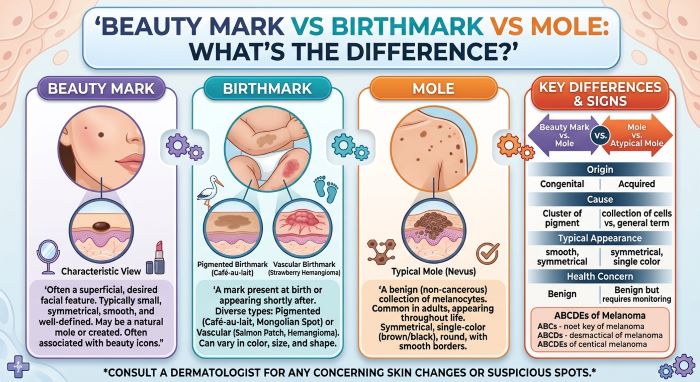
- A mole is a cluster of pigment cells (melanocytes) that forms a small brown, tan, or black spot. Moles can be present at birth or appear later.
- A beauty mark is simply a mole in a noticeable, often attractive spot, usually on the face, like above the lip or on the cheek. It’s a cultural term, not a medical one.
- A birthmark is a mark that’s present at birth or appears shortly after. It can be a pigmented mark (like some moles) or a vascular mark made of blood vessels.
So a beauty mark is a type of mole, and some moles are birthmarks. The terms overlap.
Beauty Mark vs Birthmark vs Mole at a Glance
| Feature | Mole | Beauty Mark | Birthmark |
|---|---|---|---|
| What it is | Cluster of pigment cells | A mole in a visible, flattering spot | Mark present at or near birth |
| Medical term | Nevus (plural: nevi) | None; it’s a nickname | Varies by type |
| When it appears | Birth through about age 40 | Same as moles | At birth or within weeks |
| Color | Tan, brown, black, sometimes pink | Usually dark brown or black | Brown, tan, red, pink, purple, blue gray |
| Location | Anywhere on the body | Usually on the face, neck, or chest | Anywhere |
| Cause | Pigment cells growing in clusters | Same as moles | Pigment cells or blood vessels |
| Usually harmless? | Yes | Yes | Usually |
| Needs monitoring? | Yes, for changes | Yes, like any mole | Some types |
What Is a Mole?
A mole, known medically as a nevus, forms when pigment producing cells called melanocytes grow in a cluster instead of spreading evenly through the skin. Most adults have 10 to 40 moles.
Moles can be:
- Flat or raised
- Round or oval
- Tan, brown, black, or skin colored
- Smooth or slightly bumpy
Most moles appear during childhood and young adulthood. They may darken during pregnancy or with sun exposure, and some fade with age.
Common Types of Moles
| Type | Description |
|---|---|
| Common mole | Small, round, even color, smooth edges |
| Congenital mole | Present at birth; a type of birthmark |
| Atypical (dysplastic) mole | Larger, irregular shape or color; should be monitored |
| Acquired mole | Appears after birth, usually in childhood or teens |
What Is a Beauty Mark?
A beauty mark is not a medical category. It’s a friendly nickname for a mole, usually a small, dark one on the face. Famous examples have made beauty marks iconic in fashion and film.
In the 1600s and 1700s in Europe, fashionable people even wore fake beauty marks made of fabric patches, called “mouches.” Today, some people enhance natural beauty marks with makeup or draw them on as a style choice.
Because a beauty mark is a mole, it should be checked for changes just like any other mole.
What Is a Birthmark?
A birthmark is any mark on the skin that’s present at birth or shows up within the first few weeks of life. There are two main groups.
Pigmented Birthmarks
These come from extra pigment.
- Congenital moles: Moles present at birth. Large ones should be monitored by a doctor.
- Café au lait spots: Light brown, flat patches, like coffee with milk.
- Slate gray nevi (formerly called Mongolian spots): Flat, blue gray patches, often on the lower back. Common in babies with darker skin and usually fade by school age.
Vascular Birthmarks
These come from blood vessels that formed differently.
- Salmon patches (stork bites or angel kisses): Pink, flat marks on the neck or eyelids. Very common and often fade.
- Infantile hemangiomas (strawberry marks): Raised, bright red marks that grow in the first months, then usually shrink over several years.
- Port wine stains: Flat pink, red, or purple marks that usually stay for life and may darken over time.
Are They Dangerous?
Most moles, beauty marks, and birthmarks are harmless. But a small number of moles can turn into melanoma, a serious type of skin cancer. Some large birthmarks or birthmarks near the eyes or spine may need medical follow up too.
That’s why it’s smart to check your skin regularly, no matter what you call your spots.
The ABCDE Rule for Moles
Dermatologists use the ABCDE rule to spot warning signs in moles and beauty marks:
| Letter | Stands For | Warning Sign |
|---|---|---|
| A | Asymmetry | One half doesn’t match the other |
| B | Border | Edges are ragged, notched, or blurred |
| C | Color | Uneven shades of brown, black, red, white, or blue |
| D | Diameter | Larger than about 6mm (the size of a pencil eraser), though melanomas can be smaller |
| E | Evolving | Changes in size, shape, color, or height, or new symptoms |
Also watch for the “ugly duckling” sign: a mole that looks very different from your other moles.
When to See a Doctor
See a dermatologist if a mole, beauty mark, or birthmark:
- Changes in size, shape, or color
- Bleeds, itches, or becomes painful
- Has an irregular border or uneven color
- Appears new after age 30 to 40
- Looks different from your other moles
- Is a large birthmark on a baby, or a birthmark near the eyes, lips, or spine
Early detection makes skin cancer much easier to treat.
Can They Be Removed?
Yes. Doctors can remove moles and beauty marks for medical or cosmetic reasons. Common methods include:
- Shave removal: The mole is shaved off at skin level.
- Surgical excision: The mole is cut out and the skin is stitched closed. The tissue can be tested.
- Laser treatment: Used for some flat birthmarks, like port wine stains.
Never try to remove a mole at home. It can cause infection, scarring, and may hide warning signs of skin cancer.
Protecting Your Skin
Sun exposure can cause new moles and raises skin cancer risk. Protect your skin by:
- Wearing broad spectrum sunscreen with SPF 30 or higher
- Seeking shade during midday sun
- Wearing hats and sunglasses
- Avoiding tanning beds
- Checking your skin monthly
Beauty Mark vs Birthmark vs Mole: Other Look Alike Spots
Not every brown or red spot is a mole or birthmark. Other common skin spots include:
| Spot | What It Is | Usually Appears |
|---|---|---|
| Freckles | Small flat spots from sun exposure | Childhood, after sun |
| Sun spots (lentigines) | Flat brown spots from years of sun | Adulthood, especially after 40 |
| Seborrheic keratoses | Waxy, “stuck on” growths | Middle age and older |
| Cherry angiomas | Small bright red bumps | Adulthood |
| Skin tags | Soft, flesh colored flaps | Adulthood, in skin folds |
Freckles often fade in winter, while moles stay the same year round. If you’re unsure what a spot is, a dermatologist can tell you quickly.
Beauty Mark vs Birthmark vs Mole in Babies and Kids
Many babies are born with birthmarks, and most are harmless. Parents should mention any birthmark to their pediatrician, especially if it:
- Grows quickly
- Is large or raised
- Is near the eyes, nose, mouth, or lower spine
- Bleeds or develops sores
Moles in children usually grow slowly as the child grows. That’s normal. Rapid changes should still be checked.
How to Do a Skin Self Check
- Stand in front of a full length mirror in good light.
- Check your face, scalp, neck, chest, arms, and hands.
- Use a hand mirror to check your back, buttocks, and the backs of your legs.
- Don’t forget the soles of your feet and between your toes.
- Take photos of moles to compare over time.
Doing this once a month takes just a few minutes. It’s the easiest way to keep track of every beauty mark vs birthmark vs mole on your body and notice changes early.
Understanding the beauty mark vs birthmark vs mole difference makes those checks much less confusing.
Frequently Asked Questions
Is a beauty mark the same as a mole? Yes. A beauty mark is a mole in a noticeable, often flattering spot, usually on the face.
Can a birthmark be a mole? Yes. A congenital mole is both a mole and a birthmark.
Do birthmarks go away? Some do, like salmon patches and most strawberry hemangiomas. Others, like port wine stains, usually stay.
Can new moles appear in adulthood? Yes, especially before about age 40. New moles after that age should be checked by a doctor.
Final Thoughts
The beauty mark vs birthmark vs mole difference comes down to timing and type. A mole is a cluster of pigment cells. A beauty mark is a mole with a flattering name. A birthmark is any mark present at or near birth, made of pigment or blood vessels. Whatever you call your spots, check them regularly and see a dermatologist about any changes.
Key Takeaways
- Beauty mark vs birthmark vs mole: a beauty mark is a type of mole, and some moles are birthmarks.
- Moles are clusters of pigment cells and can appear at birth or later.
- Birthmarks are present at or soon after birth and can be pigmented or vascular.
- Most marks are harmless, but moles should be checked using the ABCDE rule.
- See a dermatologist for any spot that changes, bleeds, itches, or looks unusual.
- Use sunscreen and check your skin monthly to protect against skin cancer.