How to Hem Jeans by Hand
Jeans that drag on the ground fray at the heel, pick up dirt, and never look quite right. A tailor can fix them, but you can do it at home in under an hour with a needle and thread. You do not need a sewing machine. Learning how to hem jeans by hand is one of the most useful sewing skills you can have, and it works on every style, from skinny to wide leg.
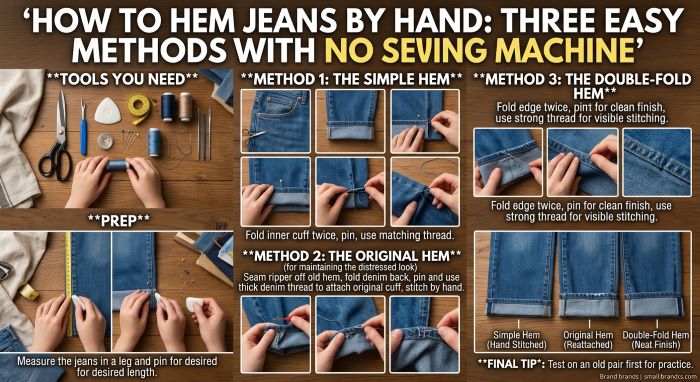
This guide covers what you need, how to measure, and three methods: a classic double-fold hem, the original hem that keeps the factory edge, and a quick invisible hem. It also covers stitches, tips for thick denim, no-sew options, and care.
What You Need
The supply list for how to hem jeans by hand is short, and most items cost very little.
| Item | Why You Need It |
|---|---|
| Denim or jeans needle for hand sewing | A strong, sharp needle goes through thick layers. Sizes 16 to 18 for machines have hand-sewing equals labeled “denim” or “heavy duty” |
| Heavy-duty or topstitching thread | Regular thread can snap on denim. Choose polyester for strength |
| Thread in the right color | Gold or copper to match classic topstitching, or navy to blend in |
| Fabric scissors | Sharp scissors cut denim cleanly |
| Measuring tape or ruler | For an even hem |
| Tailor’s chalk or a washable marker | To mark the fold and cut lines |
| Straight pins or sewing clips | To hold the hem in place. Clips are easier on thick fabric |
| Thimble | Protects your finger when you push the needle through |
| Iron and ironing board | Pressed folds make sewing far easier |
| Seam ripper | To remove the old hem, if needed |
| Small pliers, optional | To pull the needle through thick seams |
| Beeswax or thread conditioner, optional | Keeps thread from tangling |
Before You Start
Wash and Dry the Jeans
Denim shrinks, mainly in length, the first few times it is washed. Wash and dry new jeans the way you plan to in the future before you hem them. If you skip this step, your perfect hem may end up an inch too short.
This matters for secondhand jeans too. Thrift store finds and jeans that have sat in a closet or basement may have a musty odor. Treat any mildew smell in clothes before you sew, since pressing with a hot iron can set odors. A wash with a cup of white vinegar or half a cup of baking soda, followed by drying in the sun, removes most musty smells. If you see spots of mildew on clothes, wash them in the hottest water the care label allows, with an oxygen-based bleach, and dry the item fully before you go on.
Decide on the Length
The right length depends on the cut and the shoes you will wear.
| Style | Where the Hem Should Fall |
|---|---|
| Skinny and slim | At or just above the ankle bone |
| Straight | At the top of the foot, with a slight break |
| Bootcut | About half an inch off the floor at the heel, with shoes on |
| Wide leg and flare | About half an inch off the floor, with the shoes you plan to wear |
| Cropped | 1 to 3 inches above the ankle |
Mark the Hem
- Put on the jeans with the shoes you will wear most often.
- Stand straight in front of a mirror. Bending changes the length.
- Fold the extra fabric under to the inside until the length looks right. Ask a friend to help, if you can.
- Pin the fold in place on one leg.
- Take off the jeans. Measure from the original hem to the fold. Mark the same measure on the other leg. Check your own legs, though. Many people have one leg slightly longer.
- Draw a chalk line at the fold all the way around. This is your finished length.
Method 1: The Classic Double-Fold Hem
When most people picture how to hem jeans by hand, this is the method they mean. It gives a clean, strong hem that looks like the original. Use it when you need to remove more than an inch or two.
Step 1: Mark the Cutting Line
Measure 1 inch below your finished-length line, toward the old hem. Draw a second line all the way around. This extra inch is the hem allowance. For a wider hem, as on some dress jeans, allow more.
Step 2: Cut
Cut along the second line. Cut one layer at a time if the denim is thick. Keep the cut even.
Step 3: Fold and Press
Fold the raw edge up half an inch toward the inside and press it with a hot iron and steam. Fold it up half an inch again, so the raw edge is hidden inside the fold and the fold lands on your finished-length line. Press again. Pin or clip in place.
At the side seams, the layers are very thick. Tap them with a hammer or the handle of your scissors to flatten them, then press.
Step 4: Thread the Needle
Cut a piece of thread about 24 inches long. Longer thread tangles. For extra strength, use it doubled: pull the thread through the needle and tie both ends together in a knot. Run the thread across beeswax, if you have it.
Step 5: Sew With a Backstitch
The backstitch is the strongest hand stitch, and from the outside it looks much like machine stitching.
- Start at the inner leg seam, where the knot will be hidden. Bring the needle up from inside the fold, close to the top edge of the hem.
- Push the needle down one stitch length, about an eighth of an inch, behind where the thread came up.
- Bring the needle up one stitch length ahead of where the thread first came up.
- Push the needle down again at the end of the last stitch.
- Repeat all the way around. Keep the stitches small, even, and the same distance from the edge.
On the outside, you will see a neat line of stitches. Use gold thread to copy the look of jeans topstitching, or matching blue thread to hide the line.
Step 6: Finish
When you reach the start, make two or three small stitches in the same place inside the fold. Pass the needle through the loop of the last stitch to make a knot. Do it twice. Trim the thread.
Step 7: Press
Press the finished hem from the inside. Try on the jeans.
Method 2: The Original Hem
Factory hems have a worn, faded look that is hard to copy. This method keeps that edge. It is sometimes called the European hem or the Hollywood hem. It works best when you need to shorten by 1 to 4 inches, and on straight or slim legs.
Step 1: Work Out the Fold
Decide how much shorter the jeans need to be. Divide that number by two. For example, to shorten by 2 inches, your number is 1 inch.
Step 2: Fold the Cuff
Fold the bottom of the leg up to the outside, as if making a cuff. Measure from the fold to the top edge of the original hem stitching, not counting the hem itself. Adjust until that distance equals your number. Pin all the way around, lining up the side seams.
Step 3: Sew Next to the Original Hem
Sew a line of backstitches all the way around, right beside the original hem, as close to its top edge as you can get without sewing through it. Stitch through both layers of the leg.
Step 4: Check the Length
Turn the cuff down and try on the jeans. The original hem now sits at the new length, with a small fold of extra fabric hidden inside the leg.
Step 5: Trim or Tack
- If the fold inside is less than about an inch, press it up toward the knee and tack it to the side seams with a few stitches, so it stays flat.
- If the fold is larger, trim it to about half an inch from the stitching. Sew over the raw edge with a whipstitch or blanket stitch to stop fraying, or apply a little fray-stopping liquid.
Step 6: Press
Press the seam from the inside, then the outside. The join should be almost invisible, tucked right above the original hem.
Method 3: The Invisible Blind Hem
Choose this method for dressy dark jeans, trouser-style denim, or any pair where you do not want to see stitches on the outside.
- Mark, cut, and fold the hem as in Method 1, or use a single deeper fold of 1 and a half inches with the raw edge turned under.
- Thread the needle with a single strand of thread that matches the denim.
- Start at a side seam, with the knot hidden inside the fold.
- Pick up just one or two threads of the leg fabric with the tip of the needle, right above the fold.
- Move about a quarter of an inch along and take a small stitch through the folded edge of the hem.
- Repeat, going back and forth between the leg and the hem. Do not pull the thread tight.
- Knot off inside the fold and press.
Since the needle catches only a few threads on the outside, the stitches barely show. This hem is less strong than a backstitched one, so check it now and then.
Which Stitch Should You Use?
A big part of how to hem jeans by hand is picking the right stitch for the job.
| Stitch | Strength | Shows on the Outside? | Best For |
|---|---|---|---|
| Backstitch | Very strong | Yes, as a neat line | Classic and original hems |
| Running stitch | Medium | Yes, as a dashed line | Quick fixes and temporary hems |
| Blind hem stitch or slip stitch | Medium | Barely | Dressy jeans |
| Whipstitch | Medium | No, used on raw edges | Finishing cut edges inside |
| Catch stitch | Medium, with some stretch | Barely | Stretch denim |
Tips for Thick Denim
Heavy fabric is the main challenge in how to hem jeans by hand. These tips make it easier.
- Use a thimble. Your fingers will thank you.
- Use pliers to pull the needle through side seams.
- Flatten bulky seams with a hammer before you sew.
- Take one stitch at a time through thick spots. Do not load several stitches onto the needle.
- Wax the thread to reduce drag and tangles.
- Use clips, not pins, which bend in heavy fabric.
- Take breaks. Hand sewing denim is hard on the hands.
Tips for Stretch Denim
Stretch jeans need a hem with some give. Do not pull the fabric as you sew. Use polyester thread, which stretches a little, and a catch stitch or small backstitches that are not pulled tight. Press with medium heat, since high heat can damage elastic fibers.
Quick Options With No Sewing
| Method | How It Works | How Long It Lasts |
|---|---|---|
| Iron-on hem tape | A strip of fusible web bonds the fold when pressed | Several washes. May loosen on heavy denim |
| Fabric glue | Glue holds the fold | Varies. Can stiffen the hem |
| Cuffing | Roll or fold the hem to the outside | As long as you like. Fully reversible |
| Raw hem | Cut to length and let the edge fray | Permanent. Sew a line of stitches half an inch above the cut to control fraying |
These are fine for a quick fix. A sewn hem lasts longer.
Common Mistakes
Most problems with how to hem jeans by hand come from rushing the early steps.
- Hemming before washing. The jeans shrink, and the hem ends up too short.
- Measuring without shoes. Length depends on heel height.
- Cutting too soon. Pin and try on first. You cannot add fabric back.
- Using thin thread. It breaks at the heel.
- Making large stitches. They catch on toes and come loose.
- Skipping the iron. Unpressed folds shift as you sew.
- Pulling the thread too tight. The hem puckers.
- Forgetting to match the legs. Measure both.
Troubleshooting
| Problem | Cause | Fix |
|---|---|---|
| Hem is uneven | Marks were off, or fabric shifted | Remove the stitches, press flat, and mark again from the crotch seam down |
| Hem puckers | Thread pulled too tight | Snip and resew with a looser hand |
| Hem flips up | Fold too narrow, or not pressed | Press with steam, or resew with a wider fold |
| Thread keeps breaking | Thread is too thin or too long | Use heavy-duty thread in shorter lengths |
| Needle will not go through | Layers are too thick | Hammer the seam flat, and use pliers |
| Jeans are now too short | Cut too much | Let down the hem and face it with hem tape, or wear them cropped |
| Visible fold line after letting down a hem | Wear and fading at the old fold | Wash and press. Some fade lines are permanent |
Caring for Hemmed Jeans
- Turn jeans inside out before washing to reduce wear on the hem.
- Wash in cold water and avoid high dryer heat, which shrinks denim and weakens thread.
- Dry jeans fully before you put them away. Damp denim left in a hamper or a pile is a common cause of a mildew smell in clothes.
- Store jeans in a dry place with air flow. Closets in damp rooms lead to mildew on clothes over time.
- If you notice a musty odor, wash again with white vinegar and dry in sunlight. Sunlight helps with a mildew smell in clothes and with light spots of mildew on clothes.
- Check the hem every few months, and fix loose stitches before they spread.
Frequently Asked Questions
Is it hard to learn how to hem jeans by hand? No. It takes patience more than skill.
Can you really hem jeans without a sewing machine? Yes. A backstitch by hand is strong enough for daily wear.
How long does it take? About 30 to 60 minutes for a pair, based on your experience and the thickness of the denim.
What is the best stitch? The backstitch for strength, or a blind hem stitch for an invisible finish.
What thread should I use? Heavy-duty polyester or topstitching thread.
How do I keep the original hem? Use the original hem method: fold a cuff, sew beside the factory hem, and tuck the extra fabric inside.
How much hem allowance do I need? One inch for a standard double-fold hem.
Should I wash jeans before hemming? Yes. Wash and dry them at least once.
Can I hem stretch jeans by hand? Yes. Use a stitch with some give, and do not pull the fabric as you sew.
How do I hem jeans that are too long without cutting? Use the original hem method and tack the fold inside, or fold the hem up and sew it with a blind stitch.
Final Thoughts
Now you know how to hem jeans by hand. Wash the jeans first, mark the length with your shoes on, and choose a method. The classic double-fold hem is the strongest and suits most pairs. The original hem keeps the factory edge. The blind hem hides the stitches on dressy denim. In each case, press the folds, use strong thread, and keep your stitches small and even.
Your first pair may take an hour. Your second will go much faster. With a needle, thread, and a little patience, every pair of jeans you own can fit the way it should.
Key Takeaways
- The basic steps of how to hem jeans by hand are to wash, measure with shoes on, mark, fold, press, and sew.
- A backstitch with heavy-duty thread gives the strongest hand-sewn hem.
- Leave a 1-inch allowance for a classic double-fold hem.
- The original hem method keeps the factory edge by sewing a tuck right above it.
- Use a thimble, clips, and a hammer to manage thick seams.
- Press every fold before you sew, and do not pull the thread tight.
- Wash and fully dry jeans before hemming and before storage to avoid shrinkage and musty odors.